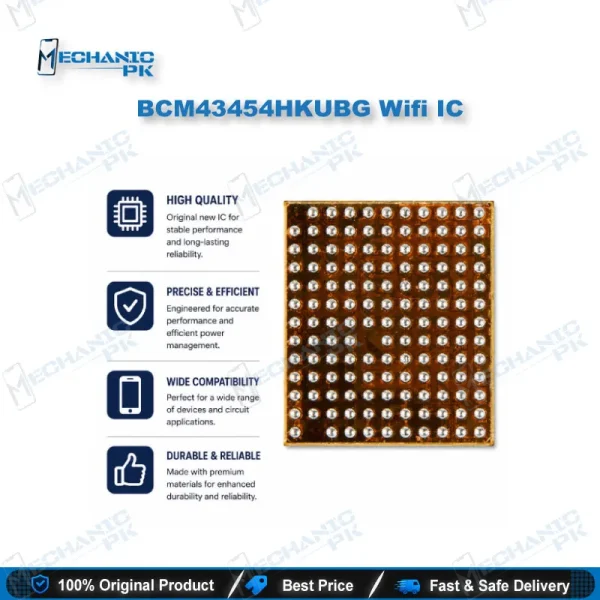



















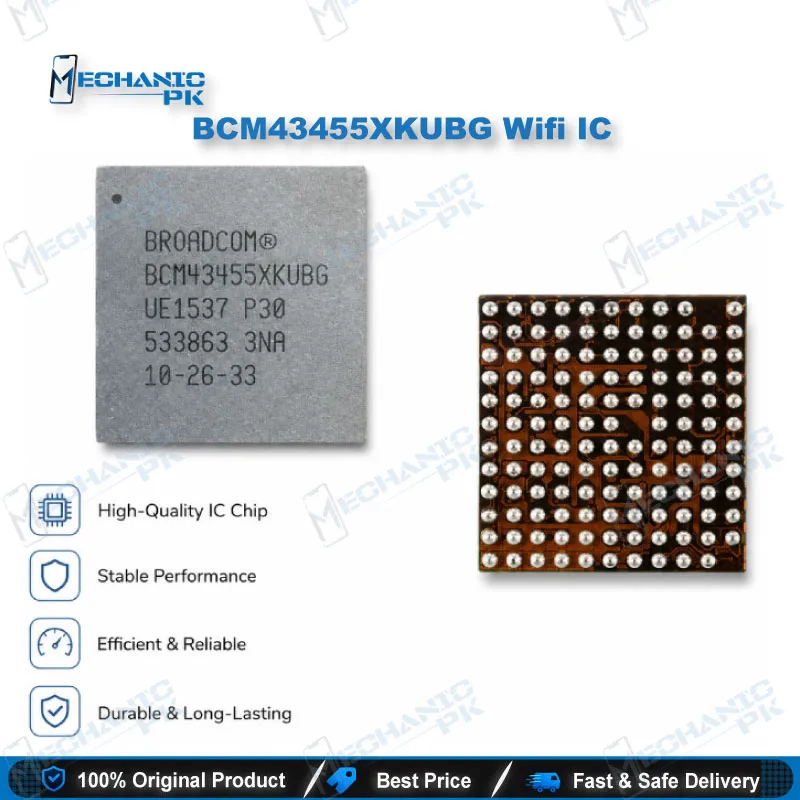
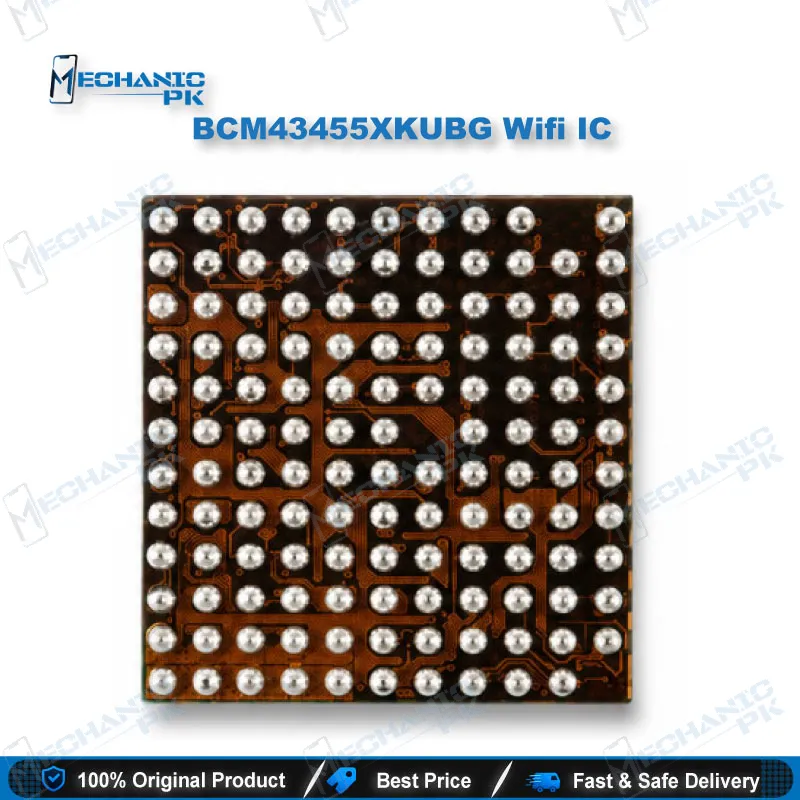
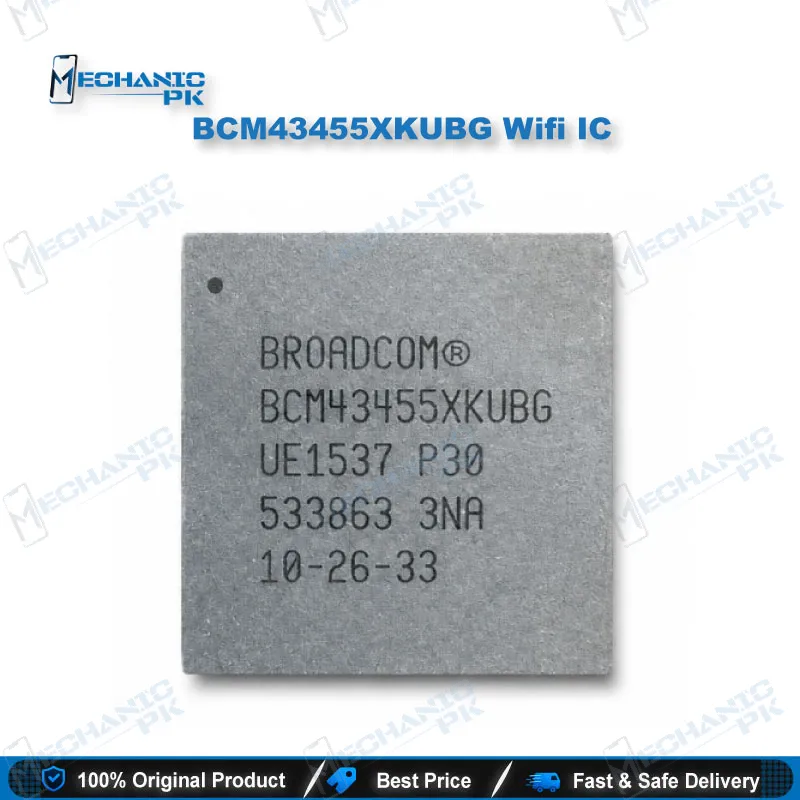
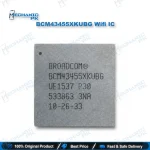
BCM43455XKUBG WiFi IC – 802.11ac Dual-Band Combo IC
₨ 850
Dual-Band WiFi and Bluetooth Combo IC
The BCM43455XKUBG is a single-chip 1×1 dual-band 802.11ac WiFi IC with integrated Bluetooth. It operates on both 2.4 GHz and 5 GHz bands and reaches PHY data rates up to 433.3 Mbps. The chip integrates the WLAN MAC, baseband and radio together with Bluetooth in one device, which keeps the wireless section of a board compact. Technicians who replace a faulty WiFi IC on a mobile board, or who need a verified chip reference for a repair job, will find these specifications directly useful.
BCM43455XKUBG WiFi IC for Dual-Band Board-Level Repair
The BCM43455XKUBG WiFi IC is a single-chip, 1×1 dual-band 802.11ac device that handles WLAN and Bluetooth in one package. Broadcom originally developed the design, and Cypress and Infineon have since carried the same part family, so you will see all three names on datasheets and distributor pages. For a repair technician, the chip’s role is straightforward. It sits in the wireless path of the handset, and when it fails, the phone loses WiFi, Bluetooth or both. Knowing where this IC fits in that path cuts diagnosis time and reduces guesswork at the bench.
Key Technical Highlights
The chip implements IEEE 802.11ac on both the 2.4 GHz and 5 GHz bands. Because it runs a single spatial stream, the configuration is 1×1 SISO, which keeps the antenna and RF layout simple. The WLAN path supports MCS0 through MCS9 with 256-QAM modulation across 20, 40 and 80 MHz channels. At the top of that range, the chip delivers data rates of up to 433.3 Mbps. On-chip power amplifiers and low-noise amplifiers serve both bands, so the external RF front end stays lean compared with discrete designs. The Bluetooth block connects to its host through a four-wire UART and shares its receive path and antenna with the WLAN radio. Together, these features make the part a compact, fully integrated wireless solution for mobile boards.
Repair Workflow Fit
On a handset board, the WiFi IC sits between the baseband processor and the RF path, so the signal chain is worth tracing on the schematic before any soldering starts. Module designs that use this chipset connect WLAN through an SDIO 3.0 host interface and Bluetooth through UART, which gives you a clear map of what to measure. Start diagnosis with the supply rails and the clock source, because a missing rail or clock looks exactly like a dead WiFi IC. Next, inspect the ball joints under magnification, looking for cracks, lifted pads or bridges around the package. If the IC needs replacement, remove it with controlled hot air, clean the pads, reball the new chip with a stencil and reflow it using a stable profile. After reflow, test WiFi and Bluetooth separately so you know which radio responds. Skipping the rail and clock checks often leads to a second rework on the same board, so take the extra minutes at the start.
Where It Fits in Your Workshop
For a repair shop or service center, this part belongs in a workflow that covers WiFi, Bluetooth and antenna faults in one pass. A hot air station handles removal and reflow, and a reballing kit supplies the balls and stencils the new chip needs. A microscope confirms pad condition before the iron or hot air touches the board, and a multimeter with a test box lets you separate supply faults from IC faults. Technical training institutes can use the datasheet-level details here as a reference for integrated WLAN and Bluetooth blocks, since the chip shows how two radios share one antenna and one package. Buyers should still verify the exact revision, package and brand label with the supplier before ordering, because this part family appears under several names and revisions across the market.
| Weight | 0.1 kg |
|---|
Key Features
- Single-chip 1x1 dual-band 802.11ac WLAN (2.4 GHz and 5 GHz)
- PHY data rates up to 433.3 Mbps with MCS0 to MCS9 and 256-QAM
- Support for 20, 40 and 80 MHz channel widths
- On-chip power amplifiers and low-noise amplifiers for both bands
- Integrated Bluetooth with a four-wire UART host interface
- Shared Bluetooth and WLAN receive path and antenna
- SDIO 3.0 WLAN host interface in module designs built on this chipset
- Integrated WLAN MAC, baseband and radio with Bluetooth on one device
Specifications
| Brand | Broadcom (Cypress / Infineon part family) |
|---|---|
| Model | BCM43455XKUBG |
| Category | RF Transceiver IC, WiFi and Bluetooth Combo |
| Compatibility | 1x1 802.11ac dual-band chipset, 2.4 GHz and 5 GHz |
| Technology | IEEE 802.11ac WLAN with integrated Bluetooth |
Common Repair Uses
- Board-level WiFi IC replacement on mobile PCBs
- Reballing and reflow of WLAN and Bluetooth ICs
- Fault diagnosis for no WiFi signal or Bluetooth not pairing
- Supply rail and clock checks before IC replacement
- Antenna and RF path inspection during WLAN fault finding
- Rework training and reference for RF transceiver ICs
Compatible Devices
- 802.11a/b/g/n/ac WLAN operation on 2.4 GHz and 5 GHz bands
- 1x1 SISO configuration with a single spatial stream
- Module designs built on the BCM43455 chipset, such as USI WM-BAC-BM-25 series modules (SDIO 3.0 WLAN, UART Bluetooth)
FAQ
What is the product name?
What is the brand of this product?
What is the model of this product?
What is this product used for?
Which devices are compatible with this product?
Who should use this product?
Does this IC support 5 GHz WiFi?
What is the maximum WiFi data rate of this chip?
Related products