





































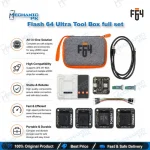



Flash 64 Lite UFS eMMC Programmer Box for Mobile Repair
₨ 82,000
Managed NAND Programming Bench Tool
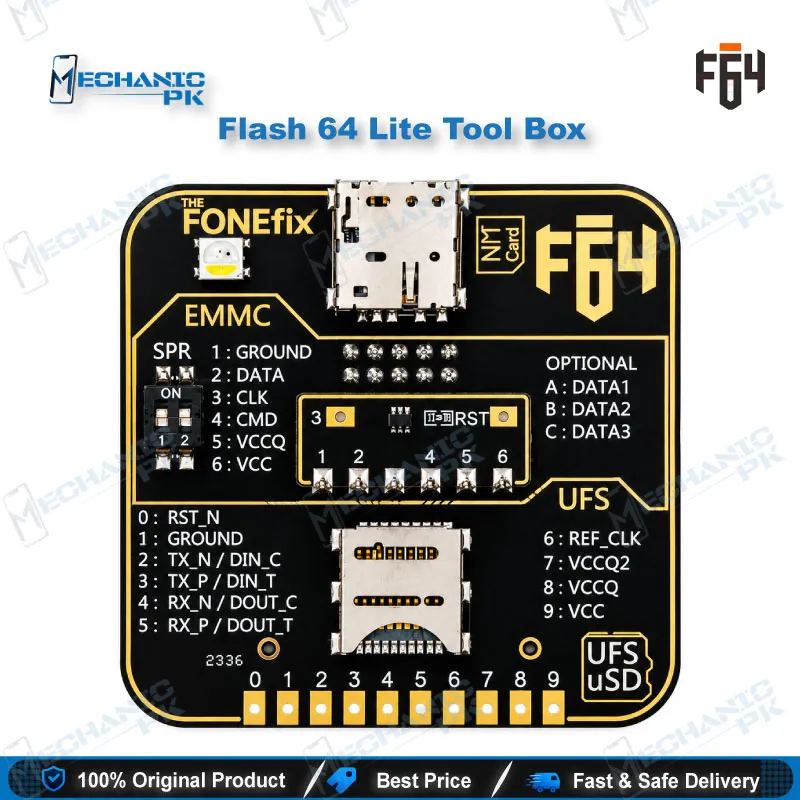
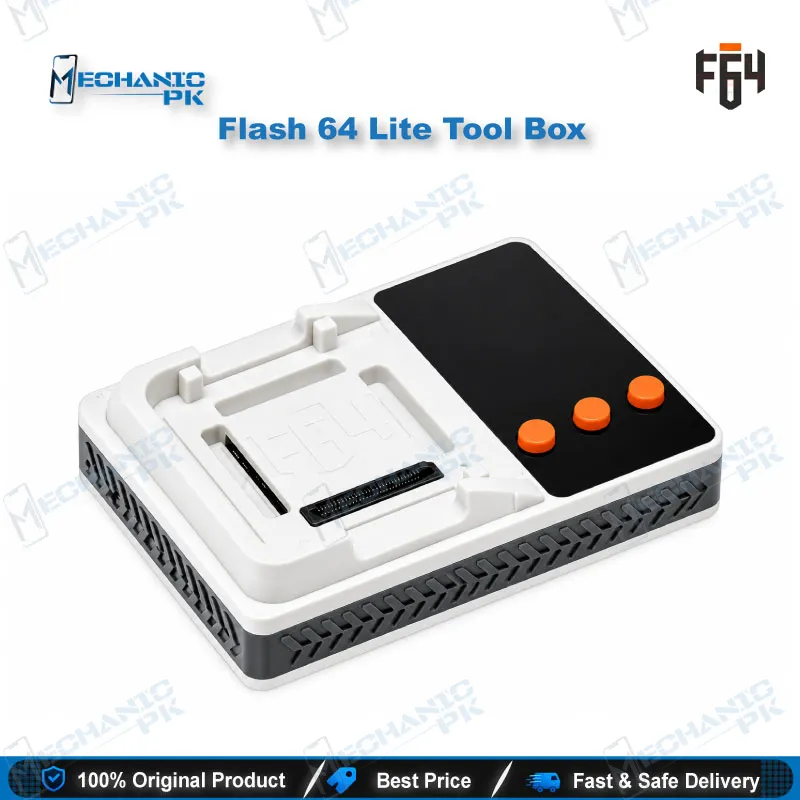
The Flash 64 Lite gives your bench direct access to UFS and eMMC managed NAND. It supports UFS versions 1.0 through 4.1 with HS-Gear speeds up to 420 MB/s, and eMMC 4.1 through 5.1 at up to 200 MB/s in 8-bit HS200 mode. The software reaches Android partitions at a high level, and RAW partitions, logical units and RPMB at a low level. It covers storage found in smartphones, TV boxes, game consoles and IoT boards, with RFFE, JTAG, SPI, I2C and UART interfaces on board. Repair shops and service centers that handle managed NAND work regularly will get the most from it.
In stock
Flash 64 Lite UFS eMMC Programmer for Managed NAND Repair
The Flash 64 Lite UFS eMMC programmer gives your bench a dedicated route into the storage chips that many modern handset faults trace back to. When a phone shows a dead screen after a bad flash, loops at boot, or loses its storage map, the fault often sits in the UFS or eMMC package rather than the main logic. This unit handles UFS storage from version 1.0 to 4.1 and eMMC from version 4.1 to 5.1. That range covers the storage families you will meet in current and recent handsets, TV boxes, game consoles and IoT boards. Treat it as a programming and configuration tool first, and your workflow will fit it well.
Interface Coverage and Speed Ratings
Speed decides how long a full read or firmware write takes, so the ratings deserve a close look. On UFS, the tool offers full compatibility with versions 1.0 through 4.1 and reaches HS-Gear speeds up to 420 MB/s. On eMMC, it works with versions 4.1 to 5.1 at up to 8-bit HS200, which delivers 200 MB/s. Full dumps of UFS chips will finish noticeably faster than eMMC dumps of similar capacity, so schedule your queue around that difference.
The platform also covers removable and embedded formats beyond managed NAND. Nano Memory Card support runs up to 90 MB/s in 4-bit mode. MicroSD support covers SDSC, SDHC, SDXC and SDUC cards at UHS-I speeds of up to 104 MB/s. The hardware also exposes RFFE, JTAG, SPI, I2C and UART interfaces. That gives you one programmer for chip-level work across several device families, which reduces the number of tools you need to keep on the bench.
Low-Level and High-Level Access on Managed NAND
Two access modes define how you use this tool. High-level access reads and writes the Android OS partitions. That suits firmware restoration and partition-level repair, where the logical structure still holds. Low-level access works directly with RAW partitions, logical units and RPMB regions. Switch to this mode when the standard partition view no longer reflects what the chip holds. RPMB stores protected data, so confirm your procedure and keep a verified backup before you write to any RPMB region.
On UFS, the software gives you control over descriptors, attributes and flags. Set these correctly after a chip replacement or a reballed package so the device reads its storage configuration as intended. On eMMC, you get full access to the Extended CSD register. That access supports deep customization and low-level repartitioning, which matters when the stock layout no longer suits the repair. Work through these settings methodically, and record each change so you can trace any unexpected result back to its source.
Where This Programmer Fits Your Repair Workflow
Think of the Flash 64 Lite as the stage between diagnosis and reassembly. Board-level work starts with a multimeter check and a microscope inspection. If the fault points to the storage package, move the chip to a reader, identify the interface, and confirm that the device responds before you write anything. Then run your read, erase or write routine, verify the result, and only then return the board to the phone. This sequence keeps the chip safe and the job defensible.
When a customer brings in a dead phone or a boot loop issue traced to storage, this unit lets you check the package before you commit to a board-level replacement. Service centers, IC-level technicians and training institutes benefit most, since the same unit covers UFS and eMMC work without a change in the core setup. For eMMC and UFS ISP work, pair the programmer with a stable power supply and a hot air station for careful chip removal and reballing. Keep a set of BGA adapters for the packages you service most often, so you can move from one job to the next without delay.
Software Requirements and Setup
The control software runs on Windows 8, Windows 10 and Windows 11. Install it on a dedicated workstation where you can keep drivers and software versions stable. Record the software version for each job, because a version change can alter how a package responds to the same operation. Connect the programmer over a direct, reliable USB port and avoid hubs during read or write operations. An interrupted write can leave a chip in an inconsistent state, and that outcome costs far more time than a few minutes of careful setup.
| Weight | 0.6 kg |
|---|
Key Features
- UFS support from version 1.0 through 4.1, with HS-Gear speeds up to 420 MB/s
- eMMC support from version 4.1 through 5.1 at 8-bit HS200, up to 200 MB/s
- High-level access to Android OS partitions
- Low-level access to RAW partitions, logical units and RPMB
- Full Extended CSD access on eMMC
- Nano Memory Card and MicroSD support, up to UHS-I 104 MB/s
- Control software for Windows 8, Windows 10 and Windows 11
Specifications
| Brand | gsmjustoncct |
|---|---|
| Model | Flash 64 Lite (F64 Lite) |
| Category | Mobile Repair Tools / NAND Programmers |
| Compatibility | UFS 1.0–4.1 and eMMC 4.1–5.1 managed NAND |
| Supported Devices | Smartphones, TV boxes, game consoles and IoT devices with managed NAND storage |
| Technology | UFS HS-Gear up to 420 MB/s; eMMC 8-bit HS200 up to 200 MB/s; Nano Memory Card up to 90 MB/s (4-bit); MicroSD (SDSC, SDHC, SDXC, SDUC) up to UHS-I 104 MB/s; RFFE, JTAG, SPI, I2C, UART; Xtensa LX7 MCU @ 240 MHz; 16 MB flash memory |
Common Repair Uses
- Reading and writing UFS and eMMC chips for firmware restoration
- Configuring UFS descriptors, attributes and flags after an IC replacement
- Extended CSD access and low-level eMMC repartitioning
- RAW partition, logical unit and RPMB work on managed NAND
- In-system programming (ISP) of eMMC and UFS storage
- Chip-level storage checks after board diagnosis of dead phones and boot loop issues
Compatible Devices
- Managed NAND storage scope (UFS and eMMC families, plus removable formats listed below)
- Smartphones using UFS storage from version 1.0 to 4.1
- Smartphones using eMMC storage from version 4.1 to 5.1
- Nano Memory Card (NM) devices, up to 90 MB/s in 4-bit mode
- MicroSD cards: SDSC, SDHC, SDXC and SDUC
- TV boxes, game consoles and IoT boards with managed NAND
- Chip-level work over RFFE, JTAG, SPI, I2C and UART interfaces
FAQ
What is the product name?
What is the brand of this product?
What is the model of this product?
What is this product used for?
Which devices are compatible with this product?
Who should use this product?
Does this programmer support UFS 4.1 chips?
Which eMMC versions does this tool support?
Related products


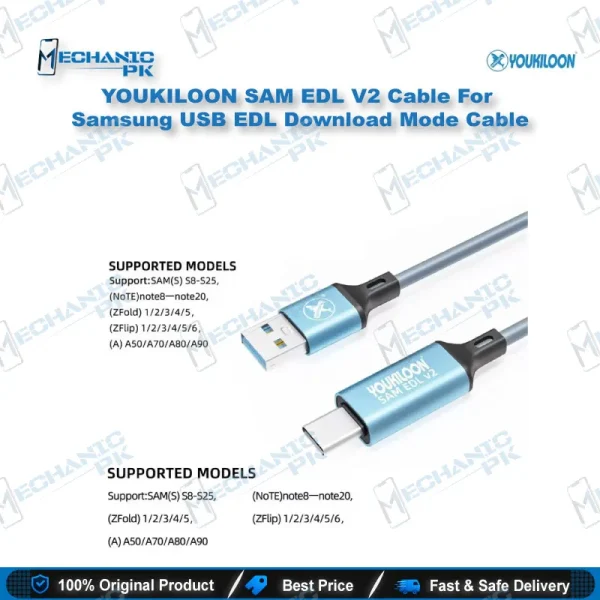
YOUKILOON SAM EDL V2 Cable For Samsung USB EDL Download Mode Cable
In stock