

















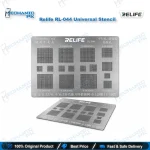
Relife RL-044 Universal Stencil 0.12mm BGA Reballing
₨ 599
Universal 0.12 mm BGA Reballing Stencil
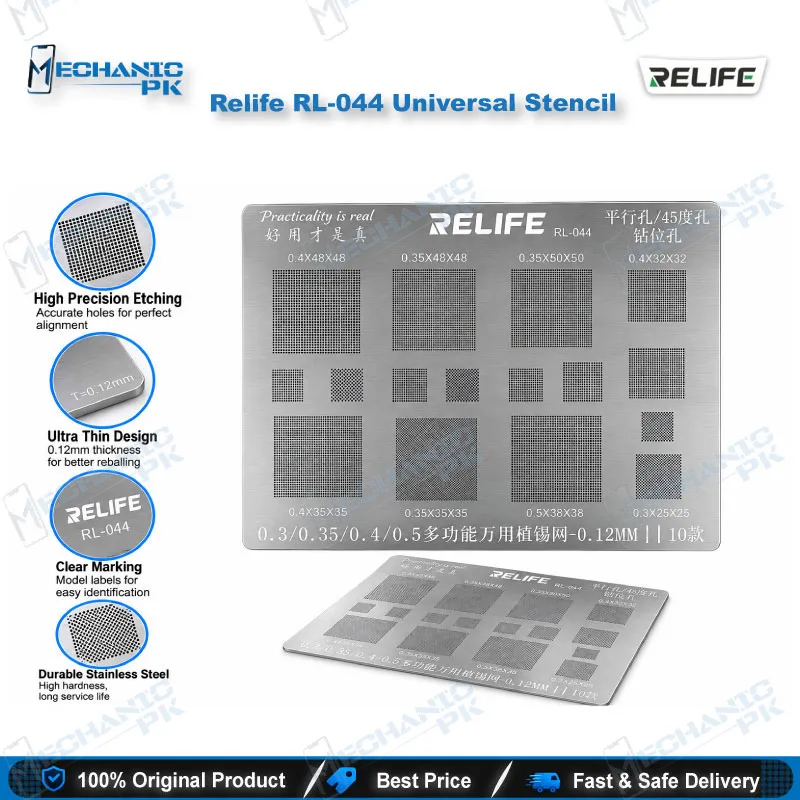
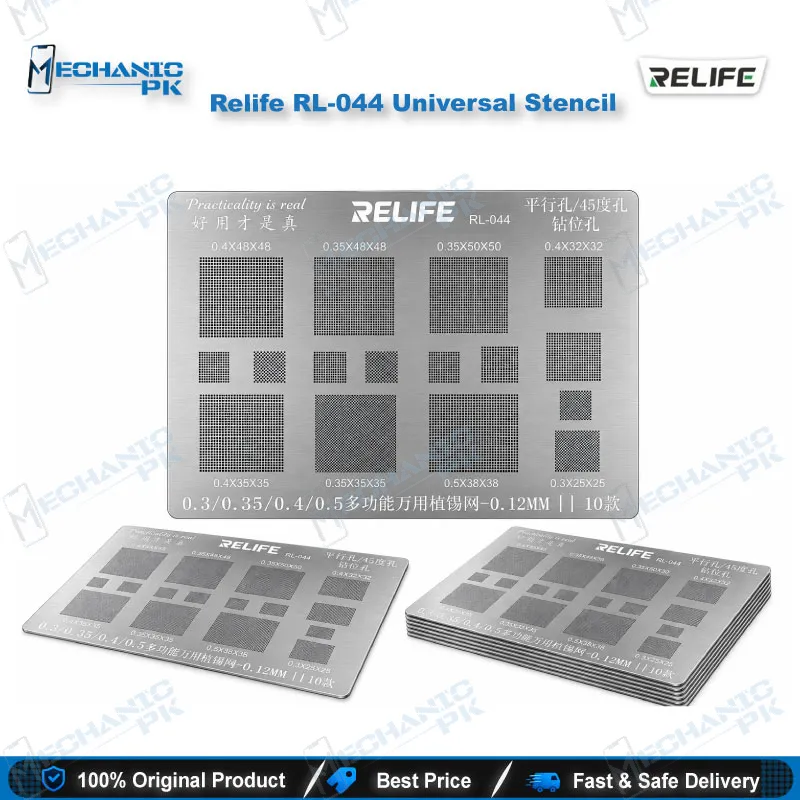
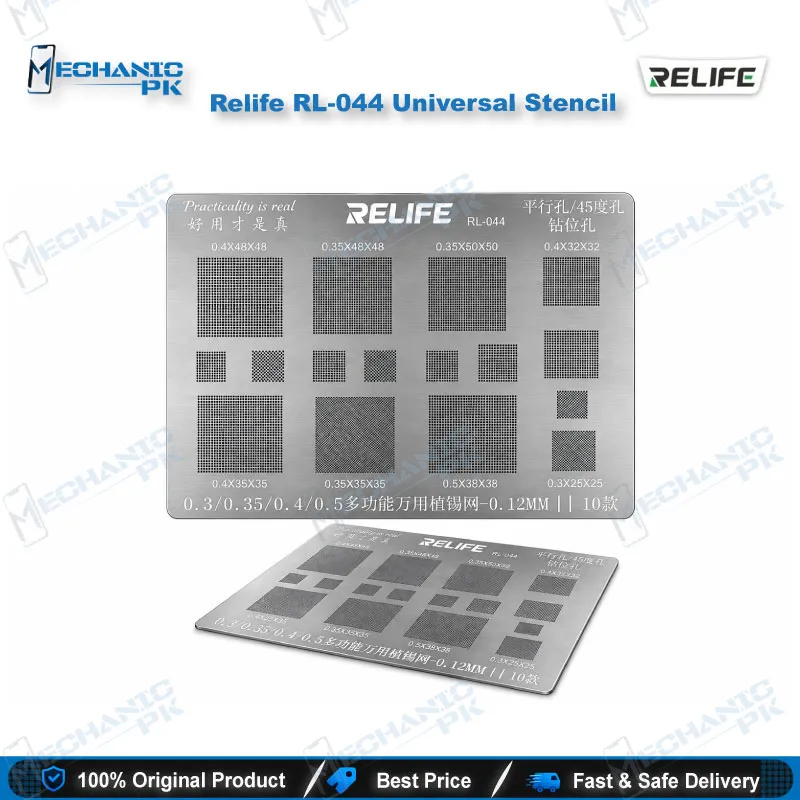
The Relife RL-044 Universal Stencil puts a multi-pitch BGA template on your bench in one thin stainless steel sheet. It supports fine-pitch chips from 0.3 mm to 0.5 mm pitch and gives you both parallel and 45° hole layouts, so you match the stencil to the chip instead of buying a separate mesh for every part. At roughly 0.12 mm thick, it controls solder ball height and stays flat under hot air. Repair shops across Pakistan use it for reballing memory, CPU and power ICs during board-level repair. Mechanicpk supplies it for technicians who want precise results from a compact, reusable tool.
In stock
Relife RL-044 Universal Stencil for Fine-Pitch BGA Reballing
The Relife RL-044 universal stencil gives you one 0.12 mm stainless steel template that handles fine-pitch BGA chips from 0.3 mm to 0.5 mm pitch, in both parallel and 45° hole layouts. When a board arrives with a lifted, damaged or freshly removed BGA IC, you reach for a single stencil instead of searching a drawer of chip-specific meshes. This page explains how the layout works, where the stencil fits in your reballing process, and what you need around it to plant clean, uniform solder balls.
How the 0.12 mm Universal Layout Works
Relife builds the RL-044 range as precision BGA stencils, and this universal version replaces a single chip map with a multi-pitch layout. The pitch options of 0.3, 0.35, 0.4 and 0.5 mm cover a wide band of the fine-pitch BGA packages you meet on phone motherboards. The parallel and 45° hole arrangements match the two common ball array orientations, so you pick the zone that mirrors your chip’s pad grid.
The approximate 0.12 mm thickness sets how much paste or solder ball material each hole holds, which decides final ball height. Stainless steel resists warping when you apply heat, and it wipes clean after each use, so one stencil serves many jobs. Measure the chip’s pitch under a microscope before you start. A correct pitch match is the single biggest factor in getting every ball to land on its pad.
Where It Fits in Your Reballing Workflow
Reballing starts after you lift the IC with a hot air station and clear old solder from the pads with flux and wick on your soldering station. Clamp the board in a PCB holder, then inspect the pads under a microscope for lifted tracks or leftover solder. Once the pads look clean and flat, you lay the Relife RL-044 universal stencil over the chip, align the correct hole zone with the pad grid, and hold it steady.
Spread solder paste or place balls through the holes, apply controlled heat, and let the balls form. Lift the stencil after the joint cools, then recheck the result under magnification. For eMMC and memory ICs, confirm continuity with a multimeter and verify the chip with your eMMC programmer or ISP pinout tool after you reseat it. A dead phone with a hardware fault often traces back to a damaged BGA joint, and this stencil gives you a controlled way to fix it during IC change karna. Pair it with a reballing kit for balls, paste and tweezers so the whole job stays at one bench position.
Why Technicians Choose a Universal Stencil
A universal stencil cuts the number of single-model meshes you carry. If your shop handles mixed Android and legacy boards, one multi-pitch template covers odd or low-volume chips you do not stock a dedicated stencil for. The slim, light steel sheet also travels easily between your bench and a customer visit.
Be realistic about the trade-off. A universal layout asks for more careful alignment than a chip-specific stencil, because you locate the right hole group yourself. If you reball one chip model all day, a dedicated RL-044 stencil for that platform saves setup time, and the universal piece stays on your bench as the backup for everything else. That upgrade path lets you start with the universal stencil and add model-specific sheets as your repair volume grows.
Mechanicpk lists the Relife RL-044 universal stencil alongside hot air stations, soldering stations, microscopes, PCB holders and reballing kits, so you can build a complete reballing setup from one catalogue. Check your chip’s pitch, confirm it falls within 0.3 to 0.5 mm, and pick the matching hole layout before you order.
| Weight | 0.5 kg |
|---|
Key Features
- Approx. 0.12 mm stainless steel construction
- Supports 0.3 mm, 0.35 mm, 0.4 mm and 0.5 mm pitch
- Parallel and 45° hole layouts on one stencil
- Universal design, not locked to one phone model
- Part of Relife’s RL-044 precision BGA stencil range
- Slim and lightweight for bench or field work
- Wipes clean for repeated use
- Durable steel that resists wear
Specifications
| Brand | Relife |
|---|---|
| Model | RL-044 |
| Category | IC / BGA Reballing Stencil |
| Compatibility | Fine-pitch BGA ICs, 0.3 / 0.35 / 0.4 / 0.5 mm pitch; parallel and 45° hole layouts |
| Technology | BGA stencil solder ball planting |
| Material | Stainless steel |
| Thickness | Approx. 0.12 mm |
Common Repair Uses
- Reballing BGA ICs during mobile phone board-level repair.
- Reballing a BGA IC after hot air removal
- Replacing missing or damaged solder balls on a lifted chip
- Reballing eMMC and memory ICs before reseating
- Reballing CPU and processor chips
- Reballing power and charging ICs
- Planting solder balls with solder paste through the stencil
- Reworking a dead phone with a BGA hardware fault
- Reballing a chip pulled from a donor board for reuse
Compatible Devices
- Universal, not tied to one phone model. Compatibility depends on the chip’s ball pitch and hole layout.
- Universal stencil, not limited to a single phone model
- BGA ICs with 0.3 mm pitch
- BGA ICs with 0.35 mm pitch
- BGA ICs with 0.4 mm pitch
- BGA ICs with 0.5 mm pitch
- BGA chips with a parallel ball layout
- BGA chips with a 45° ball layout
- Phone motherboard BGA ICs such as memory, CPU or power ICs where pitch and layout match
FAQ
What is the product name?
What is the brand of this product?
What is the model of this product?
What is this product used for?
Which devices are compatible with this product?
Who should use this product?
Which BGA pitches does the Relife RL-044 universal stencil support?
How thick is the stencil, and which hole layouts does it offer?
Related products