
















AW87339 Audio Code IC – Awinic Smart K Speaker Amplifier
₨ 280
AW87339 Audio Code IC – 3W Awinic Smart K Speaker Amplifier
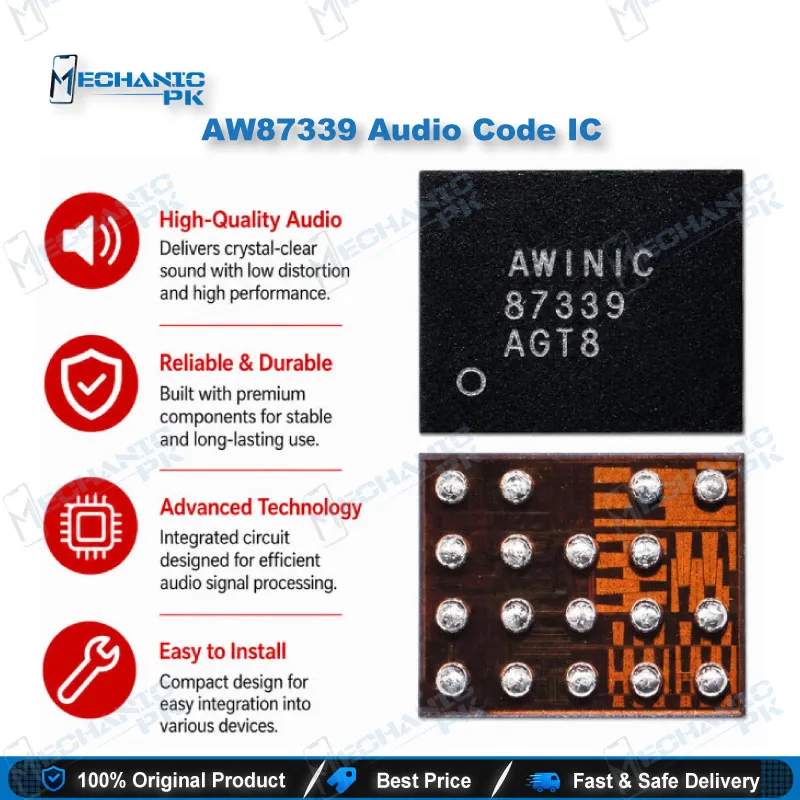
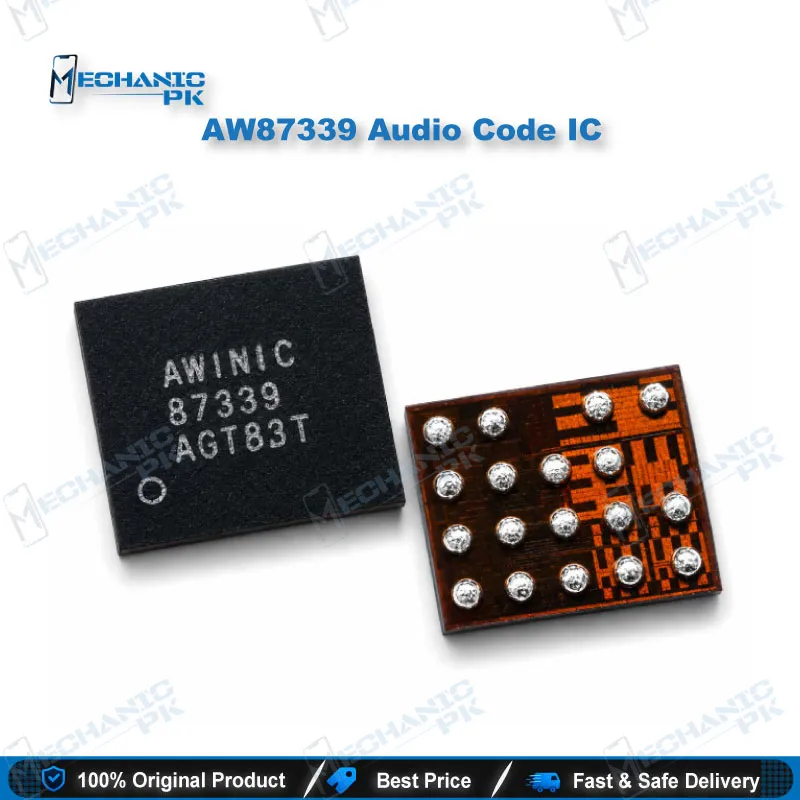
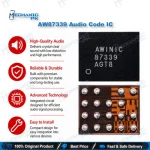
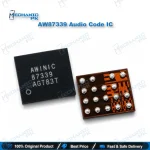
The AW87339 Audio Code IC is Awinic’s third-generation Smart K audio amplifier for smartphone loudspeaker and earpiece circuits. An inductor-free DO-Charge Pump raises the power stage rail to 8.5V, so you get up to 3W into an 8Ω speaker from a 4.2V battery at 1% THD+N. Awinic’s TLTR-AGC algorithm holds volume high while suppressing crackle, and the 38μV speaker noise floor keeps playback clean. The chip supports stereo and speaker/receiver 2-in-1 layouts, takes I2C register control from the host, and ships in a compact 18-ball WLCSP package for board-level audio section repair.
AW87339 Audio Amplifier IC for Smartphone Speaker and Earpiece Circuits
The AW87339 audio amplifier IC from Awinic drives the loudspeaker and, in 2-in-1 designs, the earpiece receiver on modern Android smartphones. Awinic classes this AW87339 Audio Code IC as a third-generation Smart K amplifier built around an inductor-free DO-Charge Pump that lifts the power stage rail to 8.5V from a single lithium cell. You get up to 3W into an 8Ω speaker at 4.2V battery voltage with 1% THD+N, a 38μV speaker noise floor, and a 102dB signal-to-noise ratio. The chip sits between the audio codec output and the speaker, so when it fails, the phone plays nothing from the bottom speaker even though the codec, microphone, and earpiece path may still work.
How the Smart K Architecture Delivers Loud, Clean Output
The DO-Charge Pump replaces the boost inductor that older amplifier designs needed, and it reaches up to 90% efficiency. That keeps current draw low during long music playback and video calls. Awinic’s Triple-Level Triple-Rate AGC (TLTR-AGC) algorithm watches the signal and adjusts gain across three levels and three rates, so loud tracks stay loud without the crackle a clipping amplifier produces. The host processor writes register values over the I2C bus, including charge pump output voltage, amplifier gain, and AGC parameters. That I2C dependency matters on your repair bench. A phone that boots normally but gives no speaker output can carry a healthy AW87339 alongside a broken SDA or SCL trace, so check the bus before you commit to an IC change karna job. Built-in over-current, over-temperature, and short-circuit protection shuts the output down under fault conditions, which explains why a shorted speaker coil often leaves the amplifier alive after you replace the speaker.
Speaker, Receiver and 2-in-1 Configurations of the Awinic Smart K Amplifier
The AW87339 supports three board layouts. In stereo designs, one chip drives the bottom speaker while a second drives a high-power receiver at the top. In 2-in-1 designs, a single chip handles both the speaker and the earpiece, switching between Smart K speaker mode and a receiver mode with selectable Class AB or Class D output. Receiver mode runs at an ultra-low 9μV noise, so calls stay hiss-free at the earpiece. Before you order, trace the schematic or board view for your model and confirm which position the chip occupies. A stereo phone with weak top audio may need the receiver-side AW87339, not the bottom one.
Replacing the AW87339 Audio Amplifier IC on a Phone Board
The AW87339 comes in an 18-ball WLCSP package measuring 2.545mm × 2.075mm, so treat every replacement as a micro-BGA job. Fix the board in a PCB holder, apply a thin layer of quality flux, and lift the old chip with your hot air station at controlled temperature and low airflow so nearby capacitors stay in place. Clean the pads with desoldering wick, then inspect them under a microscope for lifted or torn pads. If the new chip arrives without balls, reball it with a matching stencil from your reballing kit. Align ball A1 with the board marking, reflow, and let the board cool naturally. After reassembly, test speaker output across the full volume range, play a bass-heavy track to confirm the AGC behaves, and run a call to verify the earpiece path on 2-in-1 boards. A quick multimeter check on the speaker coil and the battery supply rail before removal saves time when the hardware fault sits outside the chip. Technicians still doing CSP-level work under a magnifier lamp gain the most from moving up to a stereo microscope, which makes ball alignment and pad inspection far more reliable. Mechanicpk stocks the hot air stations, soldering stations, microscopes, reballing kits, and PCB holders that complete this audio IC workflow.
| Weight | 0.1 kg |
|---|
Key Features
- Third-generation Awinic Smart K amplifier architecture
- Up to 3W output into 8Ω at 4.2V, 1% THD+N
- Inductor-free DO-Charge Pump generating an 8.5V PVDD rail with up to 90% efficiency
- TLTR-AGC algorithm for constant large volume without crackle
- 38μV speaker noise floor and 102dB SNR
- Receiver mode with selectable Class AB or Class D output and 9μV noise
- I2C control of gain, charge pump voltage, and AGC parameters
- Over-current, over-temperature, and short-circuit protection in an 18-ball WLCSP package
Specifications
| Brand | Awinic |
|---|---|
| Model | AW87339 (AW87339CSR) |
| Category | Audio Amplifier IC – Smart K Class |
| Compatibility | Smartphones using the AW87339 speaker/receiver amplifier position |
| Supported Devices | Single-cell lithium battery smartphones with stereo or speaker/receiver 2-in-1 audio layouts |
| Technology | TLTR-AGC, inductor-free DO-Charge Pump, I2C control interface |
| Input Voltage | 2.8V – 5.5V |
| Output Voltage | 8.5V (charge pump PVDD) |
| Power Rating | 3W @ 8Ω, 4.2V, 1% THD+N |
| Dimensions | WLCSP-18, 2.545mm × 2.075mm |
Common Repair Uses
- No sound from the loudspeaker during ringtones, media, and alarms
- Low or weak speaker volume after a board-level hardware fault
- Crackling, hissing, or distorted speaker output traced to the amplifier
- No earpiece sound on 2-in-1 speaker/receiver boards
- Weak top-speaker audio on stereo phones
- Audio section rebuild after liquid damage
- Short on the amplifier supply line causing current draw or local heating
- Pad repair and re-fit after a previous failed amplifier rework
Compatible Devices
- Universal at the amplifier-position level — not device-specific. Match the AW87339 marking or your model’s schematic before ordering.
- Android smartphones with an Awinic AW87339 in the loudspeaker amplifier position
- Phones using a single AW87339 in speaker and receiver 2-in-1 mode
- Stereo-speaker phones using the AW87339 for the bottom speaker
- Stereo designs using the AW87339 as a high-power receiver amplifier
- Qualcomm, MediaTek, and Unisoc boards (analog input from any audio codec or DAC, I2C control from any host)
- Devices running a single-cell lithium battery within the 2.8V – 5.5V supply range
- Boards driving 8Ω loudspeakers from the amplifier output
- Boards with an 18-ball WLCSP footprint at the amplifier position
FAQ
What is the product name?
What is the brand of this product?
What is the model of this product?
What is this product used for?
Which devices are compatible with this product?
Who should use this product?
Does the AW87339 need an external inductor like boost-type audio amplifiers?
Why is there still no speaker sound after replacing the AW87339?
Related products