














SMB1351 005 Qualcomm Charging IC – Quick Charge 3.0
₨ 350
Qualcomm SMB1351 005 Fast Charging IC
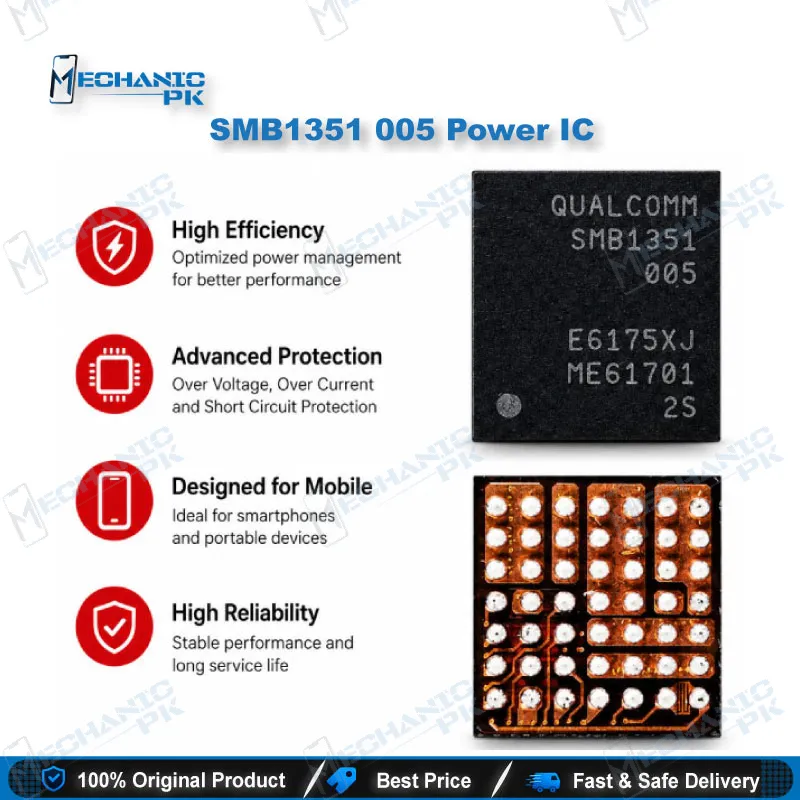
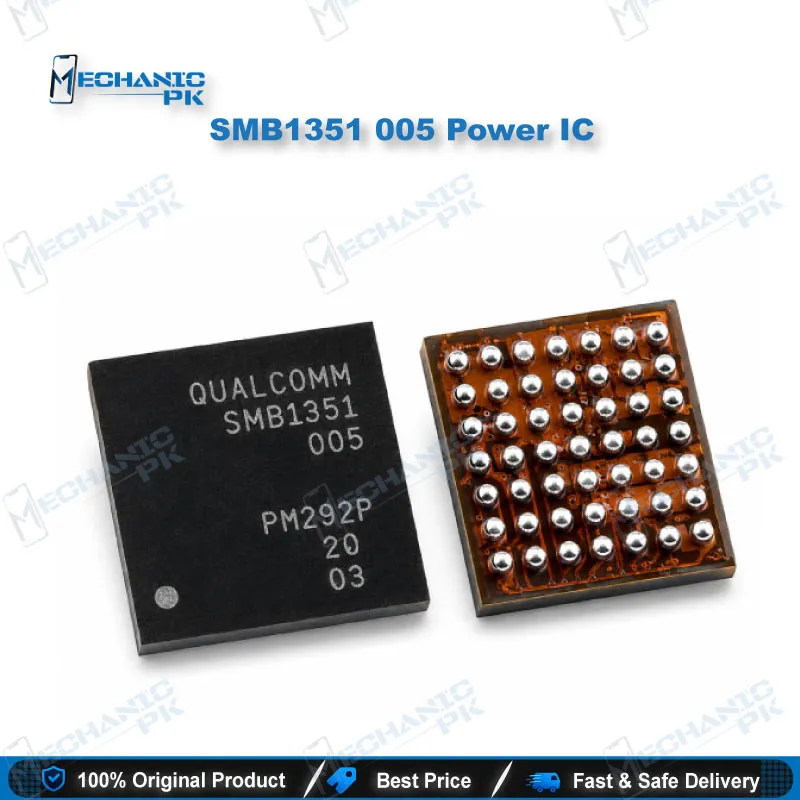
The SMB1351 005 is a Qualcomm programmable switch-mode charger IC for single-cell Li-ion and Li-Polymer batteries, built for high-current fast charging. It delivers charge current up to 4.6 A at above 90% conversion efficiency and runs Quick Charge 3.0 negotiation on its own. On PMI8994-based Qualcomm boards, it works as the parallel charger that carries the extra current. Replace it when a phone loses fast charging, charges only at standard speed, or shows a shorted charger rail. Your bench needs a hot air station, quality flux, and a microscope for a clean fine-pitch replacement.
SMB1351 Charging IC: Qualcomm Switch-Mode Charger for Fast Charging Repair
The SMB1351 charging IC is Qualcomm’s programmable switch-mode charger for single-cell Li-ion and Li-Polymer batteries, and the 005 marking identifies the exact variant that sits on your board. Qualcomm rates this chip for charge current up to 4.6 A, conversion efficiency above 90%, and autonomous Quick Charge 3.0 support. On Qualcomm platforms built around the PMI8994 PMIC, the SMB1351 runs as a parallel charger beside the PMIC’s own charging block, splitting the current load and adding Quick Charge 3.0 capability. When this IC fails, the phone usually still boots but charges slowly, refuses fast charging, or stops taking charge entirely. Mechanicpk supplies the SMB1351 005 for technicians who diagnose these faults at board level and need the correct part number on the first attempt.
Where the SMB1351 Sits in the Charging Path
Charging current enters through the USB connector, passes the input protection stage, and reaches the charger IC that converts it into a regulated battery supply. The SMB1351 handles that conversion with a switching architecture instead of a linear one, so it wastes far less energy as heat while it pushes high current into the cell. Qualcomm specifies a 22 V maximum input rating for this charger, which gives the chip headroom when a Quick Charge adapter raises VBUS above 5 V. The IC talks to the system over I²C, so the PMIC and the phone’s software read charging status and set parameters through that bus. AICL (automatic input current limit) and APSD (automatic power source detection) let the chip identify the adapter and hold input draw within what that adapter can deliver. USB OTG support lets the same IC send power outward when the phone acts as a host for accessories. Knowing this path tells you exactly which rails to probe before you touch the hot air.
Fault Symptoms That Point to This IC
A damaged SMB1351 rarely produces one clean symptom, so you confirm it with measurements before you lift it. Typical patterns include a phone that charges only at standard speed even with an original Quick Charge adapter, a charging issue where the battery percentage barely moves under load, a hot spot in the charger section during a thermal check, or a short to ground on the input rail after liquid damage or a faulty adapter. Some boards fall into a dead phone condition when a shorted charger IC drags down the main supply. Check the input line in diode mode on your multimeter, compare readings against a known-good board, and use a thermal camera or rosin to find the heating component. Once the readings isolate the SMB1351, an IC change karna becomes the clean fix, and you stop chasing software or swapping charging ports blindly.
Replacement Workflow and Bench Requirements
Qualcomm offers the SMB1350/SMB1351 family in CWLNSP and MQFN packages, so replacement demands controlled heat and precise alignment. Mount the board in a PCB holder, preheat it to reduce thermal stress on nearby components, and lift the old IC with even hot air. Clean the pads with solder wick until they sit flat and shiny. For the wafer-level package, reball the chip with a matching stencil from your reballing kit; for MQFN, tin the pads lightly and align the IC by its pin-1 mark under the microscope. After soldering, measure the input rail for shorts before you apply power, then test with a USB ammeter and a Quick Charge adapter to confirm the board negotiates higher voltage and pulls full current. Always match the complete marking, including the 005 suffix, against the original chip, since suffix codes separate variants of the same base part. If Qualcomm charging faults reach your bench regularly, a trinocular microscope and a DC power supply with a current display speed up both diagnosis and post-repair verification.
| Weight | 0.1 kg |
|---|
Key Features
- Programmable switch-mode charger for single-cell Li-ion/Li-Polymer cells
- Charge current up to 4.6 A
- Above 90% conversion efficiency for lower heat
- Autonomous Qualcomm Quick Charge 3.0 support
- 22 V maximum input rating for high-voltage adapters
- I²C interface for PMIC and software control
- AICL and APSD for adapter detection and input limiting
- USB OTG power output support
Specifications
| Brand | Qualcomm |
|---|---|
| Model | SMB1351 (marking: 005) |
| Category | Charging IC / Power IC |
| Compatibility | Qualcomm platforms using SMB1351 as a parallel charger (PMI8994-based designs) |
| Supported Devices | Single-cell Li-ion / Li-Polymer battery devices |
| Technology | Programmable switch-mode charger, Quick Charge 3.0, I²C control, AICL, APSD, USB OTG |
| Input Voltage | 22 V maximum rating |
Common Repair Uses
- Board-level charging-section repair
- Restoring Quick Charge 3.0 fast charging on a supported board
- Fixing phones stuck at standard-speed charging
- Repairing a shorted charger input rail after a faulty adapter
- Charging section recovery after liquid damage
- Dead phone caused by a shorted charger IC pulling down the supply
- Battery not charging while the cable still gets detected
- USB OTG accessories not receiving power
- Overheating in the charging section during charge
Compatible Devices
- Verified at chipset-platform and battery-type level — not device-model specific
- Qualcomm boards using the PMI8994 parallel-charging architecture
- Smartphones whose original charger IC carries the SMB1351 005 marking
- Single-cell Li-ion battery devices
- Single-cell Li-Polymer battery devices
- Quick Charge 3.0 capable phone boards built on SMB1351
- Devices charging over USB 2.0 interfaces
- Devices charging over USB 3.0 interfaces
- Portable devices fed by USB or AC adapter input
FAQ
What is the product name?
What is the brand of this product?
What is the model of this product?
What is this product used for?
Which devices are compatible with this product?
Who should use this product?
What is the maximum charge current of the SMB1351 charging IC?
Does the SMB1351 IC support Quick Charge 3.0 fast charging?
Related products