





















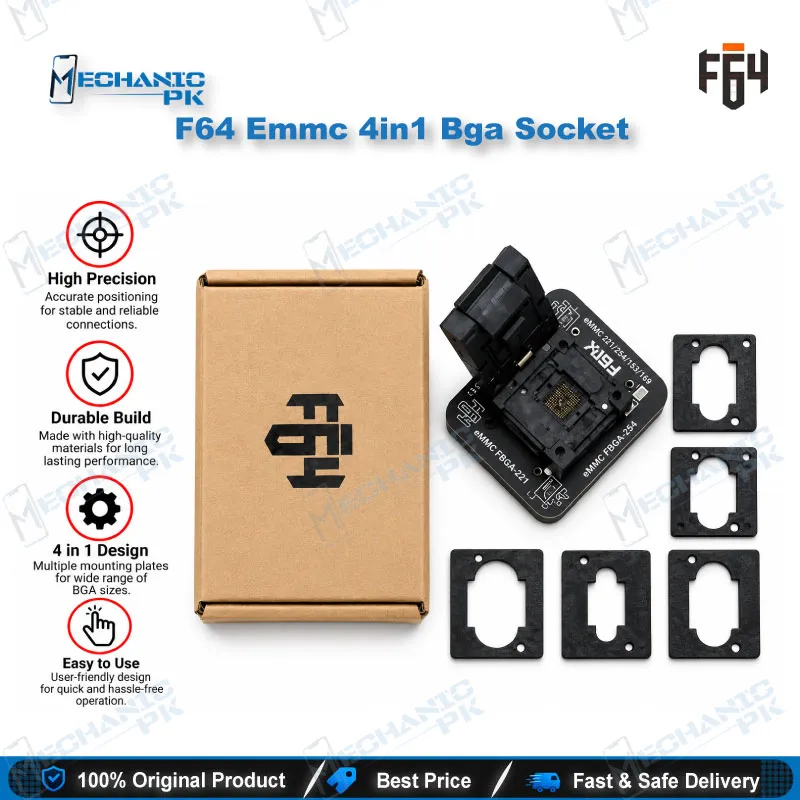
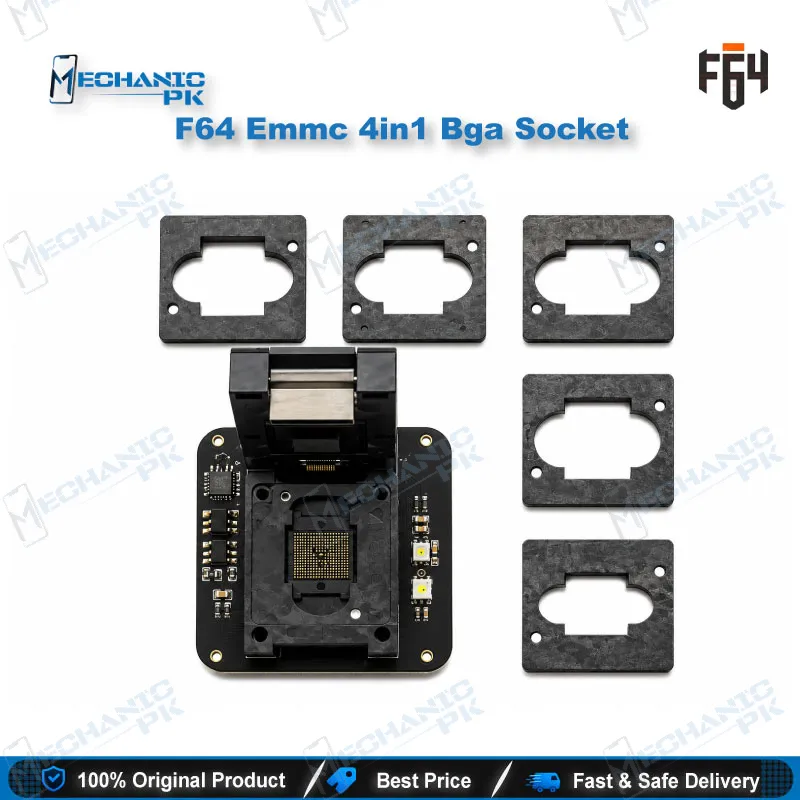
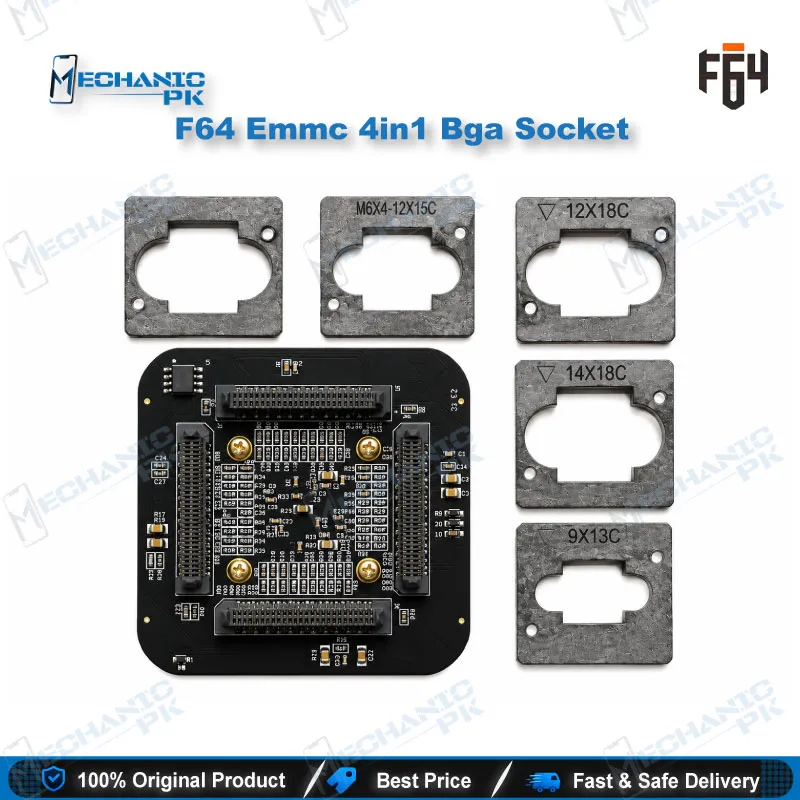

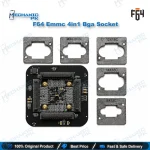
F64 Emmc 4in1 Bga Socket for Mobile IC Programming
₨ 35,000
4-in-1 eMMC BGA Socket for Programming
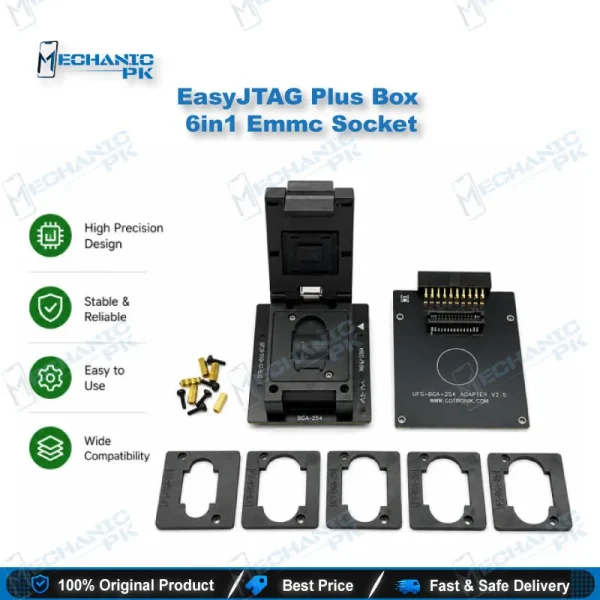
The F64 Emmc 4in1 Bga Socket gives your bench a solder-free way to connect eMMC BGA chips to a programmer. You seat the chip in the socket and run read, write, and verification jobs without reballing the package each time, which keeps the original chip intact. The 4in1 layout covers several package positions in one kit, so you carry fewer adapters for everyday eMMC work. Clean contacts and a matched package fit keep results consistent across repeated jobs. It suits mobile repair technicians, service centers, and shops handling data recovery, flashing, and boot-level faults on Pakistani handsets.
In stock
The F64 Emmc 4in1 Bga Socket suits technicians who handle eMMC storage chips often and need a stable, repeatable connection between the chip and the programmer. Instead of desoldering and reballing the chip for every read, write, or verification job, you seat the package in the socket and run the operation. The original chip stays intact, which matters when you recover user data or test a chip before committing to a board-level repair. The 4in1 layout gives one kit several socket positions, so a single accessory covers more eMMC package sizes than a basic single-position adapter. For a Pakistani repair bench, that means fewer adapters to buy, fewer parts to store, and less time switching hardware between jobs. eMMC work sits at the center of modern mobile repair. Many handsets keep their operating system, user data, and boot files on an eMMC module mounted on the main board. When that module fails or corrupts, the symptoms often look like a dead phone, a boot loop, a hang on logo, or a unit that refuses to pass a flash process. A socket lets you address the chip directly, so you can separate a storage fault from a fault in the processor or power section. That separation saves time, because you avoid replacing the wrong component, and your diagnosis gets sharper. Package size and ball layout vary across eMMC chips. Common BGA footprints include 153, 169, 221, and 254 ball packages, and each one needs a socket matched to its ball count, pitch, and body dimensions. Before you seat a chip, read the marking on the package, confirm the ball count against the socket, and check orientation against the pin-1 marking. Forcing a chip into a mismatched position can bend balls or damage the contacts, so verify the fit first. A few extra seconds at this step prevent expensive mistakes on a chip that may hold a customer’s only copy of their data. Once the chip sits in the socket, the programmer software manages communication. Use a stable power supply and a clean USB connection, and keep the socket free of flux residue and dust. Contact quality drives read and write reliability. Clean contacts give you consistent results across repeated cycles, while dirty contacts produce read errors that look like chip failure. Treat the socket as a precision part of your bench: wipe the contacts after each session, store it covered, and inspect the pins before each job. Start every eMMC job with a full read. Save the dump as a backup before you write anything, even when the customer only wants the phone to boot. A verified backup gives you a fallback if a write fails halfway, and it lets you compare chip contents before and after the operation. Label each dump with the job number and device model so you can trace it later. Service centers that repair many handset models get the most value from a multi-position layout. Keep one kit on the bench for most eMMC jobs, reserve single-position adapters for unusual packages, and cut the delay of sending chips out for reballing. Training institutes can use the same setup to teach students how eMMC reading and writing works without risking expensive boards. Repair shop owners can also standardize their process, so every technician follows the same seating, verification, and cleaning steps, which reduces avoidable errors across the team.
| Weight | 0.45 kg |
|---|
Key Features
- Solder-free seating for eMMC BGA chips
- 4in1 layout covers several package positions in one kit
- Keeps the original chip intact for repeated read and write cycles
- Supports a matched fit for common eMMC BGA ball layouts
- Helps separate storage faults from processor or power faults
- Reduces reballing wear on valuable memory chips
- Contact-based design rewards routine cleaning for consistent results
- Practical for service centers, training labs, and repair shops
Specifications
| Brand Entity | Mechanicpk |
|---|---|
| Product Entity | F64 Emmc 4in1 Bga Socket |
| Technology Entity | eMMC BGA packaging and socket-based chip programming |
| Compatible Device Entities | Removed eMMC chips in BGA packages |
| Repair Process Entity | Chip-level read, write, and verification |
| Industry Entity | Mobile phone repair, IC programming, and service center tooling |
Common Repair Uses
- Reading user data from a removed eMMC chip
- Writing or restoring firmware after a failed flash
- Verifying chip contents before a board-level repair
- Diagnosing dead phone and boot loop faults at the memory level
- Testing eMMC chips before reballing or replacement
- Backing up storage before a repair job
- Checking a removed chip for write errors before reinstalling
- Training technicians on the eMMC read and write workflow
Compatible Devices
- Removed eMMC chips in BGA packages (not device-specific)
- Scope depends on the socket positions in the kit and the chip’s ball count
- Confirm package size and pitch against the socket before seating
- Check programmer software support for the specific eMMC chip
FAQ
What is the product name?
What is this product used for?
Who should use this product?
Which devices are compatible with this product?
Which eMMC package sizes does this socket support?
Does this socket work on a dead phone without removing the chip?
Related products