















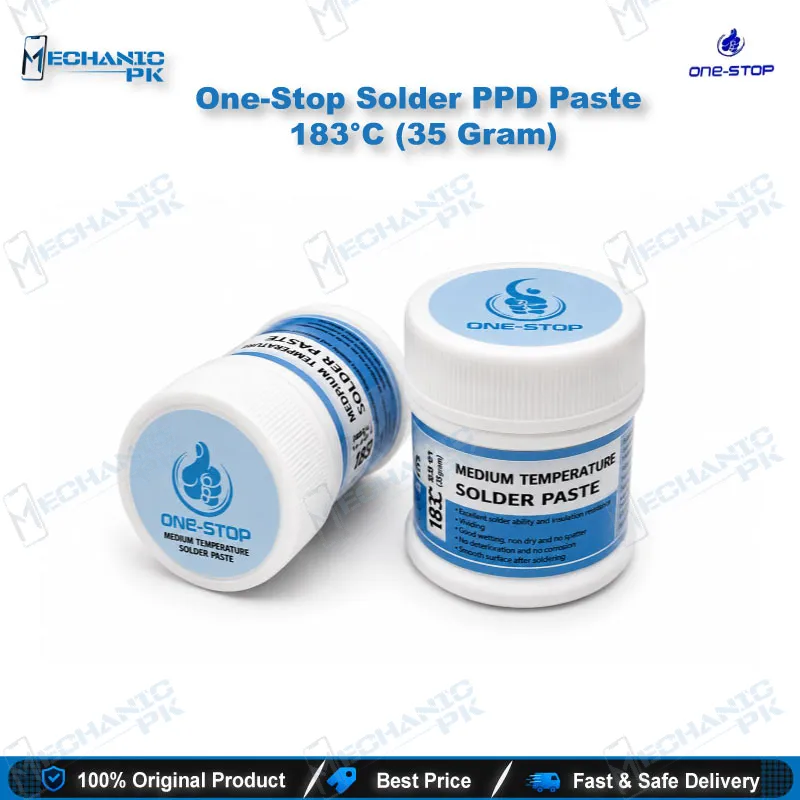
One-Stop PPD Solder Paste 183°C (35g)
₨ 400
PPD Solder Paste 183°C – 35g Pack
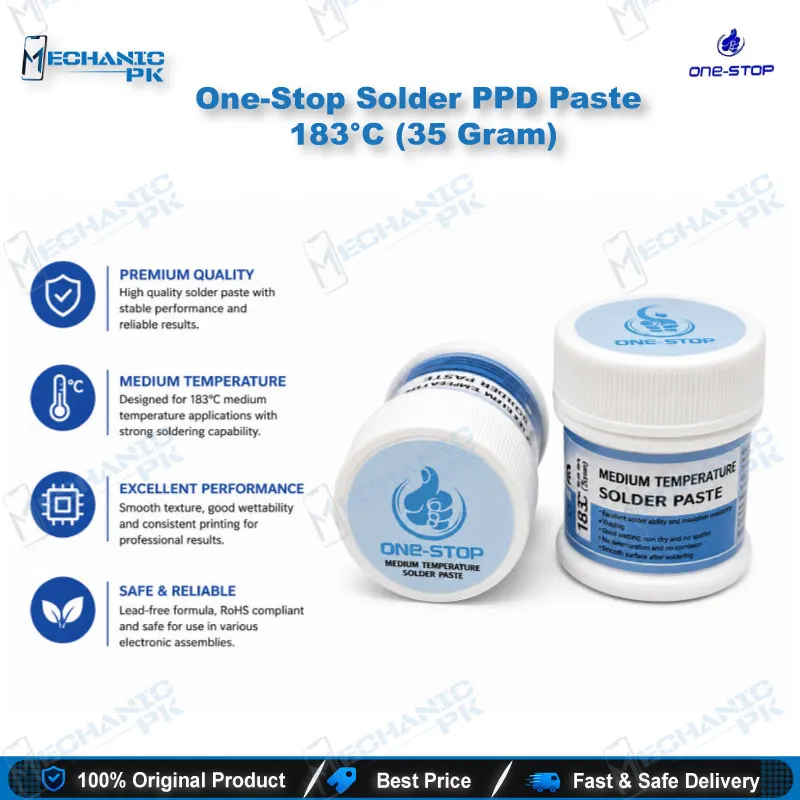
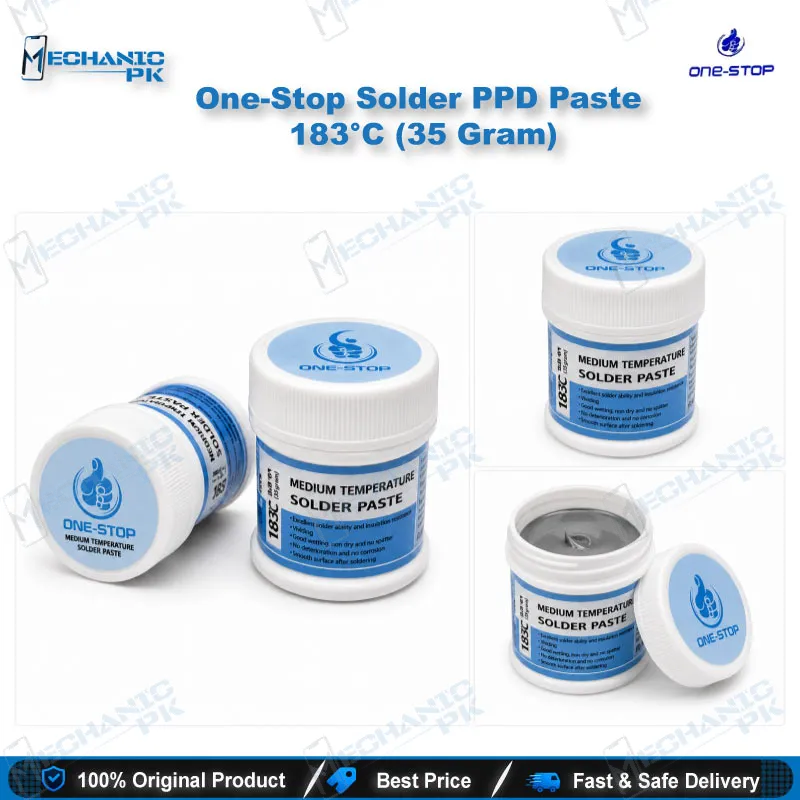
One-Stop PPD solder paste 183°C gives your repair bench a 35g supply of paste that melts at 183°C. Use it to rework SMD pads, tin BGA lands, and rebuild weak joints on phone motherboards. You work with a fixed, known melting point, so you can match your hot air station settings to the job and repeat the same result across boards. It suits dead phone cases, charging issue repairs, and IC change karna jobs where you lift and replace small components. Mechanicpk stocks it for technicians, repair shops, and service centers across Pakistan that want solder paste for mobile repair in a 35g pack.
In stock
PPD Solder Paste 183°C for Board-Level Mobile Repair
One-Stop PPD solder paste 183°C gives you 35g of paste with a verified melting point of 183°C. Technicians reach for this temperature class when they rework SMD pads, tin BGA lands, and rebuild damaged joints on phone motherboards. Mechanicpk lists it as its own consumable, so you stock it next to your hot air station, soldering station, and reballing kit instead of improvising with leftover wire solder.
Where 183°C Paste Fits in Your Rework Process
Melting point decides how paste behaves on your bench. At 183°C, the paste turns liquid at a temperature your hot air station reaches comfortably on a phone PCB. You can plan a repeatable routine around that number. Preheat the board on a PCB holder, set the airflow and nozzle for the component size, then heat the joint until the paste flows and wets the pad. Because the figure stays fixed on the pack, you can keep the same approach for a charging port, a power IC, or a row of small passives, and adjust only for board size and nozzle.
This paste also supports pad tinning before you place a chip. Many technicians lay a thin, even layer on cleaned pads, then set the component and reflow it as one step. That workflow saves time when you handle several boards in a day and want consistent joints from the first board to the last.
Practical Use on Phone Motherboards
Most hardware fault cases in a workshop come down to a weak joint, a lifted pad, or a replaced component that needs a clean, strong connection. A dead phone after a drop, a charging issue caused by a damaged connector area, or a network issue linked to a cracked RF-area joint all call for controlled soldering. You apply the paste, heat the area, and confirm the result under a microscope before you close the job.
For IC change karna work, the paste helps you rebuild the contact surface once the old chip comes off. Clean the pads, apply the paste in a thin layer, align the new part, and reflow it. After the repair, a multimeter continuity check confirms the joint before you power the board. When you need to restore a broken trace, jumper lagana on a prepared pad also goes faster once the pad carries fresh solder.
You also get value in BGA work. Pair this paste with a reballing kit and a stencil workflow to restore lands on a lifted or damaged area. The 183°C melting point gives you a clear target when you set your hot air profile, which keeps heat on the board only as long as the job needs.
Buying Notes for Workshops and Service Centers
Solder paste is a consumable, so a repair shop that handles daily board work uses it steadily. The 35g pack gives a technician or a small service center enough paste for many jobs before the next order. Keep the pack sealed when you finish, store it away from heat, and read the label on your pack for handling details, because storage needs vary between products.
Mechanicpk supplies this paste to workshops across Pakistan, so you can add it to the same order as your tweezers, flux, microscope accessories, and hot air nozzles. Stock it as a standard bench consumable and your technicians stop losing time to missing supplies mid-repair.
| Weight | 0.35 kg |
|---|
Key Features
- 35g pack for repeated workshop use
- 183°C melting point for a fixed hot air profile target
- Suits SMD rework on phone motherboards
- Supports pad tinning before component placement
- Works alongside hot air stations and soldering stations
- Pairs with reballing kits for BGA land work
- Fits dead phone, charging issue, and hardware fault repairs
- Suits technicians, repair shops, and service centers
Specifications
| Brand | One-Stop |
|---|---|
| Model | PPD Paste 183°C |
| Category | Solder Paste |
| Compatibility | Universal – not device-specific |
| Technology | Medium-temperature solder paste, 183°C melting point |
| Weight | 35g |
Common Repair Uses
- Board-level soldering and rework on mobile phone PCBs.
- SMD component replacement
- Pad tinning before placing a chip
- IC change karna on motherboards
- Charging port repair
- BGA land restoration with a reballing kit
- Rebuilding weak or cracked joints
- Dead phone board repair after drop damage
- Jumper lagana on prepared pads
Compatible Devices
- Universal – not device-specific. Suits board-level work on any mobile phone PCB where 183°C paste is appropriate.
- Android phone motherboards (Samsung, Oppo, Vivo, Infinix, Tecno, Xiaomi)
- iPhone logic boards
- Small SMD passives on phone PCBs
- Charging port and connector pads
- Power and charging IC pads
- BGA component lands
- Daughter boards and sub-boards
- Tablet and general electronics PCBs
FAQ
What is the product name?
What is the brand of this product?
What is the model of this product?
What is this product used for?
Which devices are compatible with this product?
Who should use this product?
What hot air station temperature should I set when I use 183°C solder paste?
Can I use this paste for SMD component replacement on a dead phone board?
Related products