

















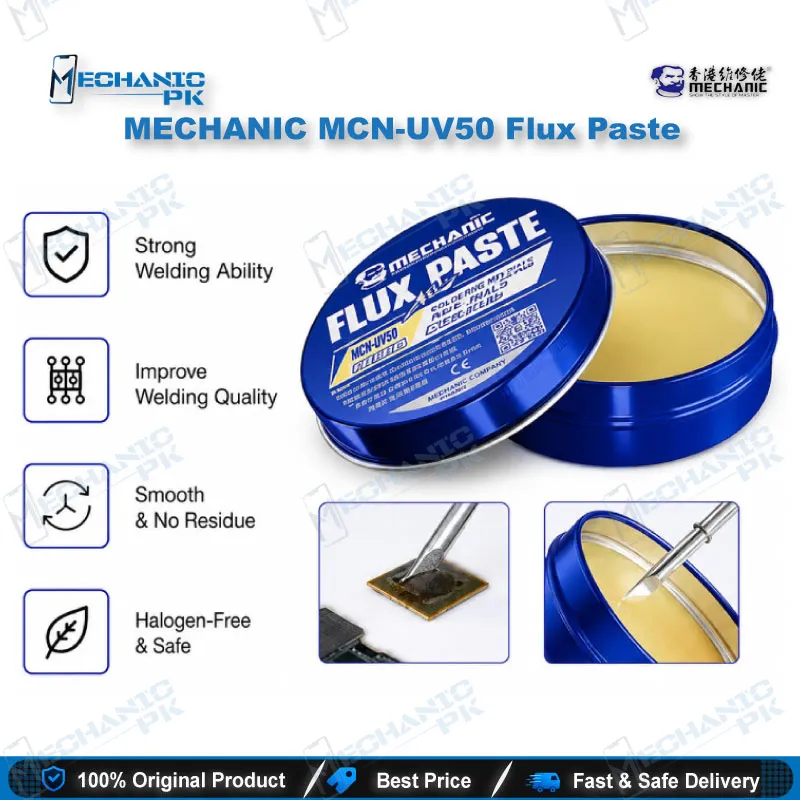
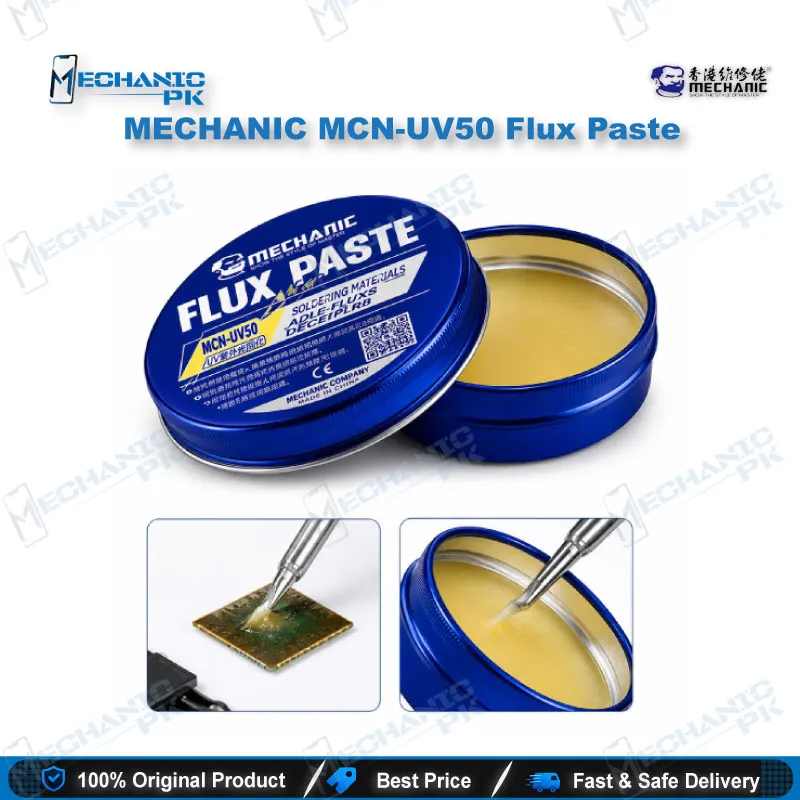

MECHANIC MCN-UV50 Rosin BGA Flux Paste
₨ 450
BGA Flux Paste for Mobile Repair, MCN-UV50
The MECHANIC MCN-UV50 is a rosin-based, no-clean BGA flux paste built for chip-level work on smartphone boards. You apply a thin film to the pad, and the paste clears oxide so solder wets the joint and flows bright and full. It has a mild pH, does not corrode ICs or PCB pads, and leaves a transparent residue that needs no washing. It suits BGA, PGA, SMD, and general PCB rework. Keep it next to your hot air station for reballing, IC replacement, and cold-joint repair.
In stock
BGA Flux Paste for Mobile Repair: MECHANIC MCN-UV50 Rosin-Based Flux
The MECHANIC MCN-UV50 is a rosin-based, no-clean BGA flux paste for mobile repair benches that do chip-level work every day. You apply it between the board pad and the solder ball or component lead, and it clears oxide so molten solder wets the joint cleanly. Technicians in Pakistan use this class of flux for BGA reballing, PGA and SMD replacement, and general PCB rework on dead phone boards. The paste has a mild pH, leaves a transparent residue, and does not corrode ICs or copper traces, so you protect the board while you work. It comes in a plastic container that is easy to store and reach on a busy bench.
How the rosin-based formula behaves during rework
Rosin-based flux paste does three jobs under hot air or an iron: it strips surface oxide, it carries heat across the joint, and it blocks re-oxidation while the alloy flows. The product data lists the MCN-UV50 viscosity at 0.2 Pa·s, so the paste holds its position on a pad instead of running into neighbouring balls. The same data states that its boiling point sits slightly above the melting point of the solder, so the flux stays active through the reflow window and does not burn off before the joint wets. You get bright, full solder joints and fewer false-solder and cold-joint faults when you apply a thin, even layer. Keep your hot air temperature inside the profile your alloy and board need. The flux supports the process, but it does not replace correct heat control.
No-clean residue and board safety
After reflow, the MCN-UV50 leaves a transparent residue, and the specification says normal repairs need no washing. That saves a cleaning step on high-volume days. You still use IPA and a brush on boards where you want a spotless finish, such as before conformal coating or before you photograph a repair for a customer. The mild pH means the paste does not attack IC balls, pads, or solder mask while it sits on the board. Store the container closed and in a cool place, because heat and air thicken rosin paste over time. Wear gloves, avoid prolonged skin contact, keep the paste away from food and drink, and do not breathe the fumes. Ventilate your bench or run a fume extractor.
Using BGA flux paste for mobile repair on your bench
You reach for this paste at several points in a hardware repair. When you lift a CPU, eMMC, UFS, or power IC with hot air, you clean the pads, add fresh paste, and reball through a stencil. When you refit the chip, a thin film on the pads helps the balls collapse and settle evenly. For small SMD parts such as capacitors, connectors, and charging port pads, you place a dab of paste and work with your soldering iron. Faults like charging issue, display problem, network issue, or a dead phone often trace back to a lifted or cold joint, and reflowing with fresh flux frequently restores contact. Pair the paste with a hot air station for heat, a microscope for inspection, a reballing kit for BGA work, and solder wick to clear old tin before you reapply. If you need precision dosing, browse the flux syringes and soldering consumables in the same category.
| Weight | 0.4 kg |
|---|
Key Features
- Rosin-based BGA solder flux paste
- No-clean formula with transparent residue
- Mild pH, no corrosion to IC or PCB
- Strong insulation properties
- Boiling point slightly above solder melting point
- Viscosity of 0.2 Pa·s for controlled placement on pads
- Bright, full joints with fewer false-solder faults
- Suits PCB, BGA, PGA, and SMD repair
Specifications
| Brand | MECHANIC |
|---|---|
| Model | MCN-UV50 (UV50) |
| Category | Soldering Consumables > Flux Paste |
| Compatibility | PCB, BGA, PGA, and SMD soldering |
| Supported Devices | Universal, not device-specific |
| Technology | Rosin-based, no-clean paste flux |
| Material | Plastic container with rosin-based paste |
| Viscosity | 0.2 Pa·s |
Common Repair Uses
- BGA reballing of CPU, eMMC, UFS, and power ICs
- IC change karna with hot air reflow
- Reflowing cold or lifted joints on dead phone boards
- SMD capacitor, resistor, and connector replacement
- Charging port pad rework for charging issue faults
- PGA package soldering
- Tinning pads before component placement
- Jumper lagana on damaged traces and pads
Compatible Devices
- Universal, not device-specific. Verified scope covers smartphone and PCB soldering with BGA, PGA, and SMD packages.
- Universal flux, not tied to a single phone brand
- Smartphone motherboards
- BGA ICs, including reballed chips
- PGA packages
- SMD components
- Bare PCB pads and traces
- Chip-level welding on PC cards and electronic boards
- General electronic parts repair
FAQ
What is the product name?
What is the brand of this product?
What is the model of this product?
What is this product used for?
Which devices are compatible with this product?
Who should use this product?
Do I need to clean MCN-UV50 flux residue after BGA reballing?
Is MCN-UV50 flux safe for IC pads and PCB traces?
Related products