

















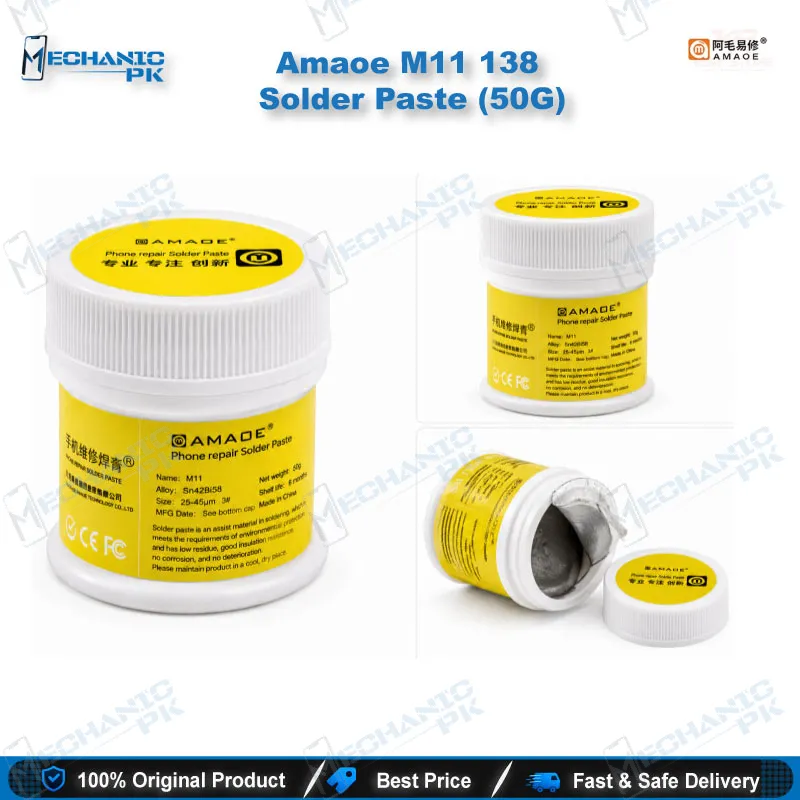
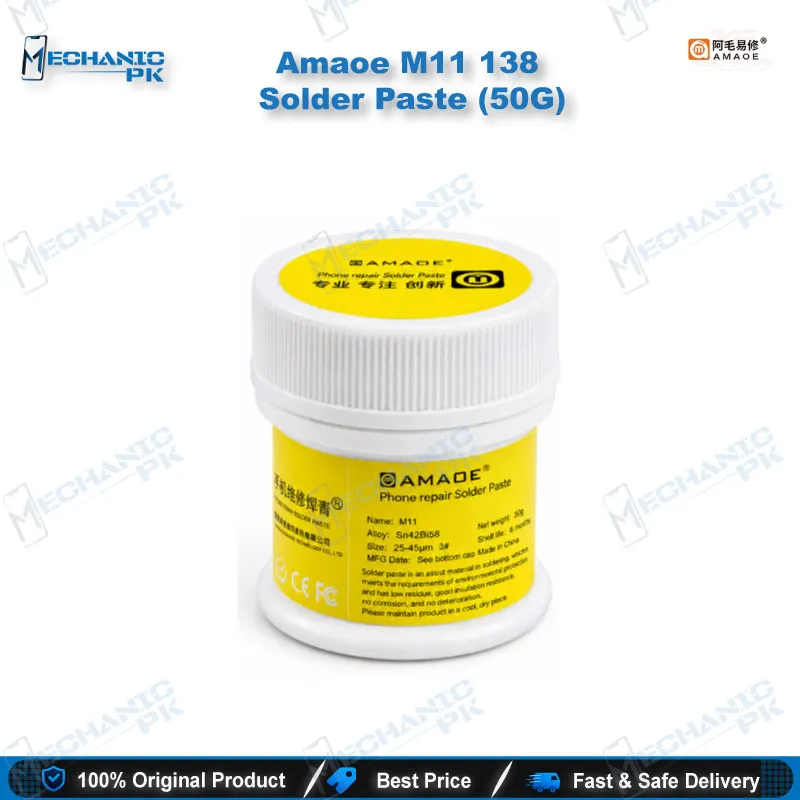
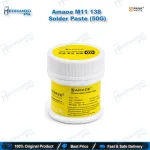
Amaoe M11 138 Solder Paste 50g Sn42Bi58 Low Temp
₨ 1,200
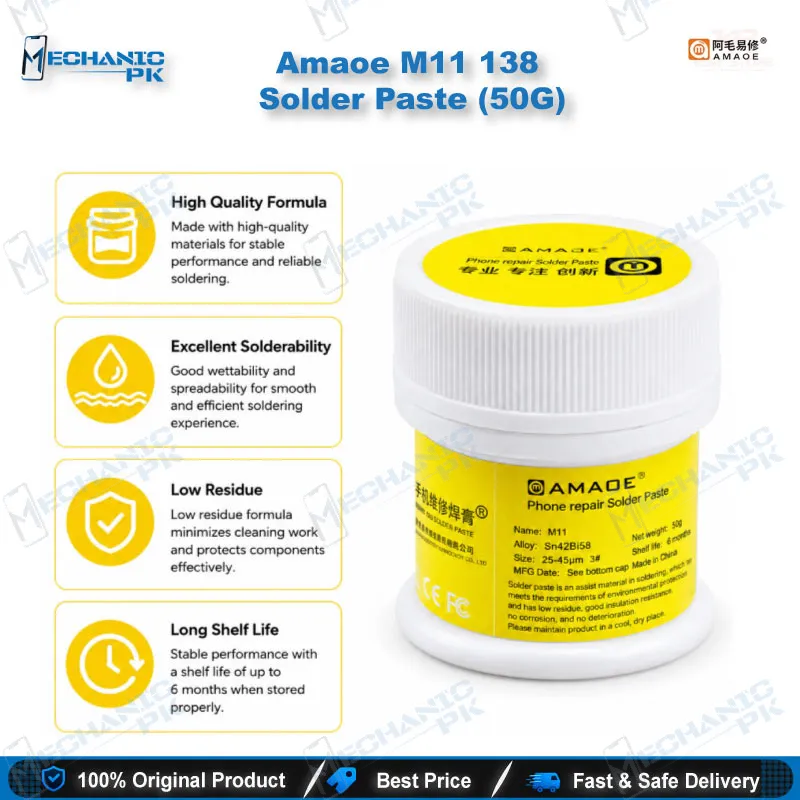
Amaoe M11 Sn42Bi58 Solder Paste for Low-Temperature Phone Repair
The Amaoe M11 138 delivers a Sn42Bi58 alloy with a 138°C melting point, giving you a lower-heat option for BGA reballing and SMD work on mobile motherboards. The pack holds 50g of paste, a practical quantity for pad tinning and ball planting on your repair bench. The low melt point helps when a board or nearby component cannot tolerate the higher temperatures of standard lead-free paste. Choose it when you need controlled reflow on heat-sensitive phone PCBs or a gentler thermal profile for a chip change. Pair it with your hot air station and reballing stencil for consistent results.
In stock
Sn42Bi58 Solder Paste: Amaoe M11 138 for Low-Temperature Mobile Repair
Sn42Bi58 solder paste is a low-temperature alloy built from 42 percent tin and 58 percent bismuth. The Amaoe M11 138 applies that chemistry to mobile phone repair, where its 138°C melting point matters on boards that suffer from heat damage. Technicians reach for this class of paste when a standard high-temperature alloy would stress nearby components, lift pads, or distort a thin logic board during rework. Your repair bench gets a workable paste for BGA reballing, pad tinning, and small SMD tasks on phone motherboards. Knowing where this paste fits in your workflow helps you choose the right reflow profile, keep joints uniform, and avoid cold joints on the pads you rebuild.
Where This Paste Fits in Your BGA Workflow
Most BGA jobs follow a clear sequence: lift the chip, clean the pads, apply fresh solder, and reflow. The Amaoe M11 138 sits at the paste application and reflow stages, where you need a consistent deposit that holds its shape on every pad. Use it only after you have cleared old solder with flux and wick, because leftover oxide or residue weakens each joint you make. Apply a thin, even layer through a stencil or with a fine tip, then align the chip carefully before any heat goes in. When you handle an IC change karna job, pad cleanliness matters far more than paste quantity, so inspect the pads under magnification first. A clean pad array lets the low-melt alloy wet evenly and form uniform joints across the whole chip. Treat each step as a link in the chain, because a weak step at the pad stage shows up later as a dead phone after the board returns to the customer.
Why Sn42Bi58 Solder Paste Suits Heat-Sensitive Phone Boards
Standard lead-free alloys melt at much higher temperatures, and that heat can damage plastic connectors, flex sections, and sensitive ICs on a board. A 138°C alloy lowers the thermal load on surrounding parts during reflow, which reduces the risk of secondary damage after the chip is back in place. This matters most on older handsets, boards with heat-sensitive modules, and repairs where board warpage would make alignment difficult. Bismuth-rich alloys carry one clear trade-off: joints can become more brittle under bending stress. Avoid relying on this paste for connectors that flex every day, and keep the finished board free from mechanical strain while it cools. Used in the right place, a Sn42Bi58 solder paste protects the parts around the joint while still giving you a solid, reliable connection.
Handling and Application on Your Bench
Keep the paste sealed between sessions, because exposure to air dries the flux and reduces wetting over time. Warm the paste slightly if it feels stiff, and avoid overheating it, since changes in viscosity can disrupt your deposit. Dispense small dots rather than large blobs, because excess paste bridges fine-pitch pads on phone BGA chips and causes shorts that cost you time. Clean the board with isopropyl alcohol once it cools, especially if the flux leaves a film that can attract dirt and affect later testing. Test your setup on a scrap board before you commit to a valuable chip. That single step confirms wetting, joint shape, and reflow timing on your own equipment, so the real repair runs with fewer surprises and less rework.
| Weight | 0.50 kg |
|---|
Key Features
- Sn42Bi58 lead-free low-temperature alloy
- 138°C melting point for heat-sensitive boards
- 50g net paste content
- Suited to BGA reballing and SMD rework
- Lower reflow temperature reduces thermal stress on nearby parts
- Fits common hot air rework and reballing stencil workflows
- Supports pad tinning and ball planting tasks
- Practical choice for mobile repair technicians and service centers
Specifications
| Brand | Amaoe |
|---|---|
| Model | M11 138 |
| Category | Solder Paste |
| Compatibility | Universal, not device-specific |
| Supported Devices | Mobile phone motherboards and BGA chips |
| Technology | Low-temperature lead-free Sn42Bi58 alloy, 138°C melting point |
| Weight | 50g |
Common Repair Uses
- Real workflows where a 138°C alloy fits phone board repair.
- Reballing BGA chips after an IC change on phone logic boards
- Pad tinning before placing a replacement chip
- Ball planting on CPU and power IC pads through a stencil
- Touch-up of tinned or lightly lifted SMD pads on mobile PCBs
- Low-temperature reflow for heat-sensitive board sections
- Attaching small SMD parts where high-heat paste could damage nearby components
- Pad repair where a fine joint needs a low-temperature alloy
- Rework on dead phone boards where heat damage must stay limited
Compatible Devices
- Universal, not device-specific. Scope covers mobile phone PCBs and BGA packages.
- Mobile phone motherboards for general BGA and SMD work
- BGA chip reballing on phone logic boards
- Small SMD components on phone PCBs
- Pad tinning and ball planting on mobile ICs
- Heat-sensitive phone PCB sections that need a lower reflow temperature
- Hot air rework stations used for phone board reflow
- Fine-tip dispensing for pad touch-ups
- Mobile repair benches handling low-temperature alloys
FAQ
What is the product name?
What is the brand of this product?
What is the model of this product?
What is this product used for?
Which devices are compatible with this product?
Who should use this product?
What melting point does the Amaoe M11 138 solder paste have?
Is Sn42Bi58 solder paste lead-free?
Related products