















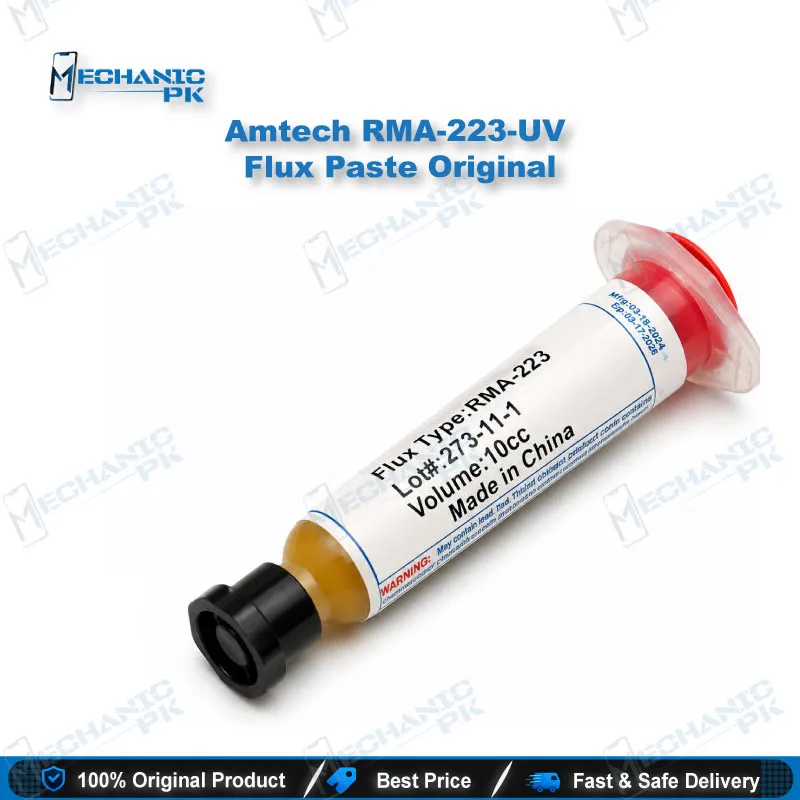
Amtech RMA-223-UV Flux Paste – Tacky BGA Rework Flux
₨ 1
Amtech RMA-223-UV Flux Paste for Controlled BGA Rework
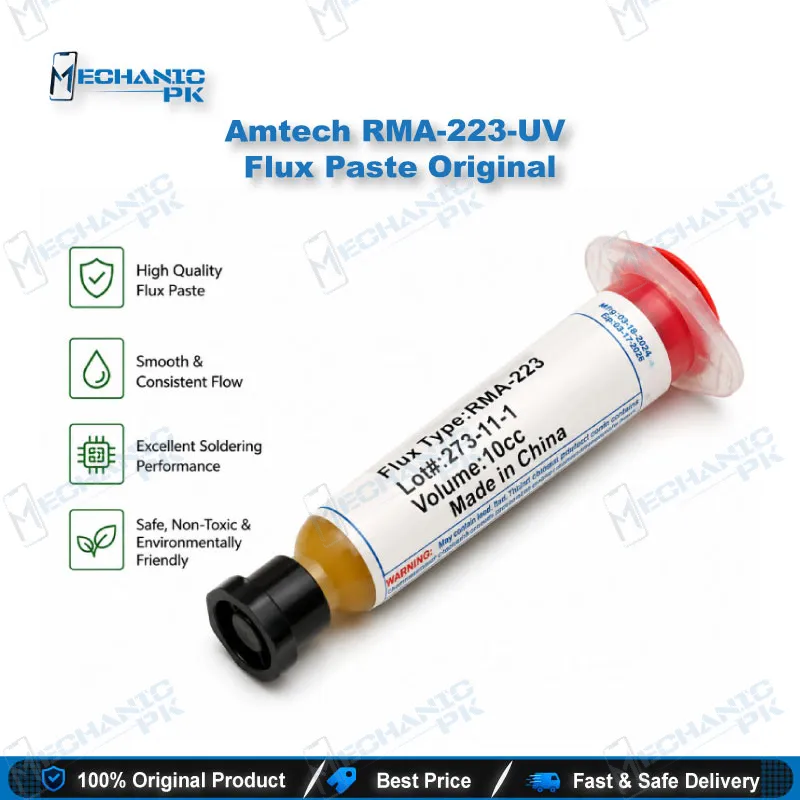
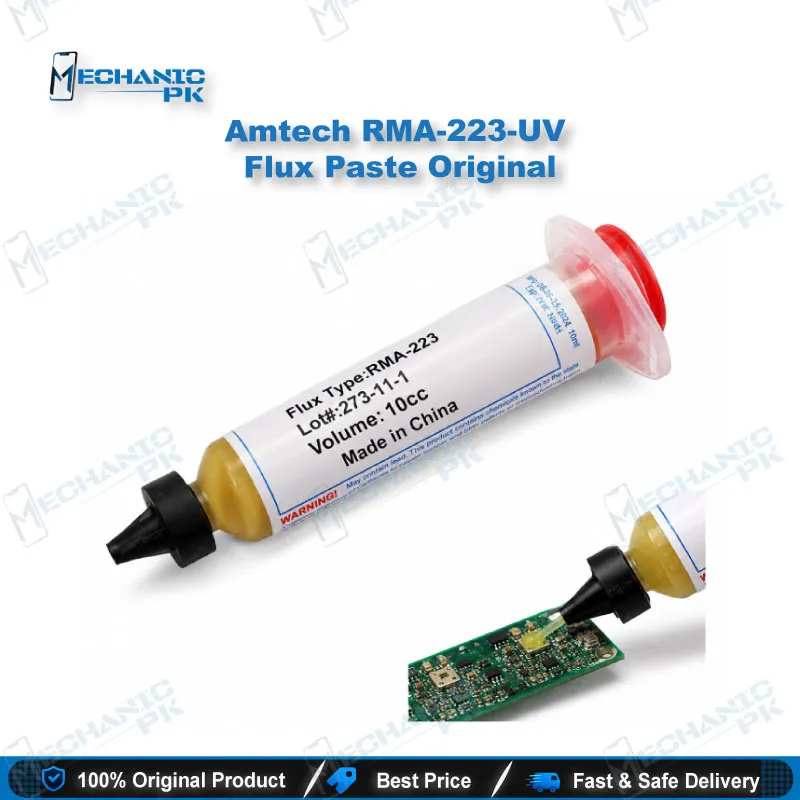
Amtech RMA-223-UV flux paste is a rosin-based, mildly active, no-clean tacky flux for syringe dispensing, stencil printing, BGA sphere attachment, and reballing. Amtech formulates it for tin/lead alloys. A built-in UV tracer shows flux splatter and leftover residue under UV light. The flux is halide-free (below 0.05%), carries a ROL0 classification, and tolerates temperatures up to 300°C. You get stable tack that holds solder spheres in place and a clean reflow on eMMC, CPU, and PMIC packages. Mechanicpk supplies it for technicians who need predictable behavior at the rework station.
Out of stock
Amtech RMA-223-UV Flux Paste for Precision PCB Rework
Amtech RMA-223-UV flux paste is a rosin-based, mildly active, no-clean tacky flux that suits syringe dispensing, stencil printing, BGA sphere attachment, and reballing on tin/lead alloys. The paste carries a UV tracer, so you can check for splatter and residue after the job. Its viscosity sits well above liquid flux, which means the paste stays where you place it while you align a stencil or seat solder spheres. If you reball eMMC, CPU, or PMIC packages on your repair bench, this flux gives you a controlled tack and a clean reflow window.
Rosin Mildly Active Chemistry and Tacky Consistency
The formulation uses rosin with mild activation, and Amtech rates it ROL0. That classification describes a non-corrosive flux that does not short components. The halide content stays below 0.05%, and the product complies with REACH regulations. The paste tolerates temperatures up to 300°C (600°F), so it survives the hot air profiles you run on BGA packages without drying out early.
Amtech specifies a viscosity range of 43 to 71 (Malcom at 10 RPM and 25°C, x10³ mPa·s). In practice, that thickness gives you a tack that grips solder spheres and resists slumping when you heat the board. You can push the paste through a syringe tip for controlled dots or lines, and you can spread it thinly across a stencil. The product ships with a dispensing tip and plunger for manual flow control, and Amtech designs the syringe for professional use with pneumatic dispensing machines. Store it at room temperature and keep it out of the refrigerator.
UV Tracer and Residue Cleaning Practice
The UV tracer separates this flux from plain rosin paste. Shine a UV light across the board after reflow and any splatter or leftover flux glows, which tells you where to clean before you close the phone. You catch stray flux near fine-pitch pads and test points that the naked eye misses.
Amtech recommends removing all residue every time. Non-activated residue can absorb moisture from the air and cause corrosion or voltage leakage on high-impedance circuits. You can remove it with hot air, a foam swab, and common solvents such as isopropanol or d-limonene. For a dead phone that returns with a charging issue or a hang on logo after rework, residue under a package is a fault you can avoid with a disciplined clean-up step.
Workflow Fit and Alloy Limits
Use this paste in the rework stage of PCB repair: lifting a BGA with a hot air station, cleaning the pads, applying tacky flux, placing spheres through a stencil, and reflowing the package. It pairs with reballing kits, BGA stencils, preheaters, and hot air stations from the Mechanicpk soldering range. When you move from basic reballing to heavier work such as eMMC or UFS replacement, the same paste carries over to the larger packages.
Check your solder alloy before you open the syringe. Amtech formulates RMA-223-UV for standard tin/lead alloys and states it does not suit lead-free metals. Technicians who reball with lead-free spheres need a flux made for that alloy family. For tin/lead work, this paste gives you a repeatable tack, a clear residue check, and a documented ROL0 chemistry.
| Weight | 0.5 kg |
|---|
Key Features
- Rosin-based, mildly active, no-clean tacky flux
- ROL0 classification (non-corrosive, does not short components)
- UV tracer reveals splatter and residue under UV light
- Halide-free (below 0.05%) and REACH compliant
- Tolerates temperatures up to 300°C (600°F)
- Viscosity 43–71 (Malcom, 10 RPM, 25°C) for controlled tack
- Syringe format with dispensing tip and plunger for manual flow control
- Removes with hot air, foam swab, isopropanol, or d-limonene
Specifications
| Brand | Amtech |
|---|---|
| Model | RMA-223-UV |
| Category | Tacky Solder Flux Paste |
| Compatibility | Standard tin/lead solder alloys (not suitable for lead-free metals) |
| Supported Devices | Universal – not device-specific |
| Technology | Rosin mildly activated (RMA), no-clean, tacky flux, ROL0 classification, UV tracer, halide-free (below 0.05%), REACH compliant |
| Maximum Temperature Tolerance | 300°C / 600°F |
| Viscosity | 43–71 (Malcom, 10 RPM, 25°C, x10³ mPa·s) |
Common Repair Uses
- Reballing an eMMC or eMCP chip after removal
- Reflowing a BGA IC for a boot loop issue
- Replacing a PMIC for a charging issue or dead phone
- Re-attaching a CPU or SoC package with fresh tin/lead spheres
- Holding solder spheres in place on a BGA stencil
- Applying controlled flux dots by syringe during IC change
- Checking for flux splatter near test points with a UV light
- Preparing pads before ISP or eMMC re-soldering
Compatible Devices
- Universal flux – works with tin/lead rework on any board, not tied to specific phone models
- BGA packages reballed with tin/lead solder spheres
- eMMC and eMCP chips during replacement or reballing
- CPU and SoC packages on smartphone mainboards
- PMIC and charging IC packages
- Audio and Wi-Fi/Bluetooth ICs in BGA form
- Stencil-based reballing setups
- Hot air rework stations and preheaters
- Tin/lead solder paste and sphere workflows
FAQ
What is the product name?
What is the brand of this product?
What is the model of this product?
What is this product used for?
Which devices are compatible with this product?
Who should use this product?
Can I use Amtech RMA-223-UV flux paste with lead-free solder balls?
Do I need to clean RMA-223-UV flux residue after reballing?
Related products