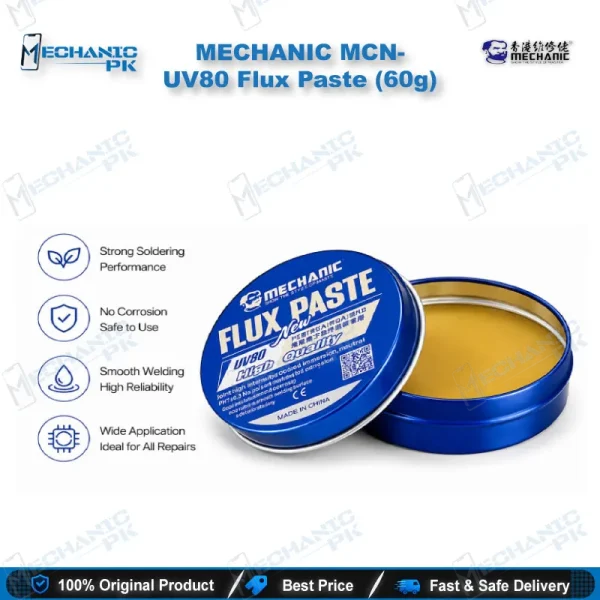
















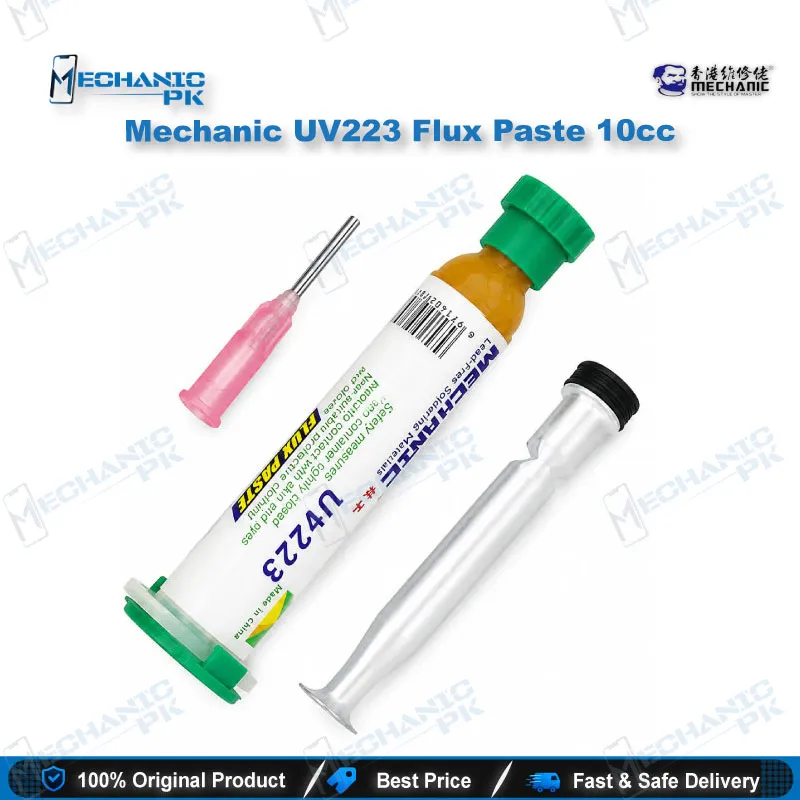
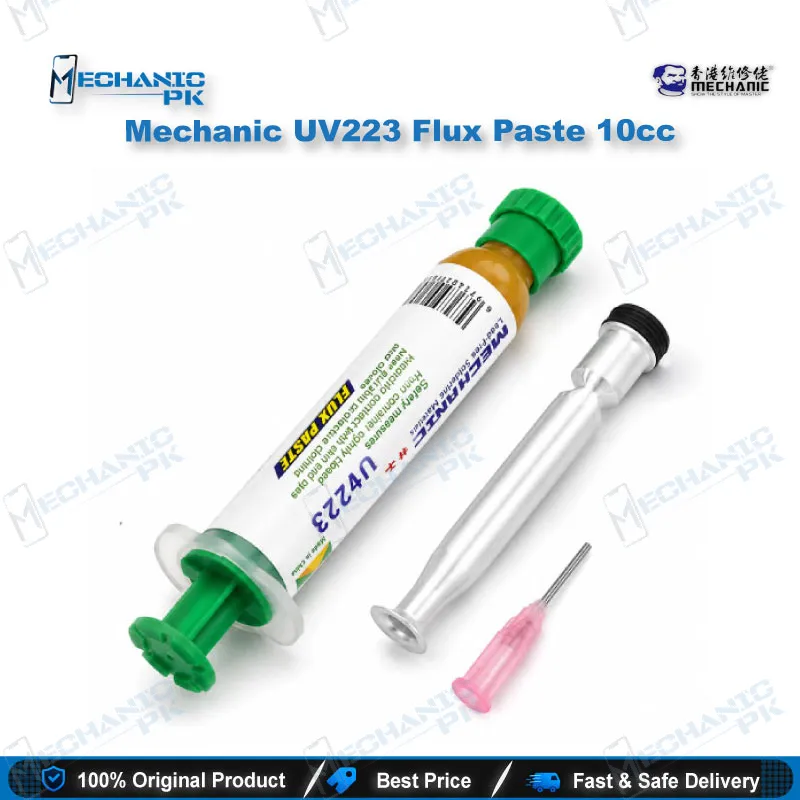
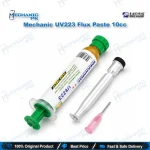
Mechanic UV223 No-Clean Flux Paste 10cc for BGA Rework
₨ 350
Mechanic UV223 Flux Paste: No-Clean Lead-Free Flux for Mobile PCB Rework
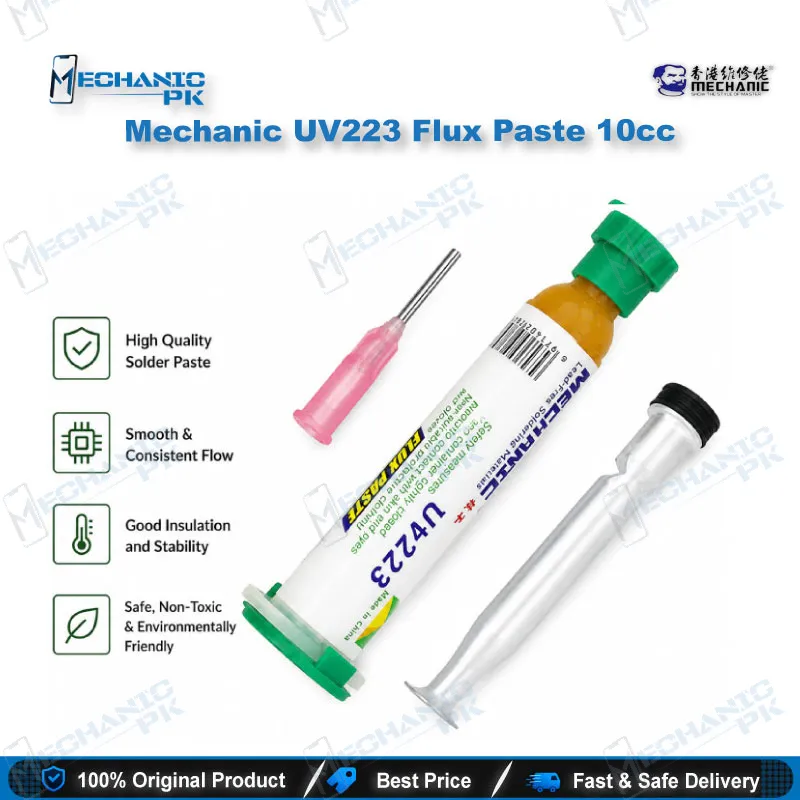
Mechanic UV223 flux paste is a lead-free, no-clean paste flux in a 10cc syringe. The non-acid formula targets BGA, SMD, and PGA rework on mobile phone and tablet PCBs. You get controlled placement under chips, good solderability, low spatter, and a very pale residue after reflow. The paste suits CPU, eMMC, UFS, and PMIC reballing, as well as pad cleanup and general micro-soldering on a repair bench. Pair it with a hot air station and a quality reballing kit for consistent joints on every rework job.
In stock
Mechanic UV223 Flux Paste 10cc for Clean BGA and SMD Rework
Mechanic UV223 flux paste is a no-clean, lead-free paste flux in a 10cc syringe, built for reflow and rework on mobile phone PCBs. The non-acid formulation lets you apply it under BGA packages, around SMD pads, and on PGA pins without worrying about long-term corrosion on the board. If your bench handles CPU, eMMC, UFS, and PMIC rework every day, UV223 gives you a controlled paste that stays where you place it and leaves very little residue behind.
How UV223 Behaves on the Board
UV223 is a paste-type flux, so it holds its position on a vertical or tilted board instead of running off the pad the way liquid flux does. That matters when you lift a BGA IC from a dense motherboard and need the flux to stay under the package during reflow. The formula targets good solderability with low spattering, which keeps nearby small passives and connectors clean.
The no-clean design means the residue after heating is very pale and non-corrosive. You can leave a thin film on non-critical areas, or wipe it with isopropyl alcohol when you want a clear view of the joints under your microscope. The lead-free formulation also suits modern boards that use lead-free solder, while the non-acid chemistry protects traces and pads during repeated rework passes.
Where It Fits in Your Rework Workflow
In a typical GSM hardware workflow, you diagnose the fault first, then decide whether the repair needs an IC change, a reball, or a pad repair. UV223 enters at the rework stage. You apply a thin layer on the cleaned pads before you place a reballed IC. You add a small amount under the package edge before you reflow a chip in place. You also use it for tinning pads and for lifting and re-seating SMD components.
Technicians use this type of flux for dead phone cases after a failed IC replacement, charging issue repairs that involve the charging IC or PMIC, and eMMC or UFS replacement before reprogramming. Because the paste works across BGA, PGA, and SMD packages, one syringe covers most of the small rework jobs on your repair bench. For stencil-based reballing, keep a dedicated reballing kit and a precise hot air station beside it, and add a lead-free solder paste or ball set matched to the IC.
Application and Handling Practice
Dispense a small bead rather than a thick layer. Excess paste boils during reflow and can push solder balls out of position. Use the needle tip to place flux directly on the pad area, then spread it thinly with a clean brush or the tip itself. Work in a ventilated space, since any flux produces fumes when you heat it, and the low-smoke character of UV223 reduces but does not remove that need.
Cap the syringe after each use and store it away from heat so the paste keeps its consistency. If you move up to higher-volume work, consider a larger flux option from the same range. For finer micro-soldering where you need extra wetting control, a nano flux paste makes a logical upgrade path from UV223. Keep a soldering station and a microscope on the same bench so you can inspect the joint quality after each rework pass.
| Weight | 0.1 kg |
|---|
Key Features
- No-clean, non-acid paste flux
- Lead-free, environmentally friendly formulation
- Good solderability with low spattering
- Very pale, non-corrosive residue
- Paste consistency that stays in place on the board
- Suits BGA, SMD, and PGA rework
- 10cc syringe for controlled dispensing
- Mobile phone and PCB repair use
Specifications
| Brand | Mechanic |
|---|---|
| Model | UV223 |
| Category | Soldering Flux Paste |
| Technology | No-clean, lead-free, non-acid paste flux |
| Compatibility | BGA, SMD, and PGA rework on mobile phone, tablet, and computer PCBs |
| Volume | 10cc syringe |
Common Repair Uses
- BGA IC reflow and replacement on dead phone boards
- Reballing CPU, eMMC, and UFS chips
- Charging issue repair involving the charging IC or PMIC
- Pad tinning and pad cleanup after IC removal
- SMD component replacement
- Rework after a failed hot air attempt
- Connector and FPC pad soldering
- Display problem repair that involves board-level components
Compatible Devices
- Universal — process-level compatibility, not device-specific
- Mobile phone motherboards (all brands)
- Tablet PCBs
- Computer and laptop board chips
- BGA packages: CPU, eMMC, UFS, PMIC
- PGA packages
- SMD resistors, capacitors, and inductors
- Charging IC and audio IC footprints
- Connector pads and FPC solder points
FAQ
What is the product name?
What is the brand of this product?
What is the model of this product?
What is this product used for?
Which devices are compatible with this product?
Who should use this product?
Is Mechanic UV223 flux paste acid-free for PCB rework?
Do I need to clean UV223 flux residue after BGA rework?
Related products