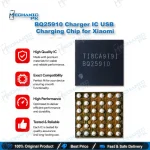
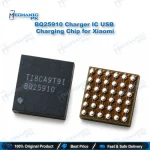
BQ25910 Charger IC USB Charging Chip for Xiaomi | 6A
₨ 600
BQ25910 Charger IC — 6A Parallel Charging Chip for Xiaomi Boards
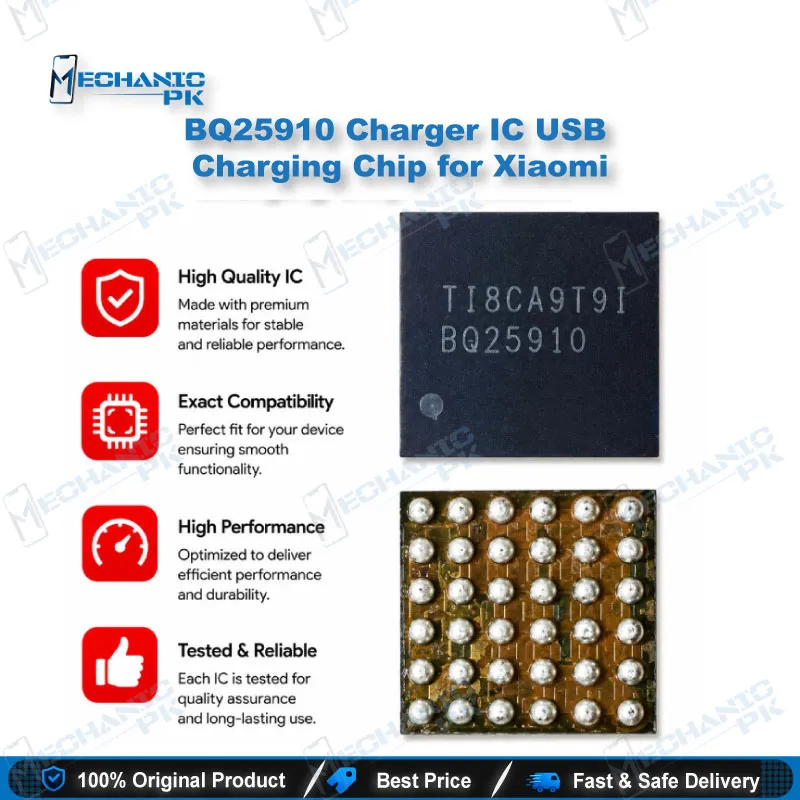
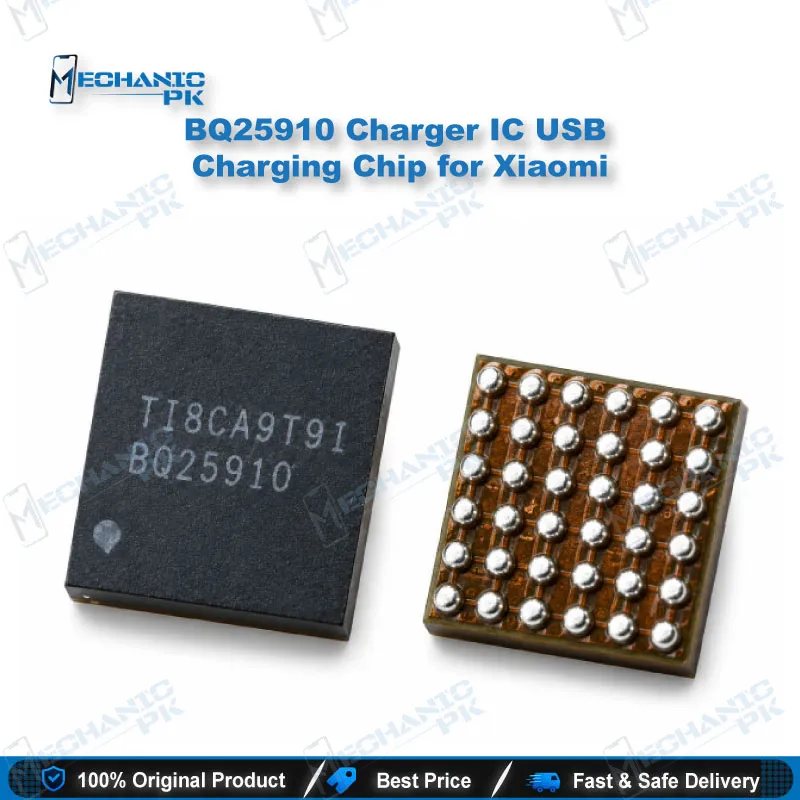
The BQ25910 Charger IC USB Charging Chip for Xiaomi is a Texas Instruments three-level buck parallel charger that works alongside the main charger and supports up to 6A of charge current for a single-cell Li-ion or Li-polymer battery. It accepts a 3.9V to 14V input, switches at 750kHz, and reports status to the host processor over I2C. Technicians use this charger IC on Xiaomi boards that show not-charging, slow-charging, or shorted charger-section faults after board diagnosis. The chip comes in a 36-ball DSBGA package, so plan the replacement with a hot air station, quality flux, and a microscope.
BQ25910 Charger IC USB Charging Chip for Xiaomi — 6A Three-Level Parallel Charger
The BQ25910 Charger IC USB Charging Chip for Xiaomi is a Texas Instruments single-cell parallel charger that shares the fast-charging load with the main charger on Xiaomi logic boards. When a Xiaomi handset arrives with a charging issue and board diagnosis traces it to the secondary charger section, the BQ25910 charger IC is the exact replacement part you need. Mechanicpk supplies this chip for technicians who work at IC level and expect the correct silicon, not a near match.
What the BQ25910 Charger IC Does Inside a Xiaomi Phone
TI built the BQ25910 as a parallel battery charge manager for single-cell Li-ion and Li-polymer packs. It does not replace the master charger; it works next to it. In a dual-charger layout, the master charger handles system power and charge termination while the BQ25910 adds current during the fast-charge phase. Splitting the current between two chips keeps each one cooler and lets the phone accept higher charge currents from a quick-charge adapter. The chip supports up to 6A of charge current and talks to the host processor over I2C, so the phone’s software sets current limits, reads charging status, and receives fault interrupts directly from it.
Three-Level Buck Architecture and Efficiency
Most phone chargers use a conventional two-level buck converter. The BQ25910 uses a three-level buck topology with a flying capacitor balanced at half the input voltage. This halves the volt-seconds across the inductor, cuts ripple, and allows a low-profile inductor on a crowded board. TI rates the chip at 95.4% charge efficiency at 1.5A from a 5V input and 93.3% at 3A from a 9V input, with a 750kHz switching frequency. For a technician, this matters at the bench: a healthy parallel charger runs cool, so a BQ25910 that heats up fast on a known-good adapter points straight to an internal fault or a problem in its surrounding components.
Input Range, Protection and Control
The chip accepts a 3.9V to 14V input range with a 20V absolute maximum rating, which covers standard USB 5V input and adjustable high-voltage adapters. Input voltage limit regulation (VINDPM) up to 14V lets it track the maximum power a weak adapter can deliver. On the protection side, the BQ25910 integrates a reverse-blocking FET, input over-voltage and poor-source detection, flying capacitor over- and under-voltage protection, a charging safety timer, and differential battery voltage remote sensing for accurate regulation. These protections explain a common bench symptom: when one of them trips, the phone often falls back to slow charging instead of failing completely.
Where It Fits in Your Repair Workflow
Charging faults on Xiaomi boards usually start at the USB connector and flex, then move into the charger section. Measure the VBUS and battery lines with a multimeter in diode mode, compare readings against a known-good board, and check the charger rails for a short. A thermal camera or rosin test under a DC power supply quickly exposes a shorted BQ25910. Once you confirm the chip has failed after a faulty high-voltage adapter, liquid damage, or a short, IC replacement becomes the clean fix. Treat a dead phone with care here: rule out the PMIC and master charger first, since a fault in either can produce similar symptoms.
Replacement Tips for the 36-Ball DSBGA Package
TI ships the BQ25910 in a 36-ball DSBGA (YFF) wafer-level package measuring roughly 2.63 × 2.46 mm. Wafer-level parts have no plastic mold over the die, so excess heat or tweezer pressure cracks them. Mount the board in a PCB holder, apply quality flux, and use controlled airflow from your hot air station. Clean the pads with a soldering station and desoldering wick, then inspect the footprint under a microscope before you place the new chip. If the IC needs fresh balls, a stencil from a reballing kit gives even ball height. After installation, check current draw on a known-good adapter and confirm fast charging returns.
Why Source the BQ25910 Charger IC from Mechanicpk
Mechanicpk stocks IC-level parts for repair centers and professional technicians across Pakistan. The BQ25910 sits in our charging IC range alongside the equipment that board-level work demands: hot air stations, soldering stations, microscopes, multimeters, PCB holders, and reballing kits. You source the chip and the rework tools from one distributor. Match the marking on the original part before ordering, and contact our team if you need help confirming the footprint on your Xiaomi board.
| Weight | 0.1 kg |
|---|
Key Features
- Parallel charger operation for fast charging in a dual-charger configuration
- Three-level buck converter that halves inductor volt-seconds and reduces ripple
- Up to 6A charge current for single-cell Li-ion and Li-polymer batteries
- 95.4% charge efficiency at 1.5A from 5V and 93.3% at 3A from 9V
- 3.9V to 14V input range with 20V absolute maximum rating
- I2C interface for host-controlled current limits, status, and fault interrupts
- Integrated reverse-blocking FET, input OVP, and flying capacitor OVP/UVP protection
- Compact 36-ball DSBGA package for space-limited phone boards
Specifications
| Brand | Texas Instruments (TI) |
|---|---|
| Model | BQ25910 (orderable variants BQ25910YFFR / BQ25910YFFT) |
| Category | Mobile Phone ICs > Charging ICs |
| Compatibility | Single-cell Li-ion and Li-polymer parallel (dual-charger) charging systems |
| Supported Devices | Xiaomi boards that use the BQ25910 as the parallel charger |
| Technology | I2C-controlled three-level switch-mode buck parallel charger, 750kHz, up to 6A charge current |
| Input Voltage | 3.9V – 14V operating (20V absolute maximum) |
| Dimensions | 36-ball DSBGA (YFF), approx. 2.63 × 2.46 mm |
Common Repair Uses
- Restoring charging on Xiaomi phones with a not-charging fault traced to the parallel charger
- Fixing fast charging that drops to slow charging on a known-good adapter
- Replacing a shorted charger IC found on the VBUS or battery rail
- Repairing phones that stopped charging after a faulty or high-voltage adapter
- Charger-section rework after liquid damage and corrosion
- Resolving overheating in the charger area during charging
- Replacing a cracked chip after a failed earlier rework attempt
- Board-level restoration of dual-charger circuits on dead phone repairs
Compatible Devices
- Xiaomi logic boards that carry the BQ25910 in the parallel charger position (match the original part before replacement)
- Xiaomi 5A boards, which component suppliers list with the BQ25910 alongside BQ24259, BQ27426, and BQ24297 (confirm against your board)
- Single-cell Li-ion battery charging systems
- Single-cell Li-polymer battery charging systems
- Dual-charger fast-charging designs that pair a master charger with a parallel charger
- Designs with USB 5V input and adjustable high-voltage adapters up to 14V
- Boards with a 36-ball DSBGA (YFF) charger footprint
- Direct replacement for BQ25910YFFR and BQ25910YFFT parts
FAQ
What is the product name?
What is the brand of this product?
What is the model of this product?
What is this product used for?
Which devices are compatible with this product?
Who should use this product?
Can the BQ25910 charge a phone without the main charger IC?
What input voltage does the BQ25910 support for fast charging?
Related products