


























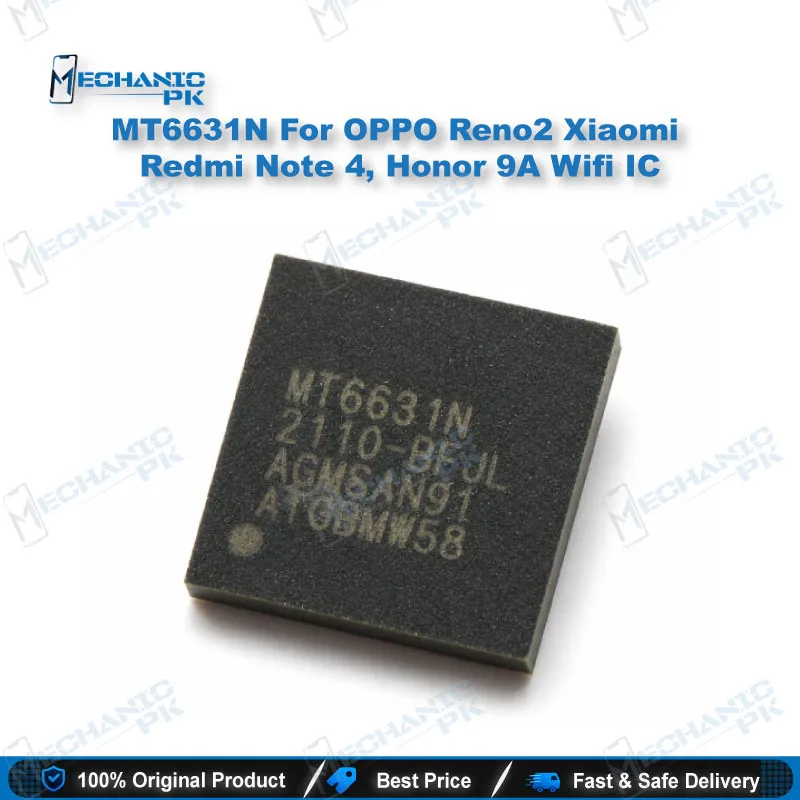
MT6631N WiFi IC for OPPO Reno2, Redmi Note 4, Honor 9A
₨ 250
MT6631N MediaTek 4-in-1 Connectivity IC for Board-Level Repair
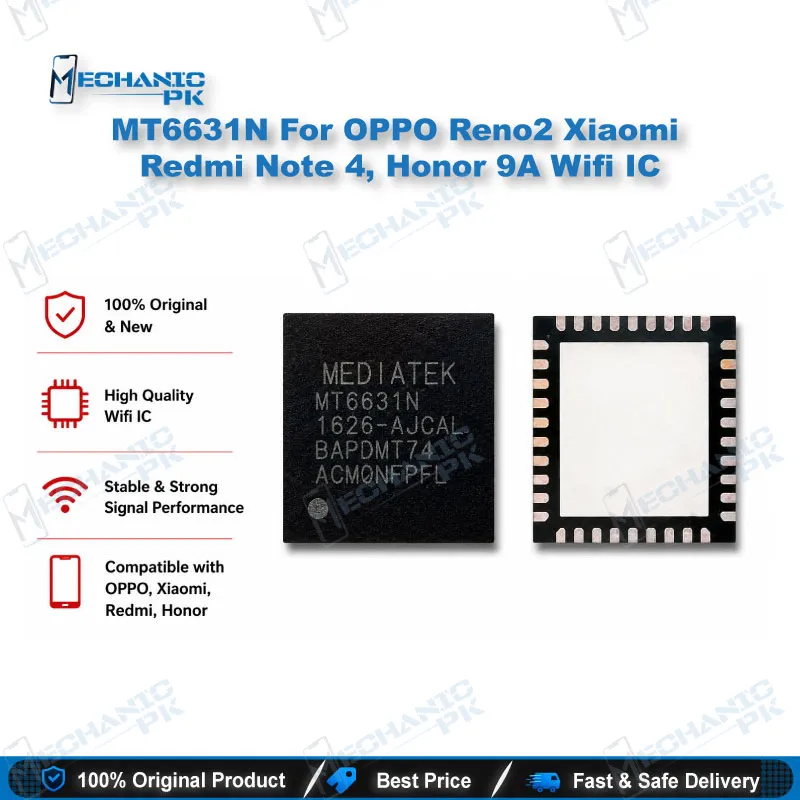
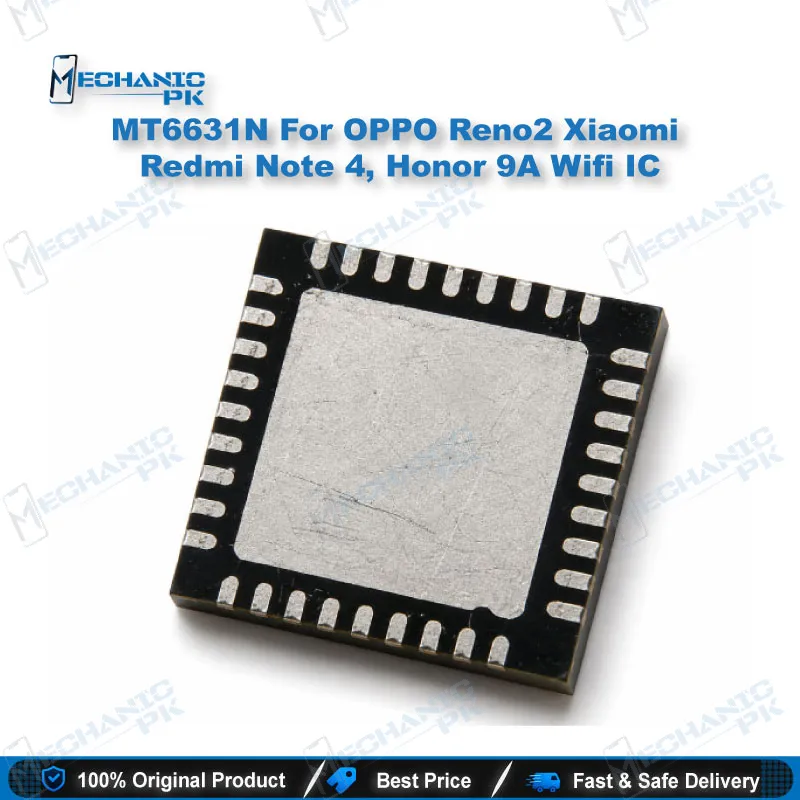
The MT6631N For OPPO Reno2 Xiaomi Redmi Note 4, Honor 9A Wifi IC is a MediaTek 4-in-1 RF connectivity chip that combines the front-ends for 2.4GHz Wi-Fi and Bluetooth, 5GHz Wi-Fi, a GPS receiver, and a complete FM receiver in one 40-pin QFN package. It supports dual-band single-stream 802.11a/b/g/n/ac and Bluetooth up to v4.1, and it works with a companion MediaTek modem that handles baseband processing. Technicians replace this MT6631N WiFi IC when Wi-Fi refuses to switch on, Bluetooth fails to scan, or GPS stops locking because of a hardware fault at the connectivity section of the board.
MT6631N WiFi IC: MediaTek Dual-Band Connectivity Front-End
The MT6631N For OPPO Reno2 Xiaomi Redmi Note 4, Honor 9A Wifi IC gives you an exact-match replacement for the connectivity chip on MediaTek-platform boards. MediaTek built the MT6631 as a 4-in-1 RF chip, so one faulty part can take out Wi-Fi, Bluetooth, GPS, and FM radio together. When a customer brings a phone with a greyed-out Wi-Fi toggle and no Bluetooth, this MT6631N WiFi IC belongs at the top of your diagnosis list.
Architecture and How the Chip Works on the Board
The MT6631N holds the RF transceiver front-ends, and the companion MediaTek modem chip holds the ADC/DAC and baseband processing for Wi-Fi, Bluetooth, and GPS. The FM section works differently: it integrates its own modem and ADC inside the MT6631N. The chip has no dedicated crystal oscillator and takes a 26MHz reference clock at its XO_IN pin from an external oscillator or the companion chip. An integrated passive device (IPD) die carries the 2.4GHz balun, matching networks, and GPS filtering, which lets the RF port connect to the antenna path through a 50-ohm trace. This architecture explains a common bench finding: a perfect-looking connectivity IC can still show no Wi-Fi when the reference clock, a supply rail, or the 2-wire control lines from the SoC fail.
Wi-Fi and Bluetooth Capability
On the Wi-Fi side, the MT6631N supports dual-band 2.4GHz and 5GHz single-stream 802.11a/b/g/n/ac with 20/40/80MHz channel bandwidth. The integrated 2.4GHz power amplifier delivers up to 20dBm CCK output, and the 5GHz PA reaches 17dBm at 54Mbps OFDM. The Bluetooth section complies with v2.1+EDR, v3.0+HS, and v4.1, with an integrated class 1 PA at 8dBm. MediaTek added concurrent reception of 2.4GHz Wi-Fi and Bluetooth over the older MT6625L, which keeps both radios working together without constant switching.
GPS and FM Radio Sections
The GPS receiver supports GPS, Galileo, Glonass, and Beidou, with simultaneous GPS + Glonass + Beidou/Galileo reception for faster position lock. Typical tracking sensitivity sits at -163dBm. The FM receiver covers 65–108MHz with RDS/RBDS support and works with both earphone (long) and FPC (short) antennas. So when a phone shows a network issue on Wi-Fi together with a GPS that never locks, the shared chip deserves suspicion before you chase individual antenna lines.
Power Rails and Diagnosis Points
The MT6631N runs on three supply rails: 1.8V for the Wi-Fi/Bluetooth radio and GPS/top logic, 2.8V for FM, and 3.3V for the Wi-Fi PA and transmit modulator. The 1.8V rail must come up before the 2.8V and 3.3V rails, otherwise the chip cannot function correctly. Before you commit to an IC change, measure these rails with a multimeter, confirm the 26MHz clock reaches XO_IN, and check continuity on the TOP_DATA and TOP_CLK control lines. A missing rail usually points to the PMIC or a damaged line rather than the IC itself, and a jumper repair often saves the board.
Replacement Workflow on Your Repair Bench
Mount the board in a PCB holder and inspect the connectivity area under a microscope for corrosion, cracked joints, or liquid damage. Remove the faulty chip with a hot air station, clean the pads with a soldering station and wick, and tin them evenly before placing the new MT6631N. QFN40 parts need careful ground-pad coverage, so a stencil from a reballing kit helps you control solder volume. MediaTek lists the chip as ESD sensitive, so handle it with grounded tweezers and an ESD mat.
Where This Part Fits in Your Workflow
The MT6631N WiFi IC sits in the IC-level repair stage, after software causes have been ruled out. If a phone needs reflashing after the repair, eMMC programmers, UFS adapters, ISP pinout tools, and test boxes cover the software side of the job. For buyers comparing connectivity parts, the MT6631N represents the newer MediaTek generation, so always match the original marking on the board before ordering.
| Weight | 0.1 kg |
|---|
Key Features
- 4-in-1 RF front-end covering Wi-Fi, Bluetooth, GPS, and FM in one chip
- Dual-band 2.4GHz and 5GHz single-stream 802.11a/b/g/n/ac support
- Channel bandwidth options of 20/40/80MHz
- Bluetooth v2.1+EDR, v3.0+HS, and v4.1 compliance with 8dBm class 1 PA
- Simultaneous GPS + Glonass + Beidou/Galileo reception
- FM receiver from 65–108MHz with RDS/RBDS
- Integrated passive device with balun and matching network
- Compact 40-pin QFN package with built-in thermal sensor
Specifications
| Brand | MediaTek |
|---|---|
| Model | MT6631N |
| Category | Mobile Phone IC / WiFi, Bluetooth, GPS and FM Connectivity IC |
| Compatibility | MediaTek-platform boards that originally carry the MT6631N |
| Supported Devices | OPPO Reno2 (MediaTek-platform variant), Xiaomi Redmi Note 4 (MediaTek variant), Honor 9A |
| Technology | Dual-band 802.11a/b/g/n/ac Wi-Fi, Bluetooth v4.1, GPS/Glonass/Beidou/Galileo, FM with RDS; QFN40 package |
| Input Voltage | 1.8V (Wi-Fi/BT and GPS), 2.8V (FM), 3.3V (Wi-Fi PA) |
Common Repair Uses
- Wi-Fi toggle greyed out or not turning on
- Bluetooth not scanning or not pairing
- GPS not locking or location drifting
- FM radio showing no stations
- Weak Wi-Fi signal after liquid damage
- IC change after a failed reflow or physical board damage
- Connectivity faults after dropped-phone board cracks
- Connectivity section rebuild during donor-board repairs
Compatible Devices
- Verified at device and MediaTek-platform level; match the MT6631N marking on the board before replacement.
- OPPO Reno2 (MediaTek-platform board variant)
- Xiaomi Redmi Note 4 (MediaTek Helio X20 variant)
- Honor 9A
- Xiaomi Redmi 9A
- Infinix Zero X Pro
- Meizu MX6
- MediaTek Helio X20 boards fitted with MT6631N
- MediaTek boards showing the MT6631N marking at the connectivity IC position
FAQ
What is the product name?
What is the brand of this product?
What is the model of this product?
What is this product used for?
Which devices are compatible with this product?
Who should use this product?
Why does Wi-Fi stay off after replacing the MT6631N IC?
Can the MT6631N replace an MT6625L connectivity IC?
Related products