

















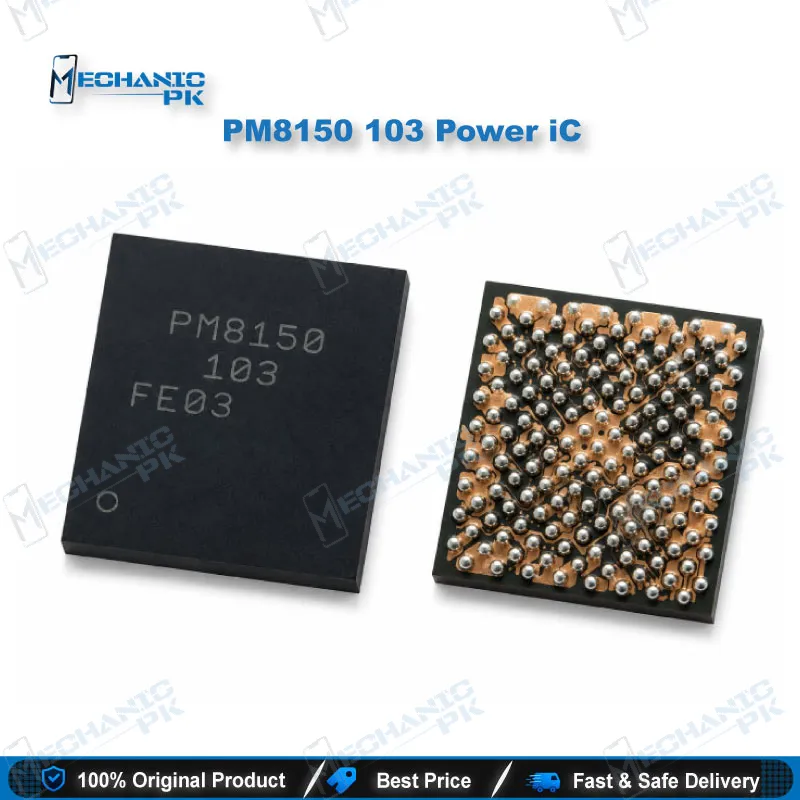
PM8150 103 Power IC – Qualcomm Snapdragon 855 PMIC
₨ 1
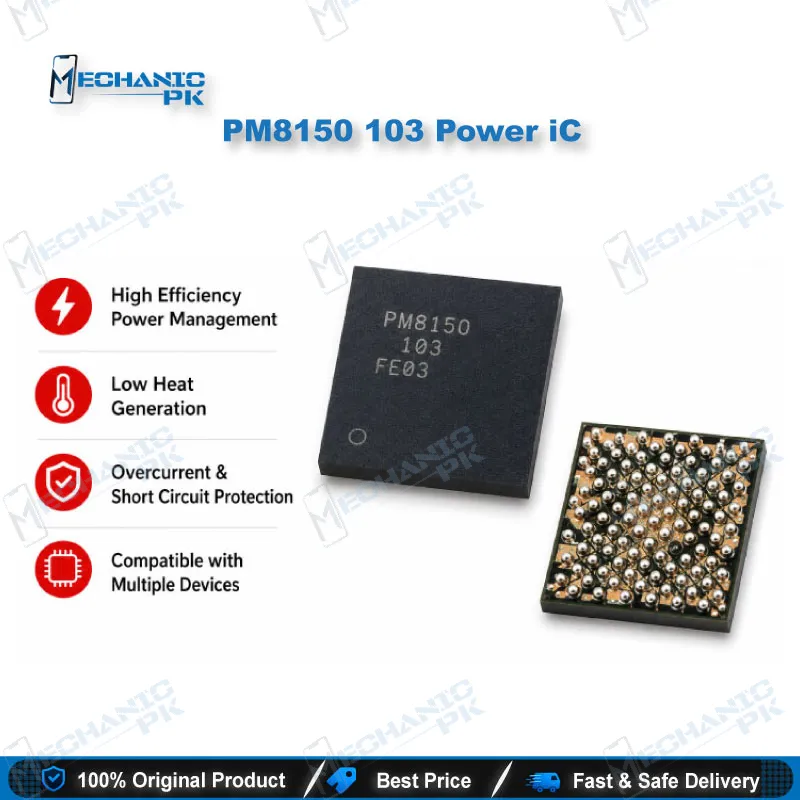
Qualcomm PM8150 103 Main PMIC for SM8150 Boards
The PM8150 103 power IC is the main Qualcomm power management chip on Snapdragon 855, 855+ and 860 boards. It drives the core SMPS and LDO rails that your processor, memory and peripherals need before the phone powers on. When this chip fails, you see a dead phone with no current draw, a short on a primary rail, or a board that restarts on the logo. Mechanicpk supplies the exact 103 marking so your IC change matches the original chip on the board. Pair it with a proper hot air station, reballing stencil and microscope for a clean, reliable replacement on flagship SM8150 motherboards.
Out of stock
PM8150 103 Power IC for Snapdragon 855 Board-Level Repair
The PM8150 103 power IC is the primary Qualcomm power management chip on SM8150 platform boards, the silicon behind Snapdragon 855, 855+ and 860 handsets. It generates the core supply rails your application processor, memory and peripherals need before the phone can boot. Qualcomm’s Linux kernel regulator bindings list ten SMPS buck regulators and eighteen LDO regulators on the PM8150, which shows how much of the board depends on this one package. When a rail inside it collapses, you get a dead phone with zero current, a short on a primary line, or a boot loop issue where the phone hangs on logo and restarts. Mechanicpk stocks this exact marking for technicians who diagnose at rail level and want a clean IC change karna job without guesswork.
Where the Snapdragon 855 PMIC Sits in the Power Tree
SM8150 boards split power duties across three Qualcomm chips. The PM8150 handles the core supply rails. The PM8150L delivers additional rails along with BOB, flash LED and RGB outputs. The PM8150B manages battery charging and the fuel gauge. Knowing this split saves you real bench time. A charging issue on a phone that boots normally usually points to the PM8150B side, while no power or abnormal boot current points you toward the PM8150. Measure the SMPS outputs around the chip with your multimeter and compare readings against a known-good board before you decide on removal.
Diagnosing a Faulty SM8150 Power IC
Start with a DC power supply and watch the current at power key press. A board that pulls no current at all, or one that jumps straight to a high fixed draw, deserves a close look at the main PMIC. Inject low voltage into a shorted rail and use rosin smoke or a thermal camera to find the hot spot. If the heat sits on a decoupling capacitor, you replace the capacitor and save the IC. If the heat sits on the PM8150 itself, the chip has an internal short and needs replacement. This step-by-step approach stops you from lifting a healthy flagship PMIC for no reason, and it protects your margin on expensive boards.
Replacing the PM8150 103 Power IC on the Bench
Flagship SM8150 boards often carry underfill around the main ICs, so plan for it. Preheat the board, soften the underfill with a remover, and lift the chip with controlled hot air instead of force. Clean every pad with flux and solder wick, then inspect under a microscope for lifted or bridged pads. Reball the new chip with the correct stencil, align it carefully, and reflow with even heat across the whole package. Always match the full marking on the original chip. Qualcomm uses suffixes such as 103 to separate chip variants, so fitting the same marking keeps your board configuration correct. After reflow, recheck every main rail before you assemble the phone and run a full boot test.
Building a Complete PMIC Repair Setup
A PMIC swap only succeeds when your bench supports it. A stable Hot Air Station and a Soldering Station handle removal and pad cleaning. A Reballing Kit with the right stencil restores the BGA balls. A PCB Holder keeps the board flat during heating, and a Multimeter confirms rail values before and after the job. If you replace flagship PMICs regularly, a trinocular microscope from our Microscopes category is the logical upgrade, since it lets you inspect pad damage and ball alignment at higher clarity and record your work for customers.
| Weight | 0.1 kg |
|---|
Key Features
- Main Qualcomm PMIC for the SM8150 (Snapdragon 855/855+/860) platform
- Exact 103 variant marking for a like-for-like replacement
- Drives ten SMPS buck rails and eighteen LDO rails on the board
- Handles core power for the CPU, memory and peripherals
- BGA package suited to standard reballing and hot air rework
- Works alongside the PM8150L and PM8150B companion chips
- Restores boards with internal PMIC shorts
- Suits board-level technicians and service centers handling flagship repairs
Specifications
| Brand | Qualcomm |
|---|---|
| Model | PM8150-103 |
| Category | Power Management IC (PMIC) |
| Compatibility | Qualcomm SM8150 platform (Snapdragon 855, 855+, 860) |
| Supported Devices | Boards fitted with an original PM8150 103 marked PMIC |
| Technology | Main platform PMIC with 10 SMPS buck regulators and 18 LDO regulators, BGA package |
Common Repair Uses
- Dead phone with no current draw on a Snapdragon 855 board
- Short on a main SMPS rail traced to the PMIC itself
- Hang on logo or boot loop issue caused by unstable core rails
- Phone dead after liquid damage near the PMIC area
- Phone dead after a failed hardware repair or overheating
- Replacing a cracked or burnt PMIC after a board drop
- Board swap jobs where the donor PMIC is faulty
- Training practice for flagship underfill BGA IC replacement
Compatible Devices
- Verified at chipset-platform level; match the 103 marking on your original chip
- Qualcomm Snapdragon 855 (SM8150) boards
- Qualcomm Snapdragon 855+ (SM8150 higher-clocked variant) boards
- Qualcomm Snapdragon 860 (SM8150-AC) boards
- SM8150 motherboards with the original PM8150 103 marking
- Boards pairing the PM8150 with a PM8150L companion PMIC
- Boards pairing the PM8150 with a PM8150B charger/fuel gauge PMIC
- Snapdragon 855 phones from flagship Android brands (verify the marking first)
- Snapdragon 860 phones from Android brands (verify the marking first)
FAQ
What is the product name?
What is the brand of this product?
What is the model of this product?
What is this product used for?
Which devices are compatible with this product?
Who should use this product?
Can I use PM8150L or PM8150B in place of PM8150 103?
How do I confirm the PM8150 is faulty on a dead Snapdragon 855 phone?
Related products