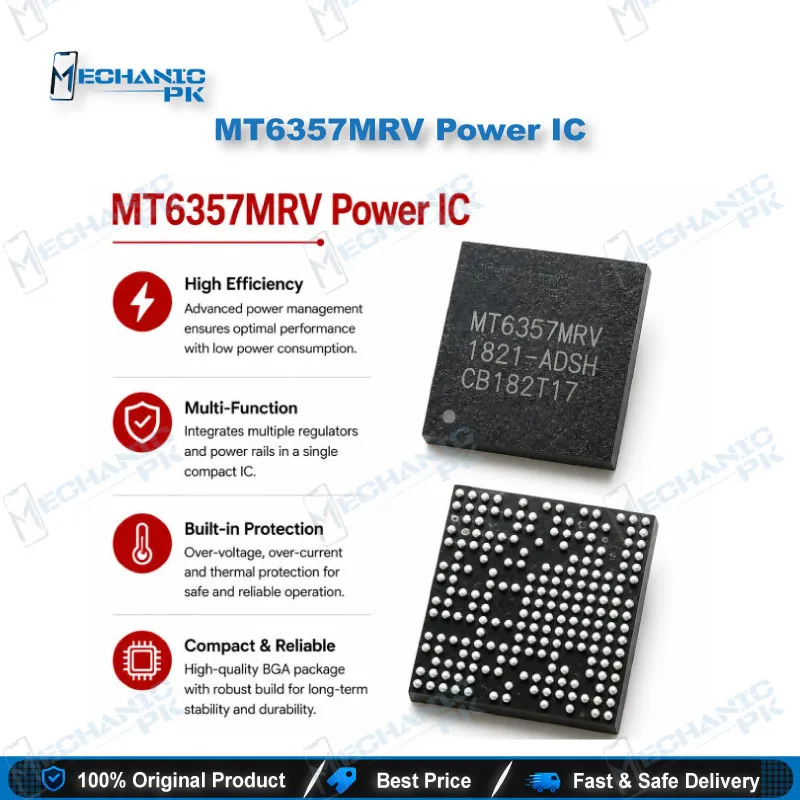
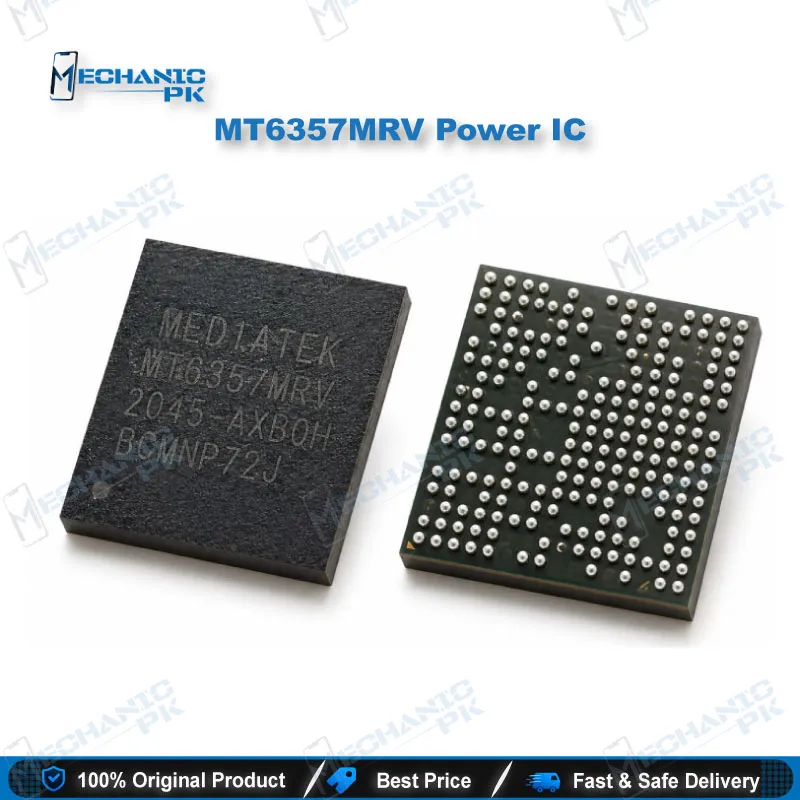
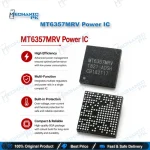
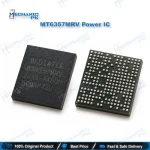
MT6357MRV Power IC – MediaTek PMIC for MT6765 Boards
₨ 250
MT6357MRV Power IC – Complete Power Management for MediaTek MT6765 Boards
The MT6357MRV Power IC is MediaTek’s dedicated power management chip for the MT6765 (Helio P35 and Helio G35) smartphone platform. It packs five buck converters and 29 LDO regulators into one BGA package and accepts a 2.6V to 5V input range. It also handles power-on sequencing, RTC, power-key detection, audio supply, and charging control. Technicians replace it when an MT6765 board shows a dead phone with no current draw, a charging issue, or a boot loop traced to a missing supply rail. Mechanicpk supplies it for board-level PMIC repair on Samsung, Xiaomi, Oppo, Vivo, Infinix, and Tecno handsets built on this platform.
Out of stock
MT6357MRV Power IC: MediaTek PMIC Engineered for the MT6765 Platform
The MT6357MRV Power IC is the main power management chip on MediaTek MT6765 smartphone boards, the platform sold as Helio P35 and Helio G35. MediaTek’s datasheet lists five buck converters and 29 LDO regulators inside a single BGA package. A single failed MT6357MRV can therefore cut supply to the CPU core, modem, memory, camera, and audio sections at the same time. On an MT6765 board that pulls no current, or one that shuts down the moment you release the power key, this chip sits at the top of your suspect list.
Verified Architecture of the MT6357MRV Power IC
MediaTek built the MT6357 family as a complete baseband power solution for 2G, 3G, and 4G handsets. The chip accepts a 2.6V to 5V input and generates dedicated buck outputs for VPROC, VCORE, VMODEM, VS1, and VPA. Its 29 LDOs feed SIM cards, camera modules, the vibrator, and other subsystems. MediaTek also integrated power-up control, battery charging control, the RTC alarm, power-key handling, and audio supply blocks into the same die. The Linux kernel’s MediaTek PMIC wrapper driver adds MT6357 support specifically for MT6765 SoCs, which confirms the CPU-to-PMIC pairing at the firmware level.
Power-On Sequence and Its Role in Diagnosis
The MT6357 starts a timed power-on sequence from three triggers: a power-key press, charger insertion, or an RTC alarm. It enables its regulators in a fixed order across a window of roughly 33 to 155 milliseconds. If one rail fails to rise, the sequence stalls and the phone never reaches the boot stage. Measuring each buck output with a multimeter during a power-key press shows you exactly where the chain breaks. Check every rail for a short to ground before you swap the chip, because a shorted capacitor downstream can damage a fresh PMIC on its first power-up.
Protection Thresholds Every Technician Should Know
MediaTek specifies a thermal shutdown point of 150°C, with release at 110°C. The undervoltage falling threshold sits at a typical 2.6V. These two values explain several complaints that look like PMIC failure but are not. A phone that restarts under load or cuts off at partial charge often has a weak battery or a high-resistance battery connector pulling input below the UV threshold. A board that shuts down after a few minutes of use may have a heat source nearby triggering thermal protection. Rule out the battery, connector, and nearby shorts before you condemn the IC.
Replacement Workflow on the Repair Bench
Secure the board in a PCB holder and apply bottom preheat to protect nearby components and the CPU. Remove any underfill or glue around the PMIC, apply flux, and lift the chip with a hot air station at a controlled temperature and airflow. Clean the pads with a soldering station and desoldering wick, then inspect them under a microscope for lifted pads or bridged balls. If the replacement chip arrives without balls, prepare it with a reballing kit and the correct stencil. Align carefully, reflow, let the board cool naturally, and verify current draw on a DC power supply before reassembly. Always match the complete marking on the original chip, since MT6357 also ships in CRV and ARV variants.
Common Faults Linked to the MT6357MRV
On MT6765 boards, a failed or damaged PMIC typically shows up as a dead phone with zero current, a charging issue where the phone detects the charger but never charges, or a hang on logo caused by an unstable core supply. Boot loop issues that survive a clean firmware flash often point toward a weak VCORE or VPROC rail rather than software. A “dead after flash” phone that shows a short on the battery line also deserves a PMIC check. Missing audio supply and modem supply faults can trace back to the same chip because both draw from its regulators.
Where This IC Fits in Your Repair Stock
Mechanicpk stocks the MT6357MRV Power IC for repair shops and service centers that handle high volumes of budget MediaTek handsets. After replacement, run a flash or diagnostic check through your test box to confirm stable boot and charging before you return the device to the customer.
| Weight | 0.1 kg |
|---|
Key Features
- Genuine MediaTek MT6357MRV marking for MT6765-platform board repair
- Five buck converters covering VPROC, VCORE, VMODEM, VS1 and VPA rails
- 29 LDO regulators feeding SIM, camera, vibrator and other subsystems
- 2.6V to 5V input range matched to single-cell Li-ion phone batteries
- Integrated power-on sequencing triggered by power key, charger or RTC alarm
- Thermal shutdown at 150°C with automatic release at 110°C
- Built-in battery charging control and audio supply blocks
- BGA package suited to hot air removal and reballing workflows
Specifications
| Brand | MediaTek |
|---|---|
| Model | MT6357MRV |
| Category | Power Management IC (PMIC) |
| Compatibility | MediaTek MT6765 platform (Helio P35 / Helio G35) |
| Technology | 5 buck converters + 29 LDO regulators, integrated power-on sequencing, RTC, charging control and audio supply |
| Input Voltage | 2.6V – 5V |
Common Repair Uses
- Dead phone repair with zero current draw on MT6765 boards
- Charging issue where the charger is detected but the battery never charges
- Hang on logo caused by an unstable VCORE or VPROC rail
- Boot loop that persists after a clean firmware flash
- "Dead after flash" phones with a PMIC-side short
- Restoring missing buck or LDO supply rails after liquid damage
- PMIC replacement after a shorted downstream capacitor damaged the original chip
- BGA reballing and reflow of the power section on MediaTek boards
Compatible Devices
- MediaTek MT6765-platform boards (Helio P35 / Helio G35); confirm the original PMIC marking before replacement
- Samsung Galaxy A12 (SM-A125F, Helio P35 variant)
- Xiaomi Redmi 9C (Helio G35)
- Oppo A16s (Helio G35)
- Vivo Y12s and Vivo Y20 2021 (Helio P35)
- Infinix S5 Pro (Helio P35)
- Tecno Camon 15 Pro (Helio P35)
- Nokia G20 (Helio G35)
- Honor 8A (Helio P35)
FAQ
What is the product name?
What is the brand of this product?
What is the model of this product?
What is this product used for?
Which devices are compatible with this product?
Who should use this product?
Is the MT6357MRV the same as the MT6357CRV?
Which rails should I check before replacing the MT6357MRV on a dead MT6765 phone?
Related products