














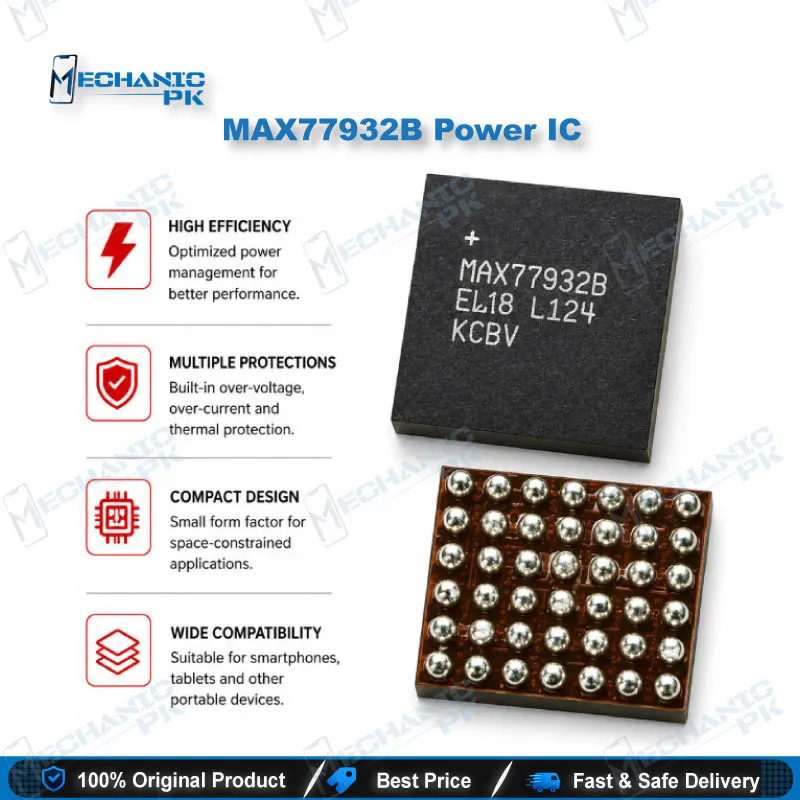
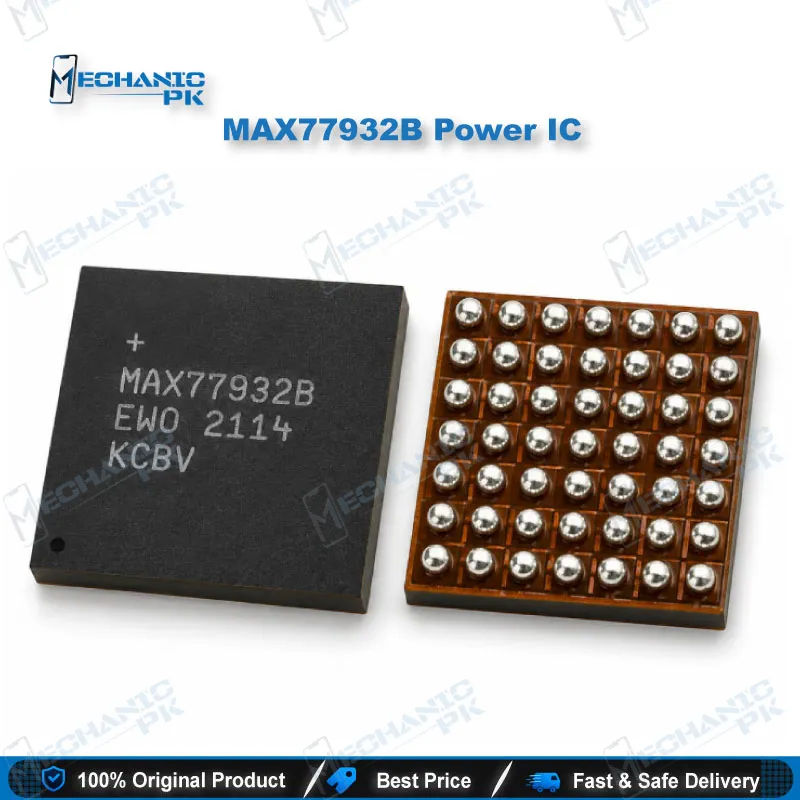
MAX77932B Power IC – Dual-Phase Switched-Capacitor IC
₨ 350
MAX77932B Power IC for Board-Level Charging Repair
The MAX77932B power IC is a dual-phase switched-capacitor converter from Maxim Integrated’s MAX77932 family. It halves its input voltage without using an inductor. That lets 2S-battery and direct-charging designs feed single-cell circuitry efficiently. Technicians replace it when a board shows any of these faults traced to this stage:
- a shorted power rail
- a hot spot in the charging section
- slow or failed charging
- a dead phone
The family supports I2C control, programmable protection thresholds and thermal shutdown. Mechanicpk stocks it as a bare replacement part for professional board-level repair. Match the marking on your original IC before you order.
MAX77932B Power IC for Switched-Capacitor Power Stages
The MAX77932B power IC belongs to Maxim Integrated’s MAX77932 family of dual-phase switched-capacitor converters, a line Analog Devices now supports. Inside a phone or tablet, this stage takes a higher input voltage and halves it. A board running a 2S battery or a divide-by-two charging path can then feed circuitry designed for single-cell voltage. When this IC fails, it usually shows up as a charging issue, a heating spot near the power section, or a dead phone with a shorted rail. Mechanicpk supplies the MAX77932B as a bare replacement part for technicians who handle board-level power faults and need the exact marking the original board carries.
How the MAX77932 Switched-Capacitor Converter IC Works
This switched-capacitor converter IC uses no inductor, unlike a buck converter. Capacitors store and transfer the energy, and two phases switch in alternation to deliver an output at half the input voltage.
Analog Devices documents the family through the MAX77932C datasheet, which lists:
- a peak efficiency of 98.5%
- an 8A output rating
- a programmable switching frequency from 0.25MHz to 1.5MHz
Frequency dithering spreads switching noise, which keeps EMI low around sensitive RF and audio sections.
The phone’s processor controls the converter over an I2C bus with an interrupt line. Through software it adjusts overcurrent, overvoltage and undervoltage thresholds, plus soft-start current and timeout. That control link matters during diagnosis. A board can show a healthy supply rail and still refuse to fast charge if the I2C lines to the IC are open or shorted. The family datasheet also specifies a power-good output and a chip-enable input, which give you two more measurable signals when you trace a hardware fault.
Diagnosing a Failed MAX77932B on Your Repair Bench
- Connect the board to a DC power supply and watch the current draw. A board that pulls heavy current the moment you apply power often hides a shorted capacitor or a shorted converter in this stage.
- Inject a low voltage into the shorted rail. Apply rosin or use a thermal camera to find the hot spot.
- If the heat sits on the IC body rather than a nearby capacitor, the IC is the culprit.
- Check the surrounding flying capacitors in diode mode with a multimeter. A cracked capacitor produces the same symptoms and costs far less to fix.
- If the phone powers up but charges slowly or stops charging on a fast charger, verify the input rail, the enable signal and the I2C lines before you commit to an IC change.
- Read the original marking under a microscope before you order a replacement MAX77932B power IC. The suffix letter identifies the exact variant the board firmware expects.
Replacement Technique for Wafer-Level Packaging
The MAX77932 family ships in a wafer-level package. The MAX77932C datasheet lists a lead-free 42-bump WLP at 0.4mm pitch, so give the B variant the same careful handling.
- Secure the board in a PCB holder and preheat the area.
- Remove the old IC with a hot air station on controlled airflow so you don’t blow away the tiny passives around it.
- Clean the pads with solder wick and a quality flux.
- Inspect the pads under a microscope for lifted or bridged pads before you place the new part.
- Align the IC by its pin-1 dot, reflow evenly, and let the board cool without disturbing it.
- Measure the input and output rails and confirm the phone charges.
- Run the phone on a fast charger long enough to confirm the converter holds a stable temperature.
This part pairs well with a reliable hot air station, a stereo microscope and a rigid PCB holder from the Mechanicpk catalog. If you handle charging-section repairs daily, a PCB preheater is the upgrade worth adding next. It cuts thermal stress on the board and makes WLP removal far more predictable.
| Weight | 0.1 kg |
|---|
Key Features
- Dual-phase switched-capacitor converter from the MAX77932 family
- Divide-by-two conversion (VOUT = VIN/2) for 2S-to-1S power stages
- Inductorless topology for a compact, low-height power section
- I2C-controlled converter parameters with interrupt reporting
- Programmable input/output overvoltage lockout and overcurrent protection
- Thermal alarm and thermal shutdown protection
- Chip-enable input and power-good output for signal-level diagnosis
- Built-in frequency dithering to reduce EMI
Specifications
| Brand | Maxim Integrated (Analog Devices) |
|---|---|
| Model | MAX77932B |
| Category | Mobile Phone Power IC |
| Compatibility | Direct replacement on boards fitted with MAX77932B |
| Technology | Dual-phase switched-capacitor converter (MAX77932 family) |
| Output Voltage | VIN ÷ 2 (MAX77932 family topology) |
Common Repair Uses
- Board-level power and charging repairs on boards that carry this IC.
- Replacing a shorted converter on a board that pulls high current at power-on
- Fixing no-charging or slow-charging faults traced to the switched-capacitor stage
- Reviving a dead phone caused by a shorted rail in the power section
- Clearing a hot spot near the charging circuit located with rosin or a thermal camera
- Restoring charging after liquid damage corrodes the IC
- Replacing the IC after a faulty charger damages the charging input
- Re-fitting the IC after a failed rework leaves lifted or bridged bumps
- Repairing the power section on 2S-battery tablets and portable devices
Compatible Devices
- Verified scope is the MAX77932 family’s application range published by Analog Devices. Fit this part only where the board carries the MAX77932B marking.
- Phone and tablet logic boards originally fitted with MAX77932B
- Smartphone direct-charging stages built on the MAX77932 family
- Devices using a 2S (dual-cell series) Li-ion battery with single-cell downstream power
- Tablets
- Power banks
- Portable gaming devices
- Chromebooks and ultrabook computers
- DSLR and mirrorless cameras
FAQ
What is the product name?
What is the brand of this product?
What is the model of this product?
What is this product used for?
Which devices are compatible with this product?
Who should use this product?
Can I replace MAX77932B with MAX77932C?
How do I check if the MAX77932B is shorted on a dead phone?
Related products