



















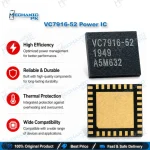
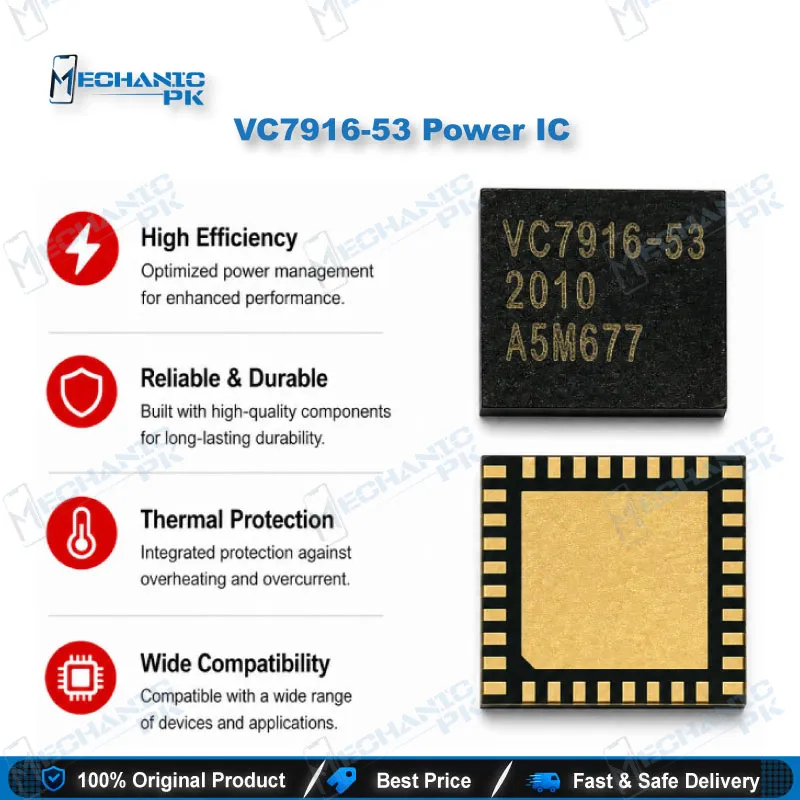
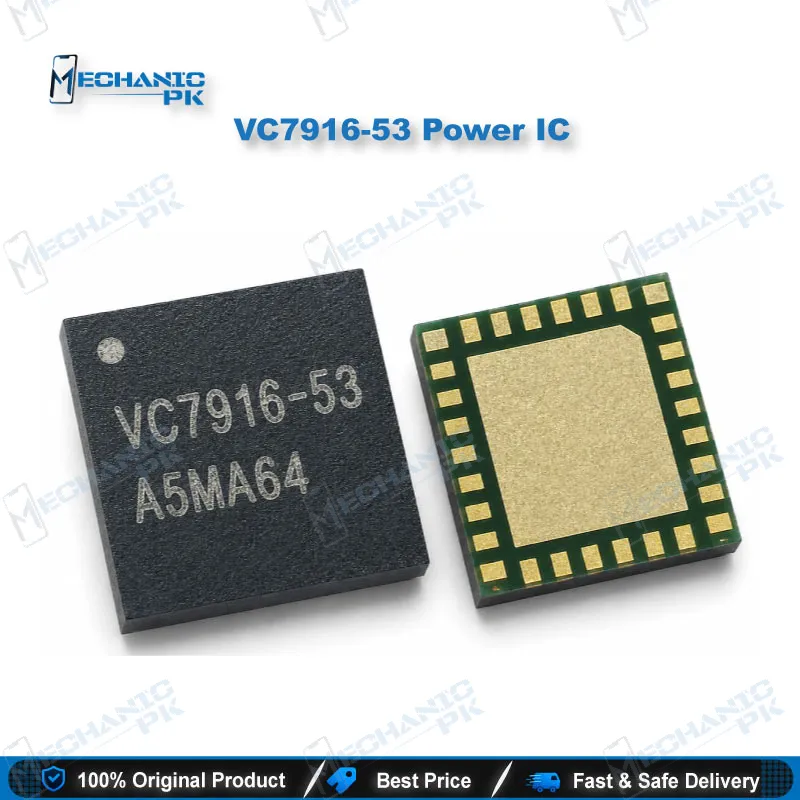
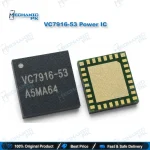
VC7916-53 Power IC VanChip RF Power Amplifier (PA)
₨ 350
VC7916-53 PA IC for Cellular Network Repair
The VC7916-53 Power IC is a VanChip RF power amplifier (PA) that boosts the transmit signal before it reaches the antenna path of a smartphone. Technicians replace it when a handset shows no service, emergency calls only, or a signal that collapses the moment a call starts, and when a shorted PA drags the battery rail down and leaves a dead phone. You get a dedicated replacement for boards that carry the original VC7916-53 marking, ready for hot air removal and reflow on your repair bench. Match the full marking, including the -53 suffix, before fitting, because the VC7916 family ships in several suffix variants.
VanChip VC7916-53 PA IC: The Transmit Power Stage on Smartphone Boards
The VC7916-53 Power IC belongs to VanChip’s VC7916 series of RF power amplifiers, the transmit-side stage that turns a low-level signal from the RF transceiver into the output power a phone needs to reach the cell tower. The VC7916-53 PA IC serves board-level technicians who handle network faults rather than software issues. When this part fails, the handset usually still boots, reads the SIM, and shows a valid IMEI, yet it cannot hold a connection. That symptom pattern separates a PA fault from a baseband or software fault, and it points you toward the RF section before you touch anything else.
Where the VC7916-53 Sits in the RF Chain
VanChip, a Tianjin-based RF front-end company, supplies power amplifier modules to a wide range of Chinese handset brands. Inside the phone, the PA takes the modulated output from the transceiver, amplifies it, and passes it through filters and switches toward the antenna. The receive path runs separately, which explains a classic field symptom: the phone shows network bars for a moment, then drops to no service as soon as it tries to register or place a call. Uplink fails while downlink still works. Because a handset PA typically draws its supply from the battery side of the power tree, a shorted PA can also load the main rail. You then face a dead phone or a board that pulls heavy current on a DC power supply, even though the CPU and PMIC remain healthy.
Diagnosing a Faulty Network PA IC Before Replacement
Confirm the fault before you lift anything. On a shorted board, inject a low voltage into the main rail and watch for a hot spot with a thermal camera or rosin smoke. If the heat concentrates on the PA, you have found your culprit. For phones that power on, check whether the device shows no service while the IMEI and baseband version read correctly. Inspect the area under a microscope for corrosion, missing capacitors, or cracked filters around the PA, since drop and liquid damage often hit these neighbouring parts first. A missing decoupling capacitor beside a healthy PA produces the same network issue, so rule those out before an IC change. Compare diode-mode readings on the PA supply and control lines against a known-good board whenever you have one. Finally, read the full marking on the original chip. VanChip ships the VC7916 family in suffixes such as -11, -31, -36, -55, and -63 alongside the -53, and a different suffix can share the footprint while differing in configuration. Fit only an exact match, or you risk a phone that powers on normally but never regains stable network.
Fitting the VC7916-53 PA IC on Your Repair Bench
Secure the board in a PCB holder and protect nearby connectors and plastic parts with heat-resistant tape. Remove the RF shield can if one covers the PA, apply fresh flux, and lift the old chip with your hot air station, letting the solder flow fully before you raise it so the pads stay intact. Clean the land with solder wick and flux, then inspect every pad, including the large ground pad beneath the module, under a stereo microscope. Tin the pads lightly and evenly, align the new VC7916-53 using its pin-one mark, and reflow until it settles flat on the land. After it cools, clean the flux residue with isopropyl alcohol, refit the shield, and test signal strength and call quality on a live SIM. A temperature-controlled soldering station speeds up pad preparation, and a reballing stencil kit helps when the land needs re-tinning. As your RF repair volume grows, a trinocular microscope with a camera upgrades both your inspection accuracy and the proof you share with customers.
| Weight | 0.1 kg |
|---|
Key Features
- VanChip VC7916-series RF power amplifier, -53 variant
- Handles transmit-side amplification between the transceiver and antenna path
- Direct replacement for boards with a matching VC7916-53 marking
- Surface-mount part suited to standard hot air rework
- Targets uplink failures: no service, emergency only, call drops
- Clears PA-related shorts on the battery rail when the chip itself has failed
- Fits a standard bench workflow of hot air, flux, microscope, and PCB holder
- Exact suffix match avoids variant mismatch on the board
Specifications
| Brand | VanChip |
|---|---|
| Model | VC7916-53 |
| Category | RF Power Amplifier (PA) IC |
| Compatibility | Boards carrying the original VC7916-53 marking |
| Technology | Cellular RF power amplifier for the smartphone transmit path |
Common Repair Uses
- No service or emergency calls only after a drop
- Network signal that disappears when the phone registers or places a call
- Weak signal and call drops on a phone with a valid IMEI and baseband
- Liquid damage repair with corrosion on the PA area
- Short on the main battery rail traced to the PA with a thermal or rosin check
- Dead phone caused by a shorted PA pulling heavy current
- Replacing a PA damaged during earlier rework on the RF section
- RF section restoration after physical board damage
Compatible Devices
- erified scope is part-marking level; device-specific model fitment is not verified.
- Smartphone motherboards with an original VC7916-53 marking on the PA position
- Android handsets that use a VanChip VC7916-series PA where the original chip reads VC7916-53
- Exact-suffix replacement only; not interchangeable with other VC7916 variants
FAQ
What is the product name?
What is the brand of this product?
What is the model of this product?
What is this product used for?
Which devices are compatible with this product?
Who should use this product?
Can a shorted VC7916-53 PA IC cause a dead phone?
Can I replace VC7916-53 with another VC7916 variant like VC7916-55?
Related products