















BQ25892 Charging IC 5A Fast Charger for Mobile Repair
₨ 500
BQ25892 Charging IC: 5A Single-Cell Charger for Repair Benches
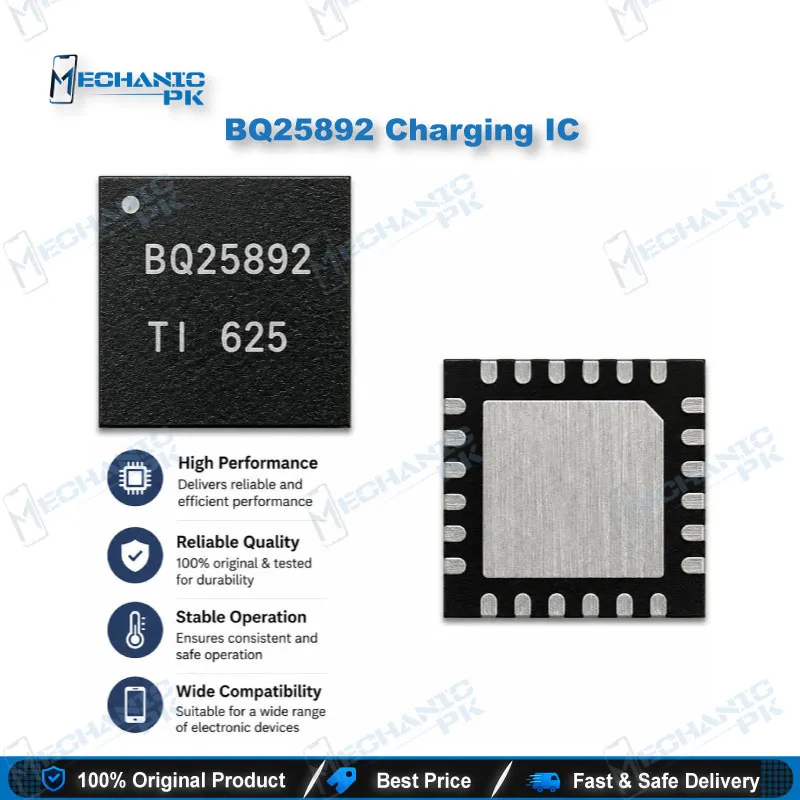
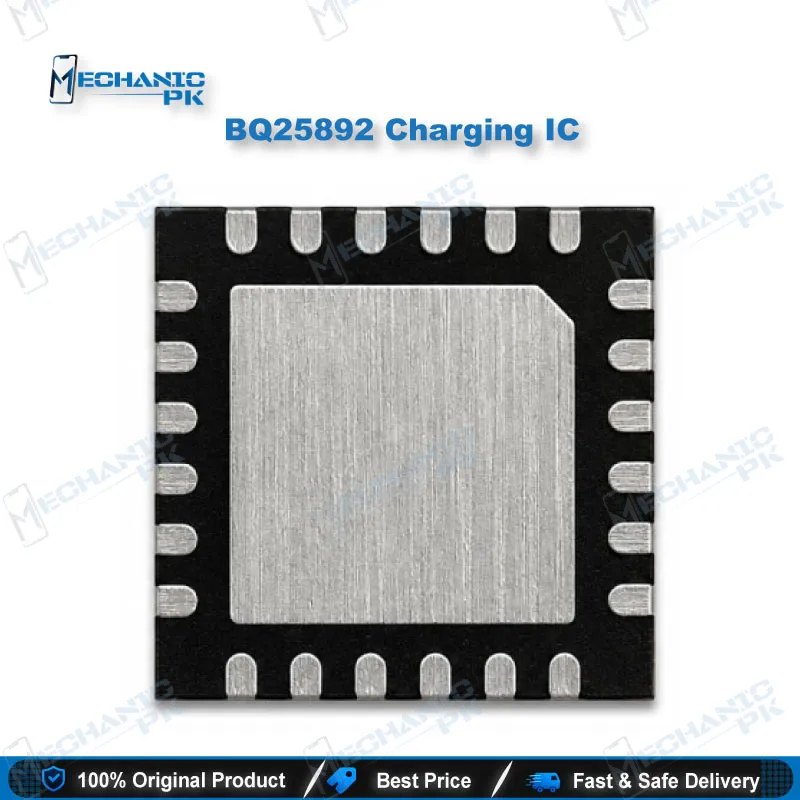
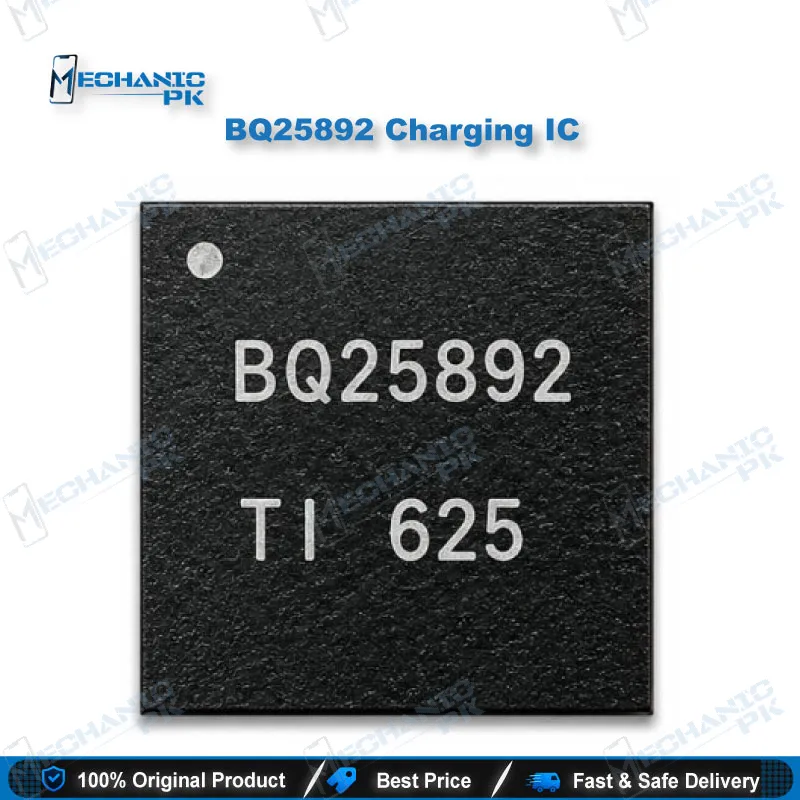
The BQ25892 charging IC delivers up to 5A of switch-mode charging for single-cell Li-Ion and Li-polymer batteries. Texas Instruments integrated the power path FETs, added I2C control, and included USB OTG boost support, so one device covers the charge and power management stage on many phone boards. Its 24-pin WQFN package measures 4 mm by 4 mm, which suits hot air rework on compact layouts. Technicians handling a charging issue or a dead phone can use the part number and marking code to confirm the correct replacement before lifting the old component.
BQ25892 Charging IC for Mobile Repair Benches
The BQ25892 charging IC for mobile repair sits at the front of the power chain on a phone board. When a handset shows a charging issue or stays dead on USB, this device decides whether current reaches the battery at all. Texas Instruments built it as a 5A switch-mode charger for single-cell Li-Ion and Li-polymer batteries, which covers the packs in most smartphones and portable devices. It also manages the system power path, so the phone can run from the adapter while the battery charges. Understanding this block helps you isolate faults before you start lifting components.
Input Stage and Power Path
The input side accepts USB sources and adjustable high-voltage adapters, with an operating range of 3.9V to 14V and an absolute safety rating of 22V. The package integrates the input reverse-blocking FET, the high-side and low-side switching FETs, and the battery FET. Because these switches sit inside the device, your bench rarely needs to trace external power transistors for this stage. A bootstrap diode for high-side gate drive is also built in, which keeps the external part count low. The device qualifies the input source before it draws full current, so a weak adapter gets identified early. On the board, measure input voltage at the VBUS path before you blame the IC.
Charge Profile and Control Options
Charging current reaches 5A, and the battery charge voltage window runs from 3.84V to 4.6V. You can configure the device over I2C, or run it in standalone mode with resistor-set parameters, which gives you flexibility on both new designs and repair work. The charger runs an autonomous charging cycle and follows its charging profile without host intervention. Resistance compensation (IRCOMP) lets the device regulate voltage closer to the cell terminal, which improves accuracy at charge termination. The datasheet also documents JEITA guideline compliance, so the charger can reduce current when battery temperature leaves the safe band. This matters when a handset heats up during fast charging and you need to confirm the IC behaves as designed.
Package and Rework Considerations
The BQ25892 ships in a 24-pin WQFN package measuring 4 mm by 4 mm, with 0.5 mm pitch and a maximum height of 0.8 mm. That footprint is compact, so you need a microscope, flux, and a controlled hot air station to lift and reflow it cleanly. Inspect the pads for lifted copper or bridged pins before you place a replacement, because a fine-pitch QFN bridge can look exactly like a charging fault. The part number carries two suffixes, RTWR and RTWT, and both list identical electrical parameters while differing in reel quantity. Match the marking code on the old chip, and then verify the charger with a bench supply and current meter before you return the handset. This sequence prevents repeat returns and saves IC change karna work on the same board.
| Weight | 0.1 kg |
|---|
Key Features
- Switch-mode buck charger for single-cell Li-Ion and Li-polymer batteries
- Charge current up to 5 A
- Integrated reverse-blocking, switching, and battery FETs
- I2C control or standalone resistor-set operation
- USB OTG boost mode support
- Input range of 3.9 V to 14 V operating, 22 V absolute maximum
- JEITA thermistor qualification support
- Compact 4 mm x 4 mm, 24-pin WQFN package
Specifications
| Brand | Texas Instruments |
|---|---|
| Model | BQ25892 |
| Category | Battery Charger IC |
| Compatibility | Single-cell Li-Ion and Li-polymer batteries |
| Supported Devices | Single-cell battery systems with USB or adjustable high-voltage input |
| Technology | Switch-mode buck charger with I2C control and USB OTG boost |
| Input Voltage | 3.9 V to 14 V operating (22 V absolute maximum) |
| Output Voltage | Battery charge voltage 3.84 V to 4.6 V |
| Power Rating | Charge current up to 5 A |
| Dimensions | 4 mm x 4 mm, 0.75 mm thickness (0.8 mm maximum height) |
Common Repair Uses
- Diagnosing a charging issue on a dead phone that shows no battery response on USB
- Replacing a failed charger IC on a board with a confirmed charging fault
- Checking power path behavior when a handset must run from the adapter with a flat battery
- Reviewing charge profile settings on boards that expose the I2C interface
- Testing OTG boost behavior on boards that feed peripherals from the battery
- Hot air rework of 24-pin WQFN charger sections under microscope
Compatible Devices
- Verified scope is chipset-level (single-cell battery and input architecture), not device-specific.
- Single-cell Li-Ion battery packs within the 3.84 V to 4.6 V charge window
- Smartphones and portable devices powered from USB input
- Systems using adjustable high-voltage adapters up to 14 V operating input
- USB OTG boost-mode designs that power peripherals from the battery
- Boards with a 24-pin 4x4 mm WQFN charger footprint
FAQ
What is the product name?
What is the brand of this product?
What is the model of this product?
What is this product used for?
Which devices are compatible with this product?
Who should use this product?
Does the BQ25892 support I2C control?
What is the maximum charge current of the BQ25892?
Related products