


















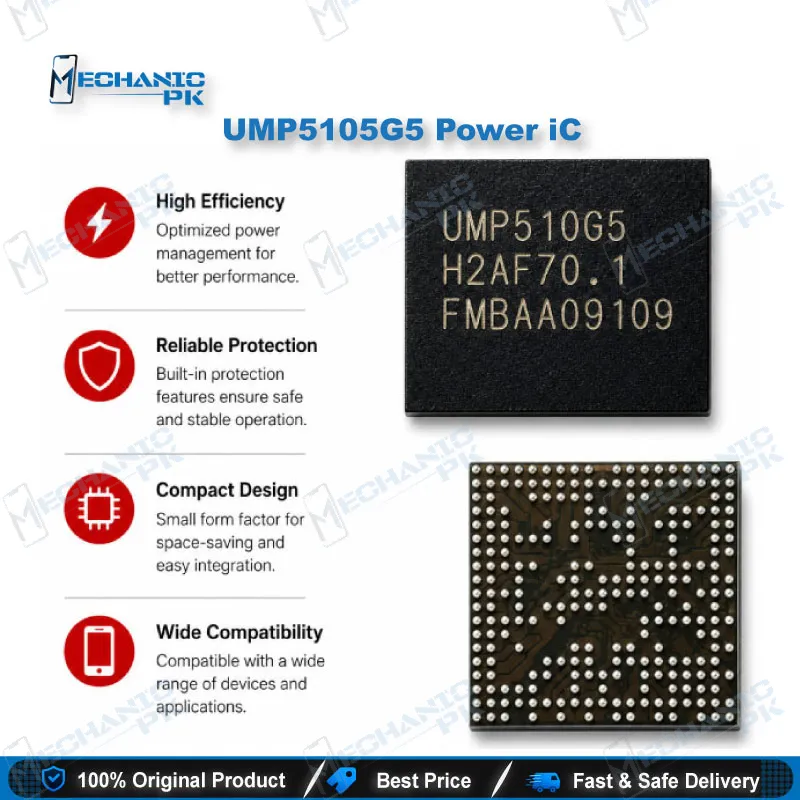
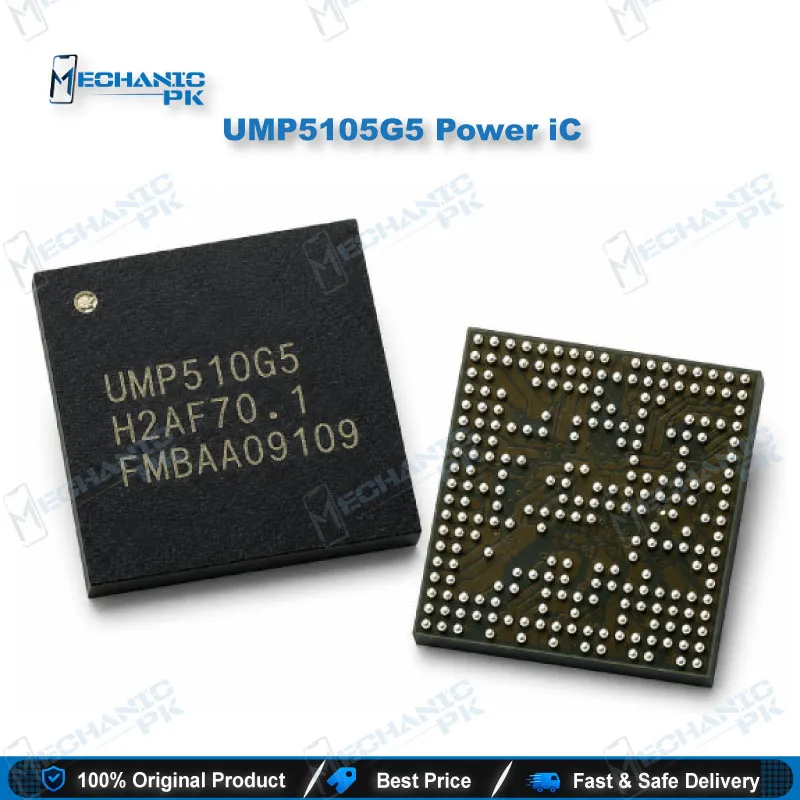
UMP5105G5 Power IC for Unisoc Spreadtrum Boards
₨ 1
Unisoc PMIC for Dead Phone Repairs
The UMP5105G5 Power IC is a power management IC for Spreadtrum and Unisoc chipset motherboards. It regulates the voltage rails that feed the processor and connected subsystems, so a fault here often shows up as a dead board. Use it as a direct board-level replacement once you have isolated a power rail fault. It comes in a BGA package, so it suits hot air rework and reballing on a standard bench setup. Confirm fitment against your board schematic before you remove the old unit. Built for technicians handling Unisoc-platform Android repairs in Pakistan’s workshops and service centers.
UMP5105G5 Power IC for Unisoc and Spreadtrum Boards
The UMP5105G5 is a power management IC built for motherboards that run on Spreadtrum and Unisoc chipsets. It regulates the voltage that reaches the processor, memory, and other onboard subsystems, so a fault in this part can stop a board from powering up at all. When you isolate a power rail problem on a Unisoc-platform handset, this PMIC becomes a primary replacement candidate. The sections below cover its role in the power path, how to confirm a fault before you replace it, and how to handle the rework safely.
Where This PMIC Sits in the Power Path
On a Unisoc board, the power management IC takes input from the battery or charging circuit and steps it down into several regulated outputs. Each output feeds a specific load, such as the processor core, RAM, or peripheral blocks. If one regulator fails, the board may draw no current, draw an abnormal spike, or stall at the boot logo without finishing startup. Reading these symptoms correctly depends on knowing which rail feeds which load. Map that layout from the schematic before you decide which section to measure.
Confirming a Fault Before Replacement
Check the charging path, battery connector, and obvious shorts before you blame the PMIC. Once those are cleared, connect a bench power supply and watch the current draw at power-on. A dead board that draws nothing usually points to a missing supply rail, while an abnormal spike often points to a shorted output. Measure the rails against the schematic where you have one, and compare them to a known-good board if you have access to one. A confirmed fault prevents you from replacing a healthy IC and losing the job.
Rework and Reballing Notes
This is a BGA package, so the job depends on heat control and pad preparation. Apply flux generously, use a hot air station with controlled temperature and airflow, and lift the old unit without dwelling on the neighboring parts. Support the board on a PCB holder so it does not flex during heating. Clean the pads fully before you reball, and check ball alignment under a microscope or magnifier before reflow. A misaligned or bridged ball under a PMIC is a common cause of a failed IC change, so inspect before you power up. Size the nozzle to the package to avoid stressing components on a dense board.
Dead-After-Flash Cases
Some dead-after-flash boards come from an interrupted or failed flash, and the damage sometimes reaches the power rail rather than the software alone. If a software retry does not bring the board back and the current draw points to the power section, the PMIC becomes a suspect. In that case, replacing the UMP5105G5 can restore correct voltage sequencing so the board boots again. Confirm the rail behavior first, so you replace the part only when the power section has actually failed.
Sourcing a Genuine Unit
PMIC stock quality varies widely. A counterfeit or recycled unit may power on briefly and then fail within days, which means a repeat comeback and lost labor. Buy from a source that tests stock and gives you a clear return path, and keep a few spare units on hand for dead-board jobs. Where possible, test the new IC on a known-good board before you hand the phone back to the customer.
| Weight | 0.1 kg |
|---|
Key Features
- Power management IC built for Spreadtrum and Unisoc chipset boards
- Regulates voltage to the processor and connected subsystems
- BGA package suited to hot air rework and reballing
- Fits a standard bench workflow: diagnose, remove, clean pads, reball, reflow
Specifications
| Brand | UMP |
|---|---|
| Model | UMP5105G5 |
| Category | Mobile Phone ICs |
| Compatibility | Spreadtrum and Unisoc chipset-based Android boards |
| Technology | Power Management IC (PMIC) |
| Weight | 0.1 kg |
Common Repair Uses
- Power-path faults on Unisoc boards.
- Dead phone with no power or no display
- No charging current draw at the power supply
- Abnormal current draw or stalling at the boot logo
- Dead-after-flash boards where the power rail is damaged
- PMIC replacement and BGA reballing
Compatible Devices
- Spreadtrum/Unisoc chipset-family Android boards
FAQ
What is the product name?
What is the brand of this product?
What is the model of this product?
What is this product used for?
Which devices are compatible with this product?
Who should use this product?
Does this PMIC fix a phone that stays dead after a failed flash?
Can this IC be reballed on a standard hot air station?
Related products