BQ24261 Charger IC – 3A Li-Ion Switch-Mode Charging Chip
₨ 350
BQ24261 Charger IC – 3A Switch-Mode Li-Ion Charger
The BQ24261 charger IC from Texas Instruments delivers up to 3A of switch-mode charging for single-cell Li-ion and Li-polymer batteries. Its power path management feeds the system and charges the battery at the same time. The host processor controls it over I2C, and it runs from a 4.2V–13.2V input while tolerating up to 30V at the input pin. A built-in 5V boost powers USB OTG accessories at up to 1A. Technicians use this IC to fix charging issues, dead boards with a shorted charger rail, and failed OTG output during board-level repair across Pakistan.
BQ24261 Charger IC for Single-Cell Li-Ion Charging Circuits
The BQ24261 charger IC from Texas Instruments is a host-controlled, switch-mode battery charger for single-cell Li-ion and Li-polymer packs. It charges at up to 3A, operates from a 4.2V to 13.2V input, withstands up to 30V at the input, and takes its configuration from the main processor over I2C. When a board built around this chip shows a charging issue, the BQ24261 sits at the center of the fault path. A correct replacement restores both battery charging and system power delivery.
How the BQ24261 Manages Power on the Board
The chip uses a synchronous buck topology, so it converts adapter or USB input into a regulated system rail with far less heat than a linear charger. Its power path design lets the system run from the input while the battery charges independently. When the adapter cannot meet system demand, the battery supplements the current and keeps the device stable under heavy load. This architecture explains a common symptom: a failed BQ24261 can leave you with a dead phone or tablet even when the battery tests healthy, because the system rail depends on the chip as much as the charge path does.
Charging Profile and Battery Protection
The BQ24261 charges in three phases: precharge for deeply discharged cells, constant current for bulk charging, and constant voltage to finish the cycle. Battery regulation voltage programs between 3.5V and 4.44V, covering standard 4.2V cells and higher-voltage Li-polymer packs. A TS thermistor input supports JEITA-compatible temperature monitoring, so the chip halts or adjusts charging when the pack moves outside its safe range. Internal thermal regulation keeps the die below 125°C, and the device includes over-voltage and over-temperature fault protection.
USB OTG Boost Function
Beyond charging, the BQ24261 boosts battery voltage to 5V and supplies up to 1A back out through the input. Devices rely on this for USB OTG accessories and power bank output. If a customer reports that OTG stopped working along with charging, check the charger IC before you move to the connector or the CPU side.
Package Variants and Identification
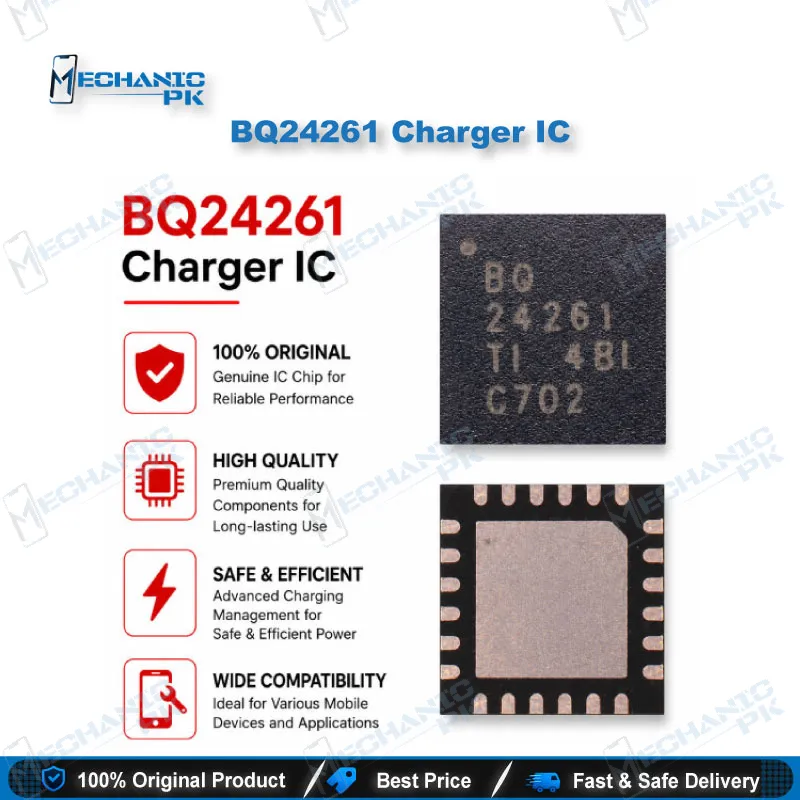
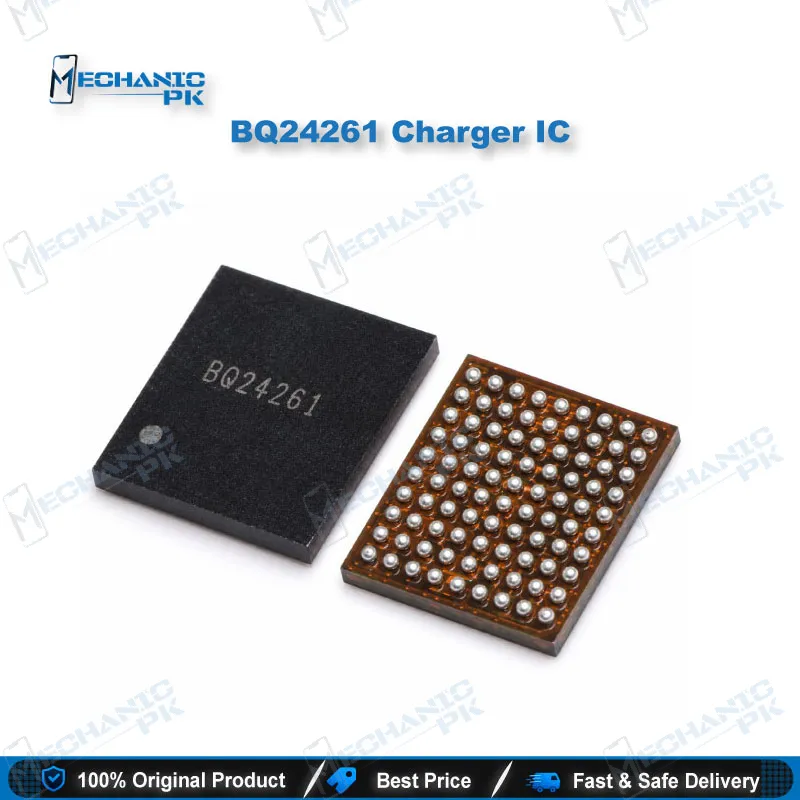
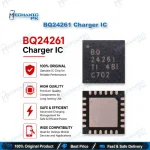
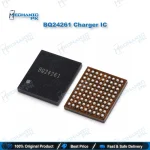
TI manufactures the BQ24261 family in two packages: a 24-pin VQFN (RGE, 4 × 4 mm, 0.5 mm pitch) and a 36-ball DSBGA (YFF, 1.6 × 2.6 mm, 0.4 mm pitch). The BQ24261M part numbers belong to the same bq2426x datasheet family. Always match the package type and the top marking on the original chip before you order, because the two footprints do not interchange.
Replacement Workflow on the Repair Bench
Diagnosis starts with a multimeter and a DC power supply. Measure input voltage at the chip, watch the current draw, and look for a short on the input or system rail. A shorted charger IC usually heats up within seconds of power, and a rosin or thermal test confirms the fault fast. For removal, a hot air station with a suitable nozzle and controlled airflow lifts the VQFN body without disturbing nearby passives. The DSBGA version demands more precision: you need a stereo microscope, a reballing kit with a matching stencil, and a PCB holder to keep the board flat while you seat the new ball grid. After installation, clean the flux residue, inspect the pads under magnification for bridges, and confirm charge current on your power supply meter.
Where This IC Fits in Your Repair Workflow
The BQ24261 belongs to the IC-level stage of PCB repair, specifically charging circuit diagnostics. Technicians usually reach it after ruling out the charging port, the flex cable, and the battery. Because the host processor programs the chip over I2C, corrupted firmware can leave charging misconfigured and mimic a hardware fault. Confirm physical symptoms such as a shorted rail, a hot chip, or missing input voltage before you commit to an IC change.
Sourcing the BQ24261 Charger IC from Mechanicpk
Mechanicpk supplies charging ICs to repair shops, service centers, and training institutes across Pakistan, alongside the soldering stations, hot air stations, and microscopes needed to fit them. Order the BQ24261 charger IC in the exact package your board requires, and pair it with quality flux and solder paste for a clean, reliable joint.
| Weight | 0.1 kg |
|---|
Key Features
- Up to 3A charge current for single-cell Li-ion and Li-polymer batteries
- Synchronous switch-mode buck topology for efficient, low-heat power conversion
- Power path management runs the system while the battery charges independently
- Host-controlled configuration through the I2C interface
- 4.2V–13.2V operating input with a 30V absolute input rating
- Programmable battery regulation voltage from 3.5V to 4.44V
- 5V USB OTG boost output with up to 1A capability
- JEITA-compatible TS thermistor input and 125°C die thermal regulation
Specifications
| Brand | Texas Instruments |
|---|---|
| Model | BQ24261 |
| Category | Battery Charger IC (Power Management) |
| Compatibility | Single-cell (1S) Li-Ion / Li-Polymer batteries |
| Supported Devices | Portable electronics built on the BQ24261 charging circuit |
| Technology | Synchronous switch-mode buck charger with power path management, I2C control, and USB OTG boost |
| Input Voltage | 4.2V–13.2V operating; 30V absolute maximum |
| Output Voltage | 3.5V–4.44V programmable battery regulation; 5V OTG boost output |
| Power Rating | 3A maximum charge current |
| Dimensions | 4 × 4 mm (VQFN-24, RGE) / 1.6 × 2.6 mm (DSBGA-36, YFF) |
Common Repair Uses
- Phone or tablet not charging, or charging very slowly
- Dead board with a shorted input or system rail traced to the charger IC
- Charger IC heating up as soon as the adapter connects
- Charging section damage after a faulty or overvoltage adapter
- OTG output not working (no 5V on the USB port)
- Battery not charging despite a healthy port, flex, and battery
- IC change after liquid damage corrodes the charging section
- Hot air removal, replacement, and DSBGA reballing during board-level repair
Compatible Devices
- Board-level compatibility — any device whose schematic places the BQ24261 at the charger IC position
- Mobile phones and tablets whose board schematic lists the BQ24261 as the charger IC
- Boards using the 24-pin VQFN (RGE, 4 × 4 mm) BQ24261 footprint
- Boards using the 36-ball DSBGA (YFF) BQ24261 footprint
- Power bank and portable charger boards built on the BQ24261
- Fitness bands and wearable electronics using this charger
- Portable audio devices with single-cell Li-ion packs
- Handheld electronic point-of-sale (EPOS) terminals
- Single-cell Li-ion / Li-polymer battery systems designed around this charger
FAQ
What is the product name?
What is the brand of this product?
What is the model of this product?
What is this product used for?
Which devices are compatible with this product?
Who should use this product?
What input voltage does the BQ24261 charger IC support?
Does the BQ24261 support USB OTG output?
Related products