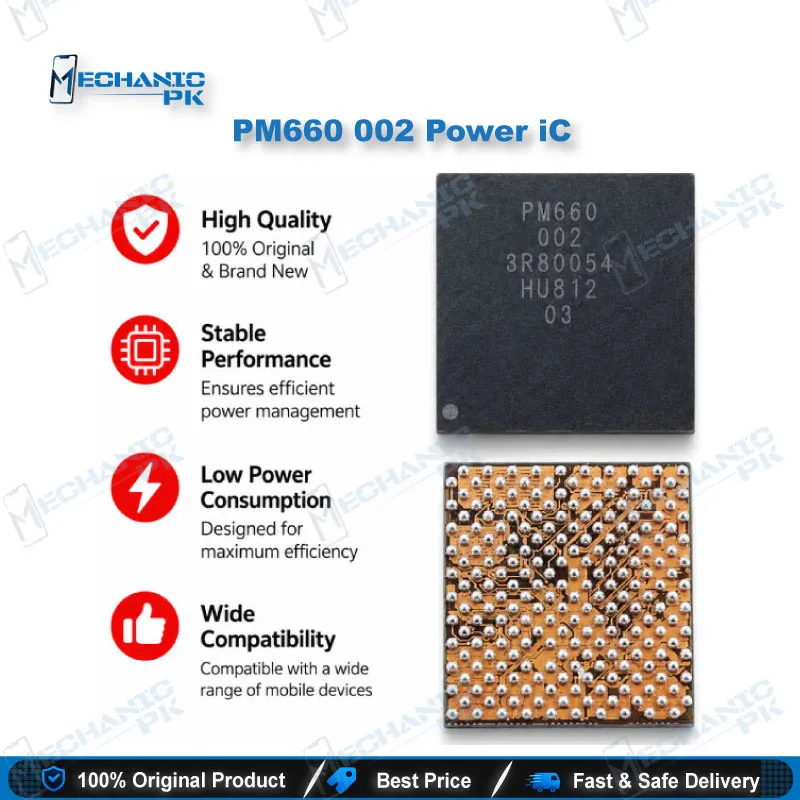
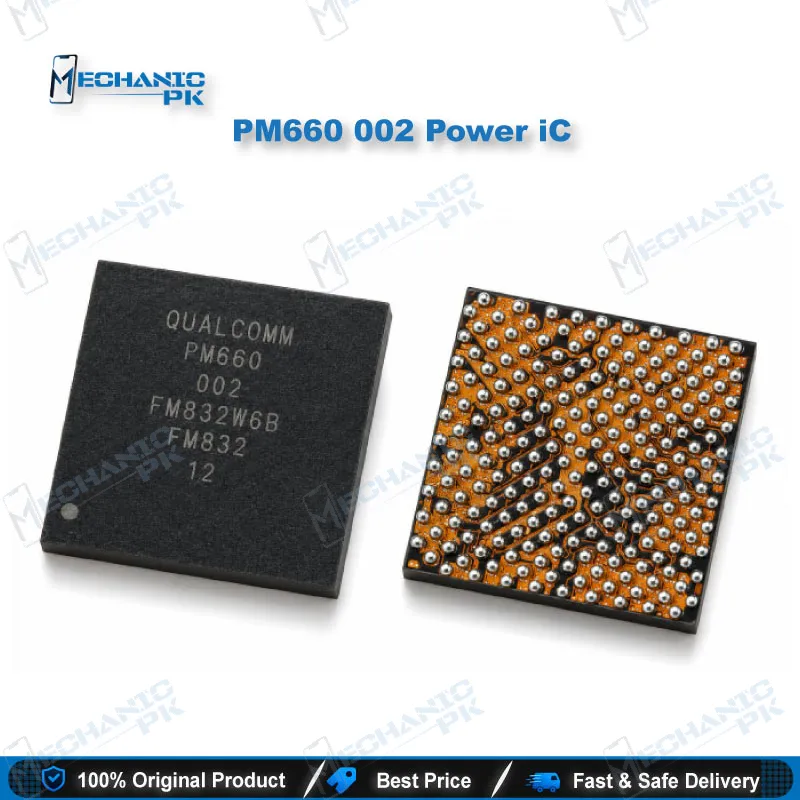
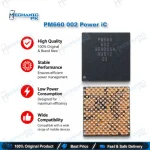
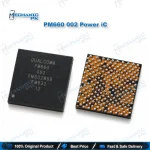
PM660 002 Power IC Qualcomm PMIC for SDM660 Boards
₨ 300
PM660 002 Power IC for Qualcomm SDM660 Platform Repair
The PM660 002 Power IC is Qualcomm’s primary power management chip for boards built on the Snapdragon 630, 636, and 660 platforms. It works as a pair with the PM660L companion PMIC and supplies the core and peripheral voltage rails that the processor, memory, and subsystems need to boot. Technicians replace this BGA chip when a Redmi Note 5 Pro, Redmi Note 7, Mi A2, or Mi Max 3 arrives as a dead phone, pulls abnormal current, or shows a short on PMIC-fed rails. Mechanicpk supplies the exact PM660-002 marking, so you can match the original part on your board before you start rework.
PM660 002 Power IC: Core PMIC for Snapdragon 630, 636 and 660 Boards
When a Snapdragon 660-series phone refuses to power on, the PM660 002 Power IC sits near the top of every board-level technician’s suspect list. Qualcomm built the PM660 as the main power management IC for SDM630, SDM636, and SDM660 platforms, and it always works alongside the PM660L. Between them, these two chips power practically every block on the board, from the CPU cores to the peripheral circuits. This listing covers the PM660-002 marking that Xiaomi, Oppo, and Vivo fitted across several high-volume models that still reach Pakistani repair benches every day.
What the Qualcomm PM660 PMIC Handles on the Board
The Qualcomm PM660 PMIC integrates six SMPS buck converters and 19 LDO regulators, according to its Linux kernel regulator documentation. Those rails feed the application processor, memory, and a long list of supporting circuits. The PM660L companion carries five SMPS, ten LDOs, a buck-or-boost regulator, and specialized display supplies. This split matters during diagnosis. A missing rail can trace back to either chip, so you need the schematic or board view to confirm which PMIC owns the dead line before you lift anything. Repair parts suppliers also list the PM660-002 as a charging and power control IC on these platforms, which explains why a stubborn charging issue that survives a port and battery swap often ends at this chip.
Diagnosing a Faulty PM660 002 Power IC
A failing PMIC rarely announces itself clearly. Typical field symptoms include a completely dead phone with zero current on the DC power supply, a board that pulls a fixed current and stops, a main-rail short that heats the PMIC within seconds, or a handset that hangs on logo after liquid damage. Before you condemn the chip, take diode-mode readings on the PMIC output rails with your multimeter and compare them against a known-good board. Apply rosin smoke or freeze spray to locate the hot spot under power. If the PM660 heats instantly while the capacitors on its output rails read normal, the chip itself carries the short and needs replacement. This step-by-step isolation stops you from swapping a healthy PMIC when the real hardware fault sits in a shorted capacitor.
Replacement Workflow and Bench Requirements
BGA PMIC work demands controlled heat and clean pads. Lock the board in a PCB holder, shield nearby plastic connectors with heat-resistant tape, and soften any underfill around the chip before lifting it. Remove the old part with a hot air station using a profile suited to your board’s solder type. Clean the pads with flux and desoldering wick, then inspect them under a microscope for lifted or torn pads. If your replacement PM660 002 Power IC arrives without solder balls, reball it with a matching stencil from your reballing kit. Align the chip with the silkscreen outline, reflow evenly, and let the board cool naturally. Power up on a DC supply first and confirm a normal boot current pattern before you reassemble the phone.
Matching the Part Marking Before You Order
Qualcomm ships the PM660 in more than one suffix variant, and parts suppliers stock both PM660-001 and PM660-002 markings. Read the full marking on your board’s original chip under magnification and match the suffix before installation. The PM660L carries a different marking and a different function, so never substitute one for the other. If you service a Redmi Note 5, confirm the variant first: the Snapdragon 636 build uses this PMIC, while the Snapdragon 625 build runs a different power platform entirely.
Building a Complete PMIC Repair Setup
A PMIC replacement ties several tool categories together. A stable soldering station handles pad leveling, a stereo microscope verifies pad condition, a multimeter confirms rail integrity, and a DC power supply or test box reveals current-draw behavior before and after the job. Many technicians also keep ISP pinout tools and eMMC programmers on the same bench, so they can pull customer data from a board with a dead power section before attempting risky rework. Stock a few spare units of the Redmi Note 7 power IC alongside this setup, and you cover one of the most frequent board-level power repairs in the Snapdragon 660 family.
| Weight | 0.1 kg |
|---|
Key Features
- Genuine PM660-002 marking that matches the original part on SDM636/SDM660 boards
- Main Qualcomm PMIC integrating 6 SMPS buck converters and 19 LDO regulators
- Works as the primary PMIC in the PM660 + PM660L power architecture
- Direct replacement for dead phone and main-rail short faults on supported models
- Covers high-volume Xiaomi models including Mi A2, Mi Max 3, Redmi Note 6 Pro, and Redmi Note 7
- BGA package suited to standard hot air and reballing workflows
- Supports charging and power control fault repair on these platforms
- Ideal stock part for repair shops servicing Snapdragon 660-series devices
Specifications
| Brand | Qualcomm |
|---|---|
| Model | PM660-002 |
| Category | Power Management IC (PMIC) |
| Compatibility | Qualcomm SDM630 / SDM636 / SDM660 platforms (paired with PM660L) |
| Supported Devices | Xiaomi, Oppo, and Vivo models on SDM636/SDM660 platforms using the PM660-002 marking |
| Technology | Multi-rail PMIC with 6 SMPS buck converters and 19 LDO regulators, BGA package |
Common Repair Uses
- Dead phone repair caused by a failed or shorted main PMIC
- Main power rail short isolation and PMIC replacement
- Charging issue repair after port, battery, and connector checks pass
- Liquid-damaged board recovery where the PMIC area shows corrosion
- Boards stuck in fixed current draw or hanging on logo due to power faults
- BGA rework practice and reballing on Snapdragon 660-series boards
- Donor-board PMIC transfer during board-level repair
- Restoring power sequencing before data recovery on customer devices
Compatible Devices
- Xiaomi Mi A2
- Xiaomi Mi Max 3
- Xiaomi Redmi Note 5 Pro / Redmi Note 5 (Snapdragon 636 variant)
- Xiaomi Redmi Note 6 Pro
- Xiaomi Redmi Note 7
- Oppo R11 / R11s
- Vivo X20 Plus
- Vivo X21
FAQ
What is the product name?
What is the brand of this product?
What is the model of this product?
What is this product used for?
Which devices are compatible with this product?
Who should use this product?
Can I replace a PM660L with the PM660 002 power IC?
How do I confirm the PM660 002 power IC is shorted before replacing it?
Related products