BQ24261M Charger IC – 3A I2C Li-ion Switch-Mode Charger
₨ 350
BQ24261M Charger IC – 3A Switch-Mode Li-ion Charger for Mobile Boards
The BQ24261M Charger IC is a Texas Instruments single-cell, switch-mode buck charger built for phones and tablets that need high-current, processor-controlled charging. It handles up to 3A of charge current, accepts a 4.2V to 13.2V operating input with 30V input tolerance, and takes its settings over I2C from the main processor. Integrated power-path management, input overvoltage protection, battery temperature monitoring, and USB OTG support make it the core of the charging section on every board that uses it. Mechanicpk supplies it for technicians handling no-charging, slow-charging, and input-short faults at board level.
BQ24261M Charger IC for Single-Cell Phone Charging Circuits
The BQ24261M Charger IC from Texas Instruments is a host-controlled, single-cell switch-mode Li-ion charger that sits between the USB input and the battery on the phones and tablets built around it. It runs from a 4.2V to 13.2V operating input, withstands up to 30V on the input side, and pushes up to 3A of charge current under I2C control from the application processor. When this chip fails, the board loses its entire charging path, so an exact replacement matters far more than a near match.
How the Charger Works Inside the Power Path
Unlike a simple linear charger, this IC uses a buck converter topology, which steps the incoming adapter voltage down efficiently and wastes less energy as heat. Its power-path management feeds the system rail directly from the input, so the phone can boot and run from the charger while the battery charges on its own path. The processor talks to the chip over I2C and sets charge voltage, charge current, and input limits through registers. That host-controlled design explains why a fault on the I2C lines or a firmware problem can look exactly like a hardware failure of the charger itself.
BQ24261M Charger IC Technical Capabilities
TI rates the battery regulation voltage across a 3.5V to 4.44V window, which covers standard 4.2V cells as well as higher-voltage Li-polymer packs. The chip includes input overvoltage protection, battery thermistor monitoring with both JEITA and hot/cold temperature profiles, and integrated USB OTG support, so the same IC can power an external accessory through the charging port. TI lists an operating temperature range of -40°C to 85°C. For a buyer who knows the industry, these figures place the part firmly in the 3A I2C battery charger IC class rather than the basic standalone charger class.
Common Charging Faults Linked to This IC
Technicians usually reach for a replacement BQ24261M Charger IC when a phone shows no charging response at all, charges at a fraction of its normal current, or heats up around the charger area the moment you connect a cable. A shorted input stage can pull the USB line down and leave a dead phone that ignores every adapter. Surges from cheap or faulty adapters cause much of this damage, which fits the IC’s position as the first stage after the charging port. A failed OTG function with charging still working can also trace back to this chip. Always confirm the fault with a USB ammeter and a multimeter before you lift the IC.
Package Variants and Board Identification
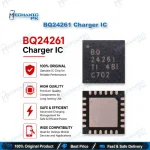
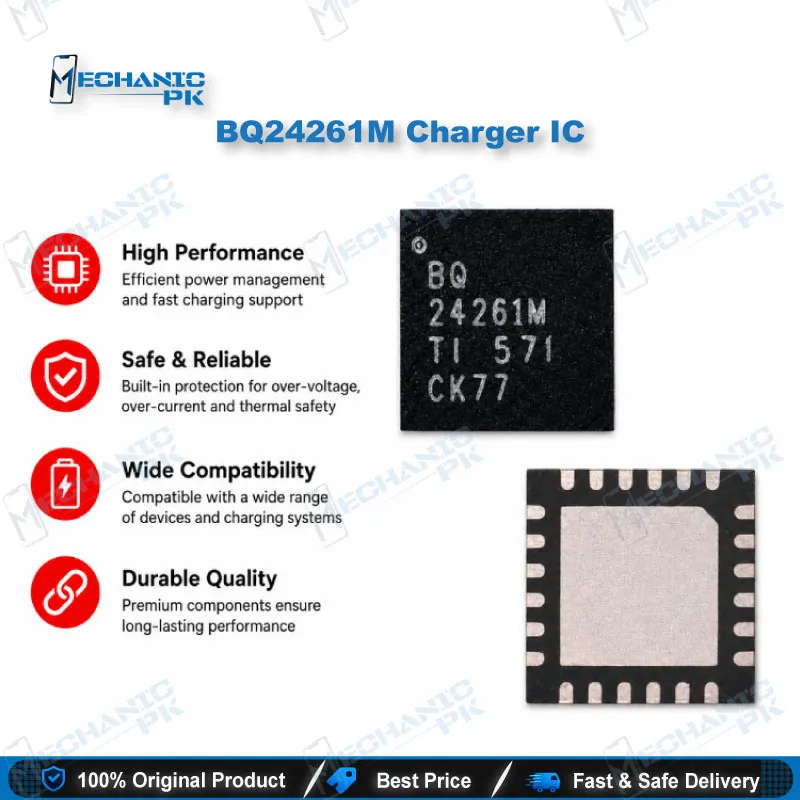
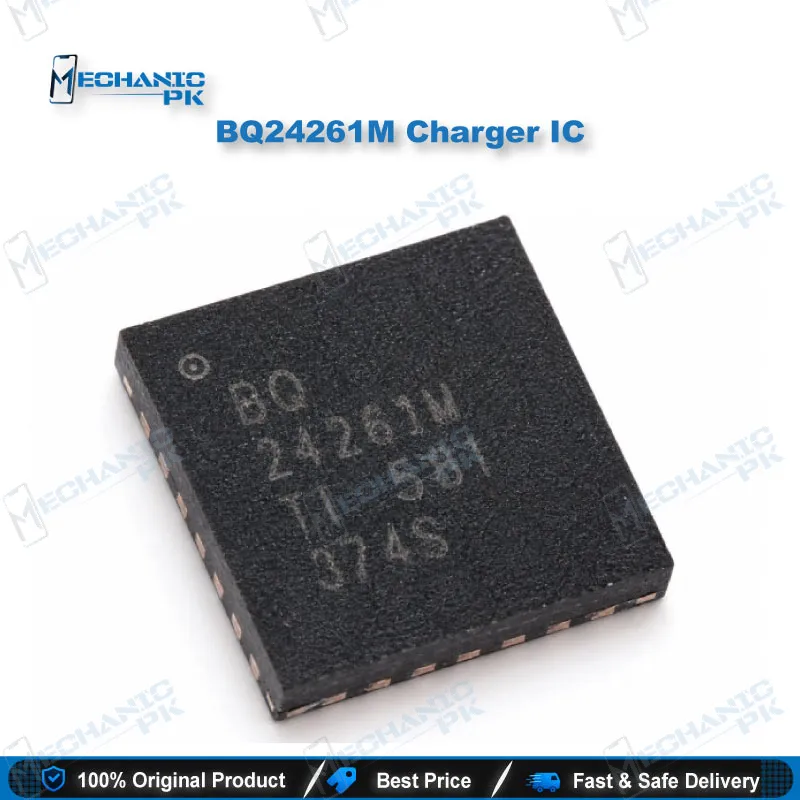
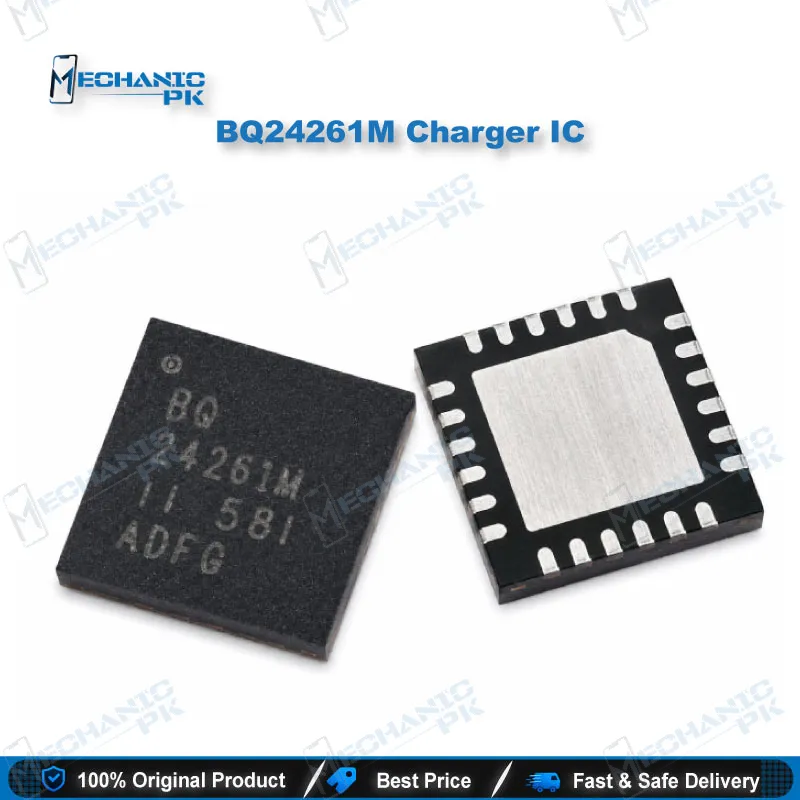
TI produced the BQ24261M in two packages: a 36-ball DSBGA (YFF) wafer-level package for space-limited phone boards, and a 24-pin VQFN (RGE) package measuring 4 x 4 mm. The DSBGA version carries the BQ24261M marking in one line, while the VQFN version splits the marking across two lines as “BQ” and “24261M”. Check the footprint on your board under a microscope before ordering, since the two packages cannot substitute for each other.
Replacement Workflow on the Repair Bench
Secure the board in a PCB holder, shield nearby components, and lift the old chip with a hot air station at controlled airflow. Clean the pads with a soldering station and desoldering wick, then inspect them under a microscope for lifted or torn pads. For the DSBGA variant, reball the chip with a matching stencil from a reballing kit, align it carefully, and reflow it with good-quality flux. After fitting, check the VBUS and VBAT lines in diode mode with a multimeter before the first power-on, then confirm actual charge current with a USB ammeter.
Supply Status and Why Exact Stock Matters
TI now lists the BQ24261M as obsolete and points new designs toward the BQ25601, which uses a different WQFN package. That shift makes genuine stock harder to source for repair work, because a newer charger will not drop onto an existing BQ24261M footprint. Keeping genuine BQ24261M charging IC stock on hand lets your workshop close charging repairs without modifying anything on the board.
| Weight | 0.1 kg |
|---|
Key Features
- Switch-mode buck topology delivers up to 3A of charge current with lower heat than linear chargers
- Operating input range of 4.2V to 13.2V with a 30V absolute maximum input rating
- Battery regulation voltage programmable from 3.5V to 4.44V for standard and high-voltage cells
- I2C host control lets the processor set charge current, charge voltage, and input limits
- Power-path management runs the system from the adapter while the battery charges separately
- Input overvoltage protection guards the board against faulty or unstable adapters
- Battery thermistor monitoring supports both JEITA and hot/cold temperature profiles
- Integrated USB OTG support for powering external accessories through the charging port
Specifications
| Brand | Texas Instruments |
|---|---|
| Model | BQ24261M |
| Category | Battery Charger IC (Mobile Charging IC) |
| Compatibility | Single-cell Li-ion / Li-polymer charging circuits that use the BQ24261M |
| Supported Devices | Phones and tablets with BQ24261M on the board |
| Technology | Switch-mode buck charger, I2C host control, power path, USB OTG |
| Package | 36-ball DSBGA (YFF) / 24-pin VQFN (RGE) |
| Input Voltage | 4.2V–13.2V operating; 30V absolute maximum |
| Output Voltage | 3.5V–4.44V battery regulation |
| Charge Current | Up to 3A |
| Operating Temperature | -40°C to 85°C |
| Dimensions | 4 x 4 x 0.88 mm (VQFN RGE package) |
Common Repair Uses
- Replacing a failed charger IC on phones that show no charging response
- Fixing slow charging or abnormally low charge current
- Clearing a shorted VBUS/input line caused by a damaged charger stage
- Repairing a dead phone after an adapter surge or overvoltage event
- Fixing heating around the charging section when a cable connects
- Restoring a USB OTG output that no longer powers accessories
- Replacing the IC during charging-section rework after liquid damage
- Reballing and refitting the DSBGA variant after pad cleaning
Compatible Devices
- Verified at circuit/chip level — not device-specific; confirm the BQ24261M marking on your board before replacing.
- Mobile phones whose schematic or board marking lists BQ24261M at the charger position
- Tablets and handheld devices built around a BQ24261M charging circuit
- Boards with a 36-ball DSBGA (YFF) charger footprint marked BQ24261M
- Boards with a 24-pin VQFN (RGE) 4 x 4 mm charger footprint marked BQ24261M
- Single-cell Li-ion battery devices
- Single-cell Li-polymer devices with a charge voltage within 3.5V–4.44V
- Devices that use I2C host-controlled charging from the main processor
- USB-powered devices that use the charger for USB OTG output
FAQ
What is the product name?
What is the brand of this product?
What is the model of this product?
What is this product used for?
Which devices are compatible with this product?
Who should use this product?
What is the maximum input voltage of the BQ24261M Charger IC?
Can the BQ25601 replace the BQ24261M on a phone board?
Related products