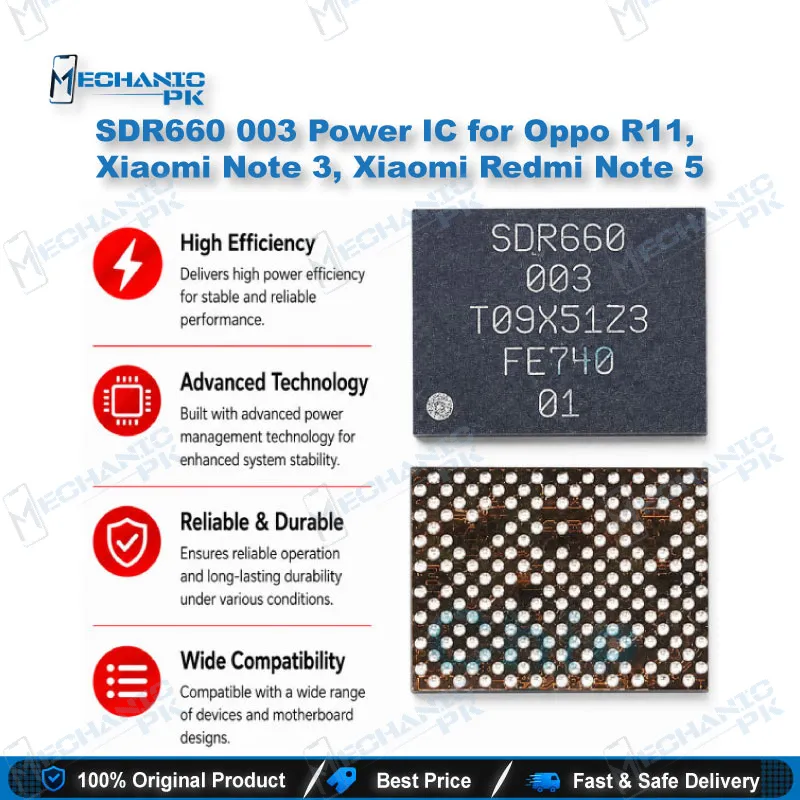
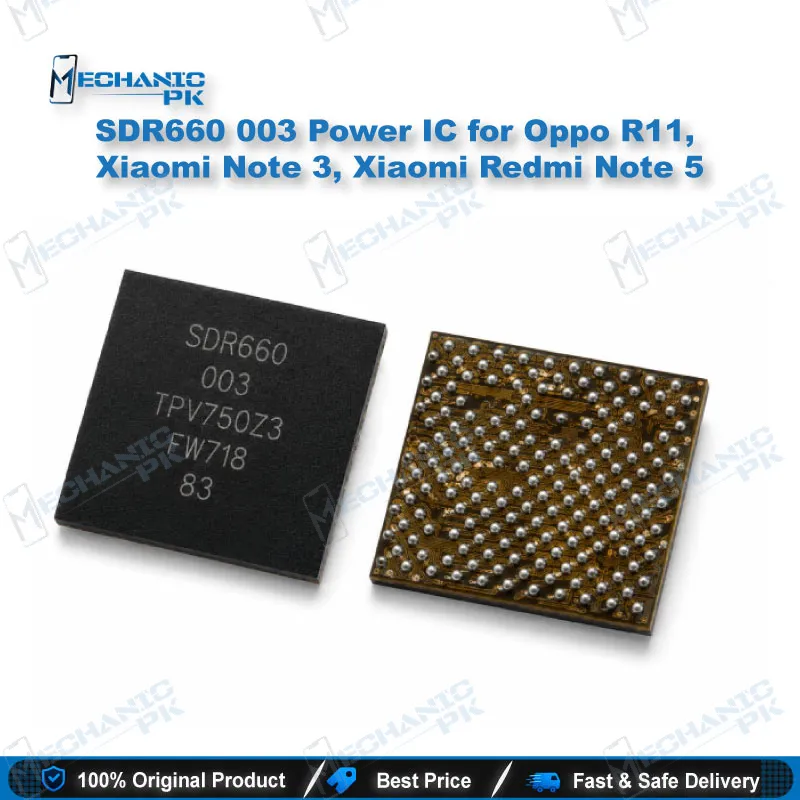
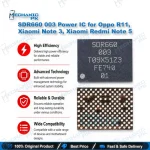
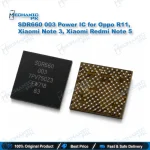
SDR660 003 RF IC for Oppo R11, Mi Note 3, Redmi Note 5
₨ 200
SDR660 003 RF IC – Qualcomm Network Transceiver
The SDR660 003 Power IC for Oppo R11, Xiaomi Note 3, Xiaomi Redmi Note 5 is, in technical terms, the Qualcomm SDR660 RF transceiver. It works with the Snapdragon X12 LTE modem on Snapdragon 660 class motherboards. The chip converts signals between the modem and the antenna front end, so a failed unit causes network faults rather than power faults. Typical symptoms include no service, emergency calls only, and a signal that drops in and out after a fall or water damage. This SDR660 003 RF IC suits board-level technicians who handle network section repair, reballing, and IC replacement on Oppo and Xiaomi Snapdragon 660 platforms.
SDR660 003 RF IC: Qualcomm LTE Transceiver for Snapdragon 660 Boards
The SDR660 003 RF IC is the Qualcomm radio frequency transceiver that sits between the Snapdragon X12 LTE modem and the antenna front end on Snapdragon 660 class motherboards. Many suppliers list it as the SDR660 003 Power IC for Oppo R11, Xiaomi Note 3, Xiaomi Redmi Note 5, but this chip handles signal conversion, not power regulation. That difference matters on your bench. A phone with a faulty transceiver still boots and runs normally, while a dead phone with no current draw points you toward the PMIC instead.
Where the SDR660 Fits in the Signal Path
Qualcomm launched the SDR660 alongside the Snapdragon 660 and 630 platforms and paired it with the X12 LTE modem, which brought 600 Mbps peak downlink to the 600 tier for the first time. On the board, the transceiver converts baseband data into RF for transmission and converts received RF back into baseband for the modem. It feeds the power amplifier modules on the transmit side and collects signals from the receive paths. When this stage fails, the phone shows a network issue: no service, emergency calls only, unstable signal bars, or a SIM card that the phone detects but never registers on the network.
Diagnosing an SDR660 Fault Before You Replace It
Experienced technicians rule out cheaper causes first. Check the antenna coax connections, the SIM tray contacts, and the antenna springs on the frame. Then rule out software. A corrupted modem partition or a damaged QCN produces symptoms very similar to a hardware fault, so a clean flash with your test box comes before any IC change. If the network stays dead after a verified flash, move to the board. Measure the supply rails around the transceiver with a multimeter, compare them against a working board, and inspect the area under a stereo microscope for corrosion, lifted pads, or cracked solder balls. Drop damage and water damage cause most SDR660 failures, so the microscope stage often tells you the answer before you pick up the hot air gun.
Replacement Workflow for the SDR660 003 RF IC
Mount the motherboard in a stable PCB holder and remove the RF shield carefully to protect nearby components. Apply flux and heat the chip with a hot air station at a controlled temperature. A preheater reduces board stress on multilayer Snapdragon 660 boards. If the board uses underfill around the chip, soften and clear it before you lift the IC, otherwise you risk tearing pads. Clean the pads with a soldering station and desoldering wick until they sit flat and bright. Reball the new SDR660 003 RF IC with a BGA reballing kit and the correct stencil, align it to the silkscreen marks, and reflow. After assembly, confirm network registration, check signal strength in field test mode, and make a test call on each SIM slot.
Compatibility Scope and Chip Marking
The Oppo R11 and the Xiaomi Mi Note 3 both run on the Snapdragon 660, which pairs with this transceiver. The Redmi Note 5 shipped in more than one hardware version depending on region, so open the board and confirm the SDR660 marking before ordering. Always match the full “SDR660 003” top marking on the original chip. Board-level matching protects you from a wasted IC change and a repeat job.
Why Repair Centers Keep the SDR660 in Stock
Snapdragon 660 phones from Oppo and Xiaomi remain in active circulation, and network section faults on these boards show up regularly at service counters. Holding the SDR660 003 RF IC in stock lets you finish a no-service repair in a single visit instead of waiting on a supplier. For complete network section work, pair it with a quality reballing kit, a stereo microscope, and a reliable hot air station so every replacement meets professional standards.
| Weight | 0.1 kg |
|---|
Key Features
- Qualcomm SDR660 RF transceiver with the original 003 top marking
- Pairs with the Snapdragon X12 LTE modem on Snapdragon 660 and 630 platforms
- Handles transmit and receive signal conversion between modem and antenna front end
- Fixes hardware-level network faults that a firmware flash cannot resolve
- Direct replacement for the Oppo R11 and Xiaomi Mi Note 3 network section
- Ball-grid package ready for reballing with a standard BGA stencil
- Suited to hot air rework with preheating on multilayer boards
- Lets repair centers complete no-service jobs in a single visit
Specifications
| Brand | Qualcomm |
|---|---|
| Model | SDR660 (003 marking) |
| Category | RF Transceiver IC / Network IC |
| Compatibility | Snapdragon 660 and 630 platforms with Snapdragon X12 LTE modem |
| Supported Devices | Oppo R11, Xiaomi Mi Note 3, Xiaomi Redmi Note 5 (SDR660-equipped boards) |
| Technology | LTE RF transceiver paired with Qualcomm Snapdragon X12 LTE modem |
Common Repair Uses
- No service or no signal repair after a verified software flash
- Emergency calls only fault on Snapdragon 660 boards
- Weak or unstable network signal after drop damage
- Network section repair on water-damaged motherboards
- Replacing a cracked or shorted RF transceiver
- Reballing the network transceiver to fix cracked solder joints
- Network section rebuild after a failed previous rework
Compatible Devices
- Oppo R11
- Xiaomi Mi Note 3
- Xiaomi Redmi Note 5 (versions that carry the SDR660 on the board — confirm marking before ordering)
- Motherboards built on the Qualcomm Snapdragon 660 platform with SDR660 transceiver
- Motherboards built on the Qualcomm Snapdragon 630 platform with SDR660 transceiver
- Any board with an original chip marked "SDR660 003"
FAQ
What is the product name?
What is the brand of this product?
What is the model of this product?
What is this product used for?
Which devices are compatible with this product?
Who should use this product?
Is the SDR660 a power IC or a network IC?
Will replacing the SDR660 fix no service on Oppo R11 if the problem is software?
Related products