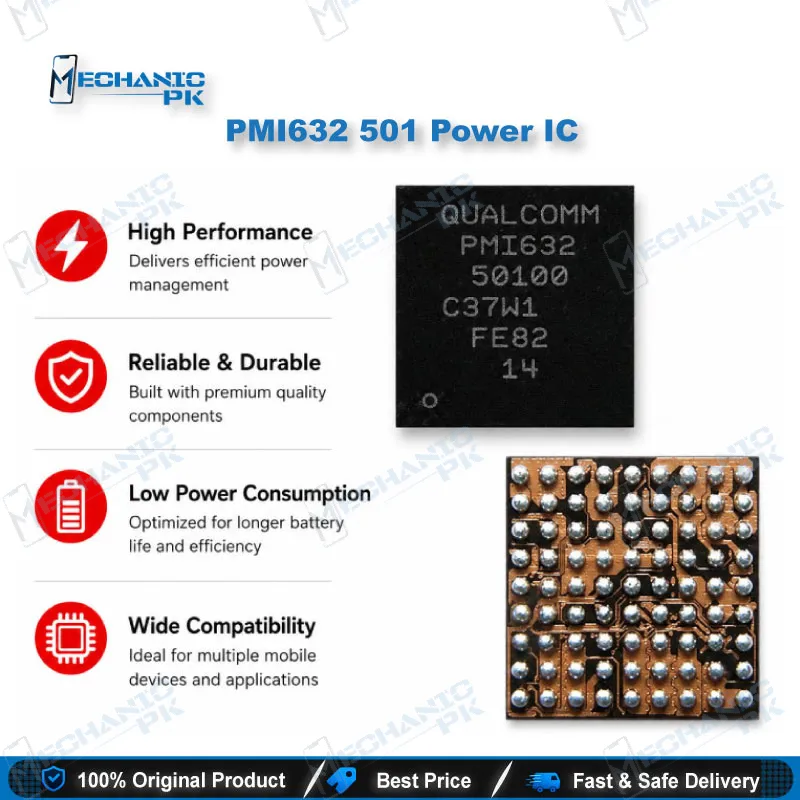
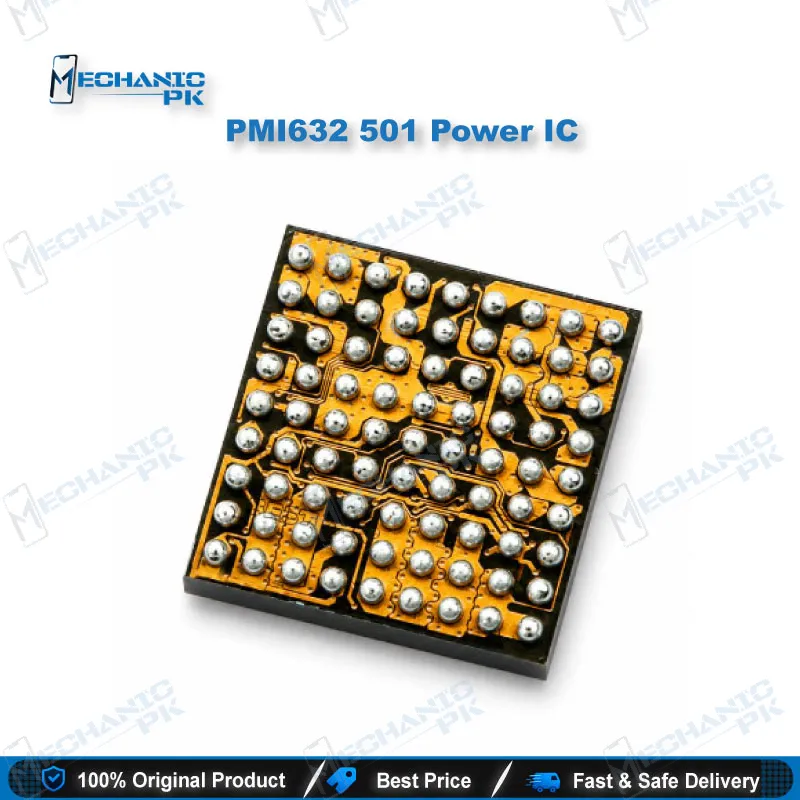
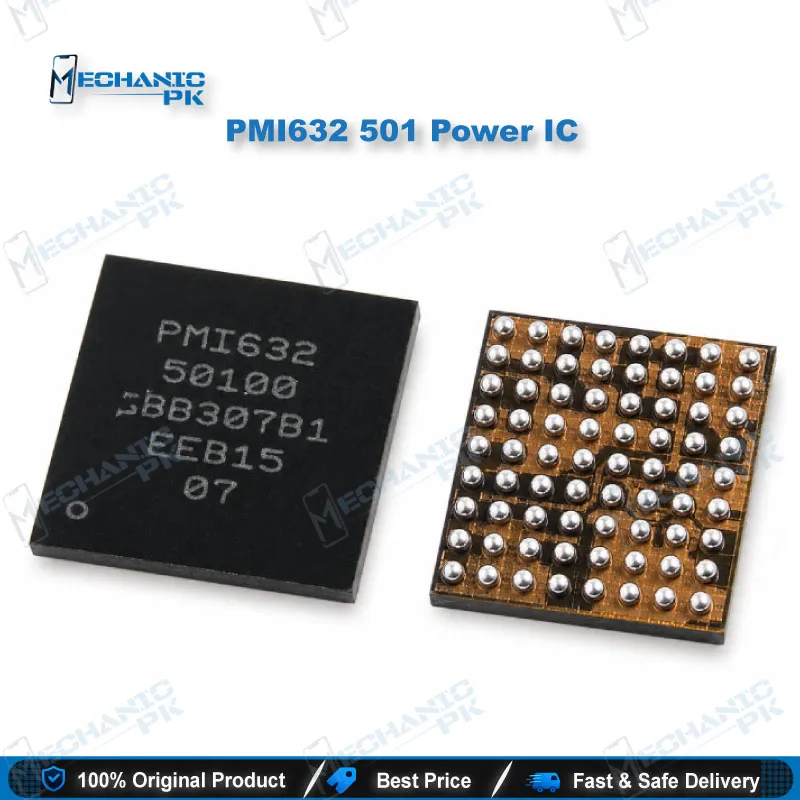
PMI632 501 Power IC – Qualcomm PMIC for Snapdragon 632
₨ 450
PMI632 501 Power IC – Qualcomm PMIC Overview
The PMI632 501 Power IC is Qualcomm’s companion power management chip for Snapdragon 632 and Snapdragon 439 smartphone boards. It runs battery charging, fuel gauging, USB Type-C detection, OTG output, vibration motor drive and thermal monitoring from a single WLCSP package. Technicians replace it when a board shows no charging after a battery and port swap, a fuel gauge that misreports, or a dead phone traced to a shorted power line. Match the PMI632 part number and the 501 suffix on your original chip before ordering, then fit it with hot air, a stencil and clean flux for a reliable board-level repair.
PMI632 501 Power IC: Qualcomm Charging and Power Management for Snapdragon 632 and 439 Boards
The PMI632 501 Power IC is a Qualcomm power management chip that sits beside the application processor on Snapdragon 632 and Snapdragon 439 smartphone boards. It runs the battery charger, the fuel gauge, USB Type-C detection and a set of support blocks the phone needs before it can boot. When this chip fails, you typically face a dead phone, a board that refuses to charge, or a battery percentage that jumps without reason. Mechanicpk supplies the PMI632 501 Power IC for technicians who need an exact-marking replacement for board-level PMIC work.
What the PMI632 Controls on the Board
Qualcomm builds the PMI632 on TSMC’s 0.13 µm bipolar-CMOS-DMOS (BCD) process and ships it in a wafer-level chip-scale package (WLCSP). Qualcomm’s Linux kernel sources list the blocks it carries: a switch-mode battery charger with step charging and software JEITA temperature control, the QGauge fuel gauge, a USB Type-C port controller, a VBUS regulator for OTG output, an ADC for thermistor readings, eight GPIOs, a haptics driver for the vibration motor, and an LPG module with five PWM channels, three of which can drive an RGB notification LED. Qualcomm’s reference thermal configuration sets passive, hot and critical trips at 95 °C, 115 °C and 125 °C for the chip’s die sensor. Because one IC handles this many functions, a single fault can surface as several unrelated symptoms.
Platform Compatibility and the 501 Marking
Kernel developers describe the PMI632 as the PMIC commonly paired with the SDM632 chipset, and Qualcomm’s SDM439 device tree pairs the two as well. The Fairphone 3, an SDM632 phone, runs the PMI632 under the mainline Linux kernel. Qualcomm’s Snapdragon 662/460 (“bengal”) reference designs also include PMI632 configurations. In the Pakistani repair market, you will mostly meet this chip on budget Xiaomi Redmi, Oppo and Vivo boards built on these platforms. Before you order, read the marking on the original chip and match both the PMI632 part number and the 501 suffix, rather than assuming every board on the same chipset uses the identical variant.
Repair Faults That Point to the PMI632 501 Power IC
Charging faults top the list. A phone that shows no charging even after a new battery and charging port, a charge counter that stalls at a fixed percentage, or a board that only runs on the charger all deserve a PMIC check once you rule out the port, flex and battery. A short on the VBUS or battery line that heats this chip during a thermal camera or rosin test, a dead phone with no current draw on a DC power supply, and a vibration motor or OTG port that stops responding after liquid damage can all trace back to the same IC. Measure the surrounding capacitors and coils in diode mode before you commit to a PMIC change.
Replacement Workflow on the Bench
Lock the board in a PCB holder and inspect the area under a microscope for corrosion, lifted pads or cracked balls. Shield nearby plastic connectors, then lift the old chip with a hot air station and good flux. Clean the pads with solder wick and a soldering station, level them, and check for torn pads before placement. The WLCSP package leaves no tolerance for bridged or missing balls, so keep a matching stencil from your reballing kit ready if you reball a salvaged part. After placement, power the board through a DC supply and watch the current curve for a normal boot instead of a hang on logo before you reassemble.
Why Technicians Source It from Mechanicpk
Mechanicpk stocks power ICs alongside the full board-repair toolkit, so you can order the PMI632 501 Power IC with the hot air stations, soldering stations, microscopes, reballing kits, PCB holders and multimeters your PMIC work depends on. For software-side diagnosis on the same boards, our ISP pinout tools, eMMC programmers, UFS adapters and test boxes cover dead-after-flash and boot loop cases where a hardware fault is not the real culprit. Every Mechanicpk listing states only verified technical data, so this page reflects what Qualcomm documentation and kernel sources confirm for this chip.
| Weight | 0.1 kg |
|---|
Key Features
- Qualcomm PMIC built on TSMC 0.13 µm BCD process in a compact WLCSP package
- Integrated switch-mode battery charger with step charging and software JEITA control
- QGauge fuel gauge for battery state-of-charge reporting
- USB Type-C port controller with VBUS regulator for OTG output (no USB Power Delivery)
- Haptics driver for the phone's vibration motor
- LPG module with five PWM channels, three usable for an RGB notification LED
- Eight GPIOs and an ADC for thermistor and system readings
- Die-temperature sensor with hardware thermal mitigation support
Specifications
| Brand | Qualcomm |
|---|---|
| Model | PMI632 501 |
| Category | Power Management IC (PMIC) / Charging IC |
| Compatibility | Qualcomm Snapdragon 632 (SDM632) and Snapdragon 439 (SDM439) platforms |
| Supported Devices | Boards whose original PMIC carries the PMI632 501 marking |
| Technology | TSMC 0.13 µm BCD process, WLCSP package |
Common Repair Uses
- No charging fault that persists after battery and charging port replacement
- Battery percentage stuck, jumping or misreporting (fuel gauge fault)
- Dead phone with a shorted VBUS or battery line at the PMIC
- Phone that only powers on while connected to the charger
- USB Type-C detection or OTG output failure
- Vibration motor not working after board damage
- RGB notification LED failure on boards that use the PMI632 LPG
- PMIC replacement during liquid-damage and board refurbishment work
Compatible Devices
- Chipset-platform scope; confirm the original chip marking before replacement
- Qualcomm Snapdragon 632 (SDM632) platform boards
- Qualcomm Snapdragon 439 (SDM439) platform boards
- Fairphone 3 (SDM632, PMI632 confirmed in mainline kernel)
- Snapdragon 662 (SM6115) reference designs with PMI632 configuration
- Snapdragon 460 (SM4250) reference designs with PMI632 configuration
- Xiaomi Redmi boards built on these platforms with PMI632 501 marking
- Oppo and Vivo boards built on these platforms with PMI632 501 marking
- Any board where the original PMIC reads PMI632 501
FAQ
What is the product name?
What is the brand of this product?
What is the model of this product?
What is this product used for?
Which devices are compatible with this product?
Who should use this product?
Does the PMI632 501 Power IC support USB Power Delivery fast charging?
Which Qualcomm chipsets use the PMI632 PMIC?
Related products