















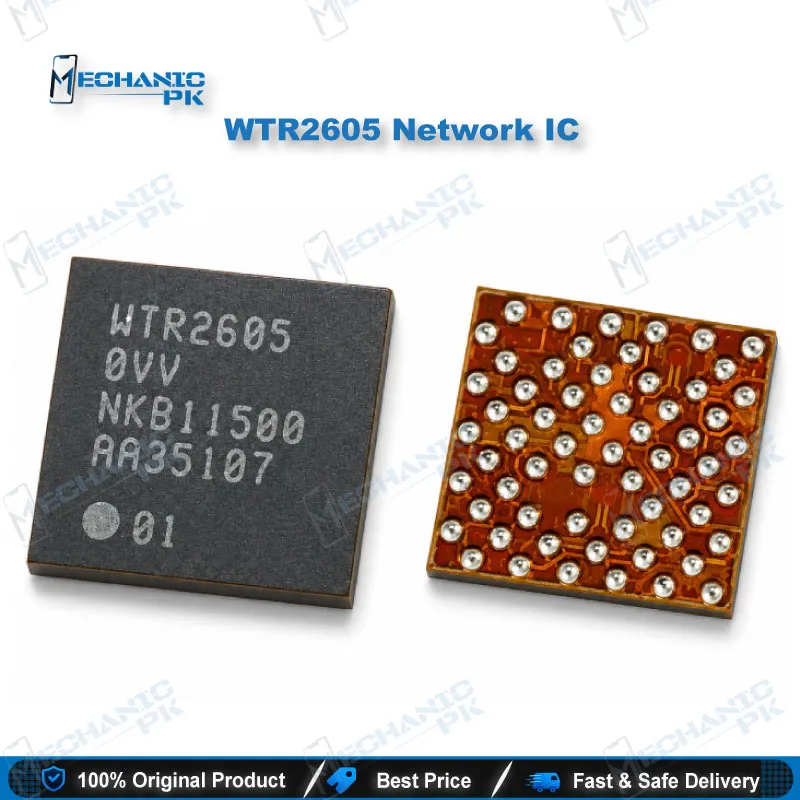
Qualcomm WTR2605 Network IC – RF Transceiver for MSM8226
₨ 250
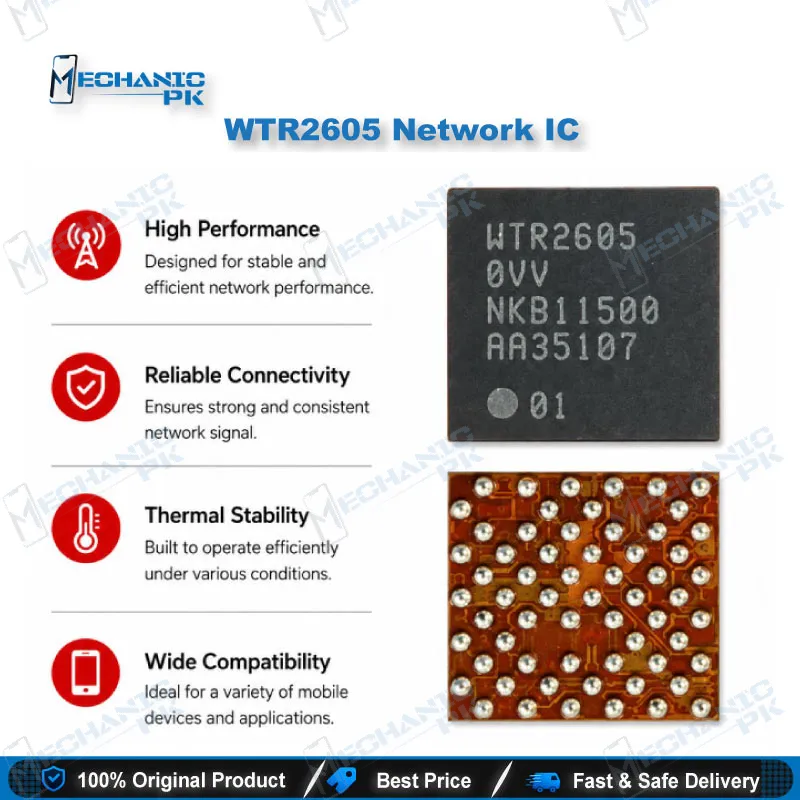
Qualcomm WTR2605 Multimode RF Transceiver IC
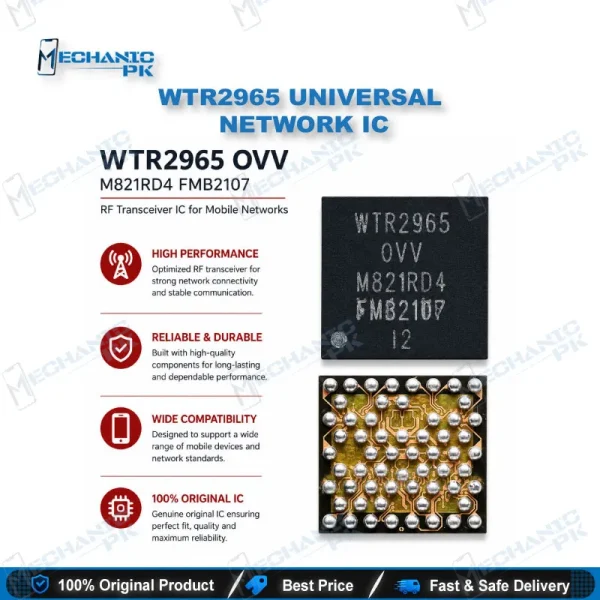
The Qualcomm WTR2605 network IC is the multimode radio transceiver that Qualcomm built for its MSM8226 and MSM8626 smartphone platforms. It covers TD-SCDMA, CDMA 1xAdv and HSPA+, and it carries an integrated GPS core with GLONASS and BeiDou support. Qualcomm rates it at 40 percent lower power and a 60 percent smaller footprint than the previous transceiver generation. Technicians replace it when a board keeps a valid baseband but shows permanent no service, weak 3G signal or no satellite lock. Match the WTR2605 marking on your board, and you get the exact Qualcomm part for a clean RF section repair.
WTR2605 Network IC for MSM8226 and MSM8626 RF Repairs
The WTR2605 network IC is Qualcomm’s multimode radio transceiver, and it sits between the antenna front end and the baseband on MSM8226 and MSM8626 phone designs. Qualcomm launched it alongside those chipsets to do one job: convert incoming RF into I/Q data for the baseband, then synthesize outgoing I/Q data back into RF for transmission. When this part fails, the phone loses its link to the network while the processor, memory and display keep working normally. Mechanicpk stocks the WTR2605 for technicians who have traced a no-service fault to the transceiver and need the exact Qualcomm part number, not a nearby substitute.
Radio Coverage and GNSS Built Into One Transceiver
Qualcomm designed the WTR2605 around 3G multimode coverage. The transceiver handles TD-SCDMA, CDMA 1xAdv and HSPA+, which lets one board design serve both UMTS and CDMA carriers. It also carries an integrated GPS core with GLONASS and BeiDou support, so location services run through this same chip instead of a separate GNSS receiver. That detail matters on your bench: a phone that shows no signal and no satellite lock at the same time points straight at the transceiver rather than at two unrelated faults. Qualcomm rated the WTR2605 at 40 percent lower power draw and a 60 percent smaller footprint than the generation before it. Read the smaller footprint as a precision warning, because tight pad spacing leaves little margin for excess heat or a misaligned placement. Qualcomm never positioned this part for LTE; it aimed the MSM8226 and MSM8626 platforms at high-volume 3G handsets.
Diagnosing the RF Section Before You Change the IC
Confirm the fault before you lift anything. A healthy baseband with a valid IMEI but a permanent “No Service” or “Searching” status narrows the network issue to the RF chain: antenna, switch, filters, power amplifier and the transceiver itself. Check the antenna feed and switch first, then measure the transceiver supply rails with a multimeter against the board schematic. On WCDMA and CDMA designs, test the PA module ahead of the WTR2605 as well; Qorvo built its TQM7M6025 PA module specifically to pair with this transceiver for WCDMA bands 2, 5, 25 and 26 plus CDMA BC0 and BC1. If the rails read correct and the front end tests good, yet the phone still drops the network after a fall or liquid exposure, the transceiver becomes your prime suspect. Rosin vapor or a thermal camera on a powered board also exposes a shorted transceiver in seconds.
WTR2605 Network IC Replacement Workflow on Your Bench
An IC change karna job on the WTR2605 rewards patience. Clamp the board in a PCB holder, shield nearby plastic connectors and small capacitors, and clear any underfill around the transceiver before you apply heat. Lift the old chip with a hot air station on a controlled profile, then clean the pads with flux and wick until every pad sits flat and bright. Inspect the area under a microscope for lifted pads or torn traces, and repair them with a fine jumper before you place the new part. Align the WTR2605 by its pin-1 marker, reflow it evenly, and let the board cool naturally. If you salvage a transceiver from a donor board, a matching reballing kit and stencil restore the solder balls before refitting. After assembly, check signal bars, place a test call, open a data session and run a GPS lock test to confirm every path works. For shops that handle RF work daily, the logical upgrade is a dedicated BGA rework station paired with a stable boom microscope, which shortens every transceiver job.
| Weight | 0.1 kg |
|---|
Key Features
- Genuine Qualcomm multimode RF transceiver, part number WTR2605
- Native transceiver for MSM8226 and MSM8626 platforms, including QRD versions
- TD-SCDMA 3G support
- CDMA 1xAdv support
- HSPA+ support
- Integrated GPS core with GLONASS and BeiDou
- 40 percent lower power than the previous Qualcomm transceiver generation
- 60 percent smaller footprint than the previous generation
Specifications
| Brand | Qualcomm |
|---|---|
| Model | WTR2605 |
| Category | Network IC (Multimode RF Transceiver) |
| Compatibility | Qualcomm MSM8226, MSM8626, QRD8226 and QRD8626 platforms |
| Supported Devices | 3G smartphones built on the MSM8226 / MSM8626 platforms |
| Technology | Multimode RF transceiver — TD-SCDMA, CDMA 1xAdv, HSPA+, integrated GNSS (GPS, GLONASS, BeiDou) |
Common Repair Uses
- Board-level RF section repair on WTR2605-equipped boards
- No service or permanent “Searching” with a valid IMEI
- Emergency-calls-only fault after a drop or liquid damage
- Weak or unstable 3G HSPA+ signal and data
- GPS, GLONASS or BeiDou not locking satellites
- Shorted transceiver found through rosin or thermal testing
- Transceiver replacement after RF section burn damage
- Donor-board transceiver reball and refit
- RF section practice in technical training institutes
Compatible Devices
- Verified at chipset-platform level. Match the WTR2605 marking on the board before ordering.
- Qualcomm MSM8226-based smartphones
- Qualcomm MSM8626-based smartphones
- QRD8226 reference-design handsets
- QRD8626 reference-design handsets
- TD-SCDMA 3G handsets on MSM8x26 platforms
- CDMA 1xAdv handsets on the MSM8626 platform
- HSPA+ handsets on the MSM8226 platform
- Dual-SIM (DSDS / DSDA) handsets on MSM8226 / MSM8626
FAQ
What is the product name?
What is the brand of this product?
What is the model of this product?
What is this product used for?
Which devices are compatible with this product?
Who should use this product?
Does the WTR2605 network IC support 4G LTE?
Can a faulty WTR2605 cause GPS not working along with no service?
Related products