















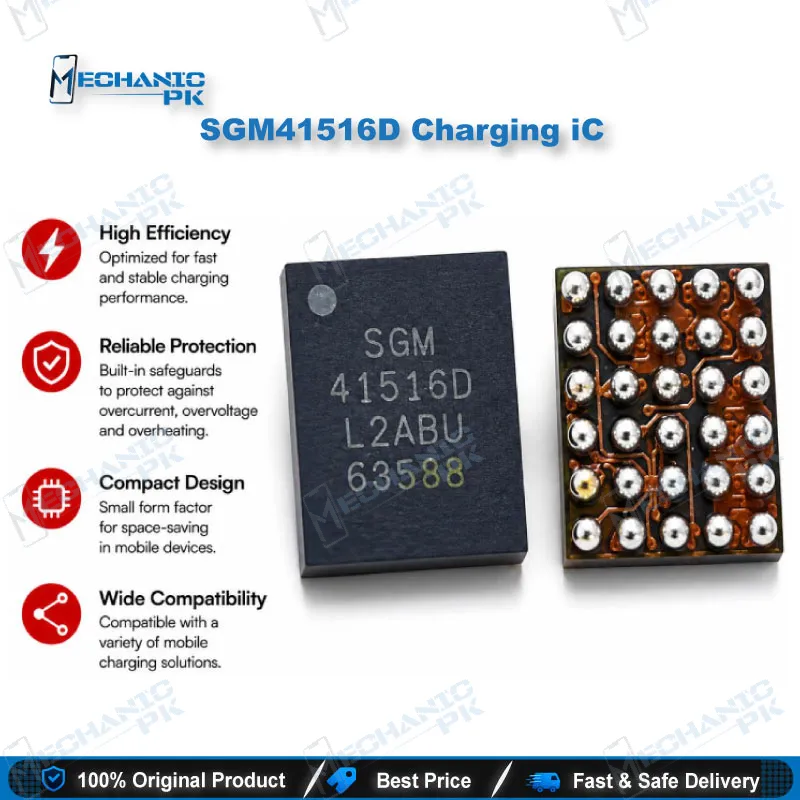
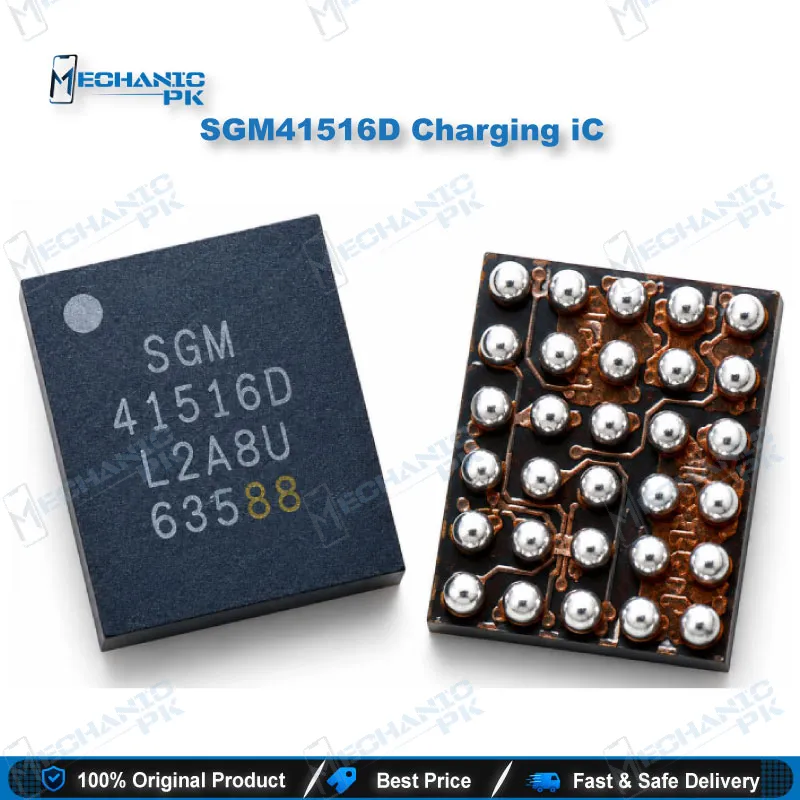
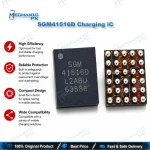
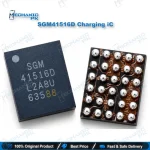
SGM41516D Charging IC – 3.78A NVDC Battery Charger
₨ 300
SGM41516D Charging IC for Single-Cell Li-Ion Battery Charging
The SGM41516D is a 3.78A single-cell battery charger IC with NVDC power path management, built for smartphones, tablets, and portable systems. It accepts a 3.9V to 13.5V input and charges Li-Ion or Li-polymer cells under I2C control. Its 1.5MHz synchronous buck charger handles fast charging from USB and 9V or 12V adapters, while the integrated boost converter supplies up to 1.2A for OTG accessories. On the repair bench, this is the charging stage you check when a handset shows a charging issue or fails to charge after liquid damage. The WLCSP-2.0×2.4-30B package requires fine-pitch rework equipment and a microscope.
Out of stock
SGM41516D Charging IC: Technical Overview
The SGM41516D charging IC handles the battery side of the charging path in single-cell Li-Ion and Li-polymer devices. It combines a buck charger, a power path manager, and a boost converter in one package, so a single chip covers charging, system supply, and reverse power output. For technicians, this integration means a faulty charger stage can explain many symptoms, from no charging to a phone that runs only while a charger stays connected. Understanding how this IC moves power between the input, the battery, and the system helps you isolate faults faster on your repair bench. The device also supports I2C programming, so host software can adjust charging parameters instead of relying only on fixed hardware values.
Charging Performance and Power Path Behavior
The SGM41516D delivers up to 3.78A of charge current through a 1.5MHz synchronous buck stage. The datasheet lists 95.5% charge efficiency at 1A from a 5V input and 92.5% at 2A from a 9V input. These figures matter when you assess heat on a board, because a more efficient charger produces less heat under load. The device uses NVDC power path management, which keeps the system supplied from the input even when the battery is low or absent. This lets a handset boot and run while the cell charges, a behavior you should confirm during testing. Input voltage limit (VINDPM) is programmable with a selectable offset, so the IC tracks maximum power from adapters that sag under load. The input range runs from 3.9V to 13.5V, and the design favors 9V and 12V adapters. Pair these settings with your test box and a current-limited supply when you verify charging behavior after a repair.
Boost Mode, Protection Features, and Package Handling
In boost mode, the IC supplies USB On-The-Go accessories with output up to 1.2A. The datasheet lists boost efficiency of 93.5% at 0.5A and 92.2% at 1A. Protection covers overvoltage, overcurrent with hiccup recovery, output short circuit, battery temperature monitoring, charging safety timers, thermal shutdown, and input undervoltage lockout. The input withstands 22V absolute maximum, so keep your variable supply well below that limit during bench testing. Soft-start tolerates capacitive loads up to 500µF, which helps when your board adds bulk capacitance on the output. The green WLCSP-2.0×2.4-30B package measures 2.0 by 2.4 mm. Rework of a WLCSP part demands a stable hot air profile, fresh flux, and careful alignment against the pad layout, so verify orientation under a microscope before you apply heat.
Using the SGM41516D on Your Repair Bench
Start diagnostics at the input path. Connect a charger and check whether the input rail reaches the IC, then check the battery and system rails. If input is present but the battery does not charge, the fault may sit in the charger stage, the battery connector, or the battery temperature circuit, so test each one separately. Liquid-damaged boards often show corrosion around the power path, and replacing the IC will not fix a board where the surrounding passives remain corroded. Clean the area and inspect nearby components before you do an IC change karna on the charger stage. When the IC communicates over I2C, confirm the bus lines before you blame the chip, because a bus fault can mimic a dead charger. After replacement, test under real load, watch the temperature, and record each measured rail so the next technician can follow the same workflow.
| Weight | 0.1 kg |
|---|
Key Features
- 3.78A single-cell battery charger with NVDC power path management
- 1.5MHz synchronous buck charger with selectable PFM light-load mode
- 95.5% charge efficiency at 1A from 5V input; 92.5% at 2A from 9V input
- Boost converter for USB OTG with output up to 1.2A
- I2C programming for flexible charging control
- Programmable VINDPM with selectable offset for maximum power tracking
- Hiccup mode overcurrent and output short-circuit protection
- 3.9V to 13.5V input range, 22V absolute maximum, green WLCSP-2.0×2.4-30B package
Specifications
| Brand | SG Micro |
|---|---|
| Model | SGM41516D |
| Category | Single-cell battery charger IC |
| Compatibility | Single-cell Li-Ion and Li-polymer battery systems |
| Supported Devices | Smartphones, tablets, and portable systems |
| Technology | 1.5MHz synchronous buck charger, NVDC power path, I2C control, boost (OTG) mode |
| Input Voltage | 3.9 V to 13.5 V (22 V absolute maximum) |
| Dimensions | 2.0 × 2.4 mm (WLCSP-2.0×2.4-30B package) |
Common Repair Uses
- Diagnosing charging issue faults where input is present but the battery does not charge
- Checking the power path on dead phone boards after liquid damage
- Verifying charger stage behavior after an IC change karna
- Testing OTG accessory power and boost mode on a board
- Checking input voltage limit behavior with a variable adapter supply
- Monitoring charge current and temperature during post-repair load testing
Compatible Devices
- Universal for single-cell Li-Ion and Li-polymer designs. Not device-specific.
- Single-cell Li-Ion battery systems
- Single-cell Li-polymer battery systems
- Smartphones with single-cell battery designs
- Tablets and portable systems
- USB 2.0 and USB 3.0 input sources
- 9V and 12V high-voltage adapter inputs
FAQ
What is the product name?
What is the brand of this product?
What is the model of this product?
What is this product used for?
Which devices are compatible with this product?
Who should use this product?
Does the SGM41516D support OTG reverse power output?
What input voltage range does the SGM41516D accept?
Related products