














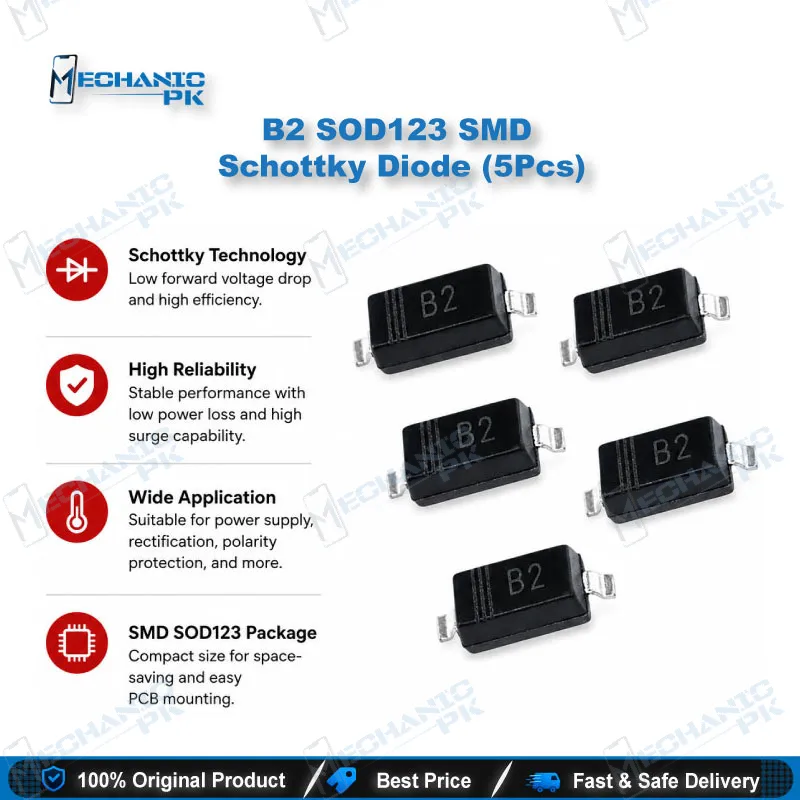
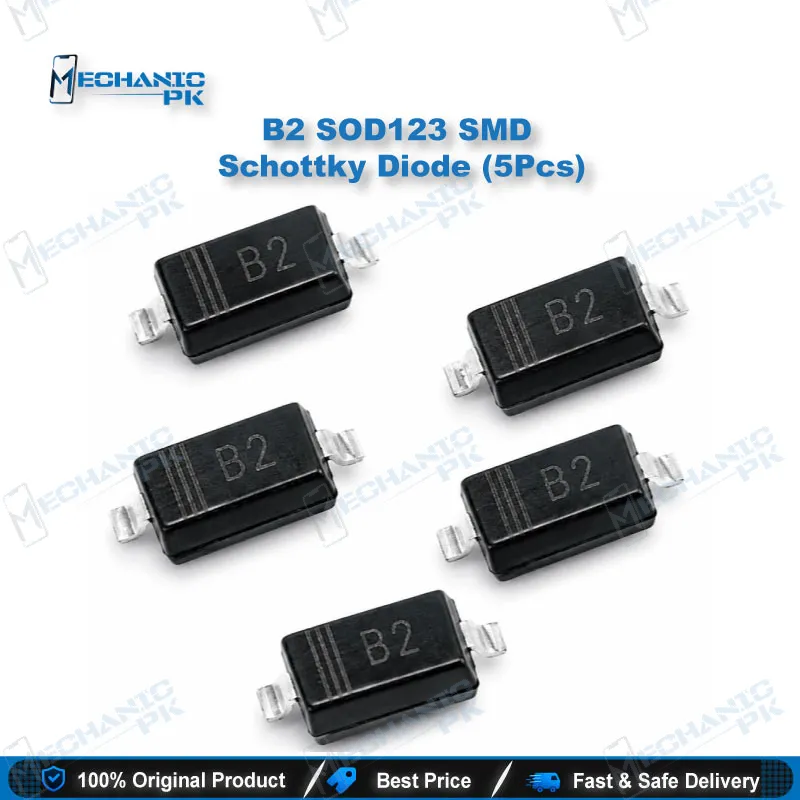
B2 SOD123 SMD Schottky Diode MBR0520 20V 0.5A (5Pcs)
₨ 150
B2 SOD123 Schottky Diode Pack for Low-Voltage Board Repair
This pack gives you five B2-marked SOD-123 Schottky diodes, the device code for the MBR0520 family of 20V, 0.5A surface-mount rectifiers. A Schottky barrier junction delivers a low forward voltage drop and fast switching, which suits low-voltage rectification, freewheeling paths in small DC-DC converters, and reverse-polarity protection lines. The SOD-123 body carries a cathode band for clear orientation during placement. When your diode-mode reading shows a shorted or open B2 on a board, you can swap it with an exact-code part instead of guessing at a substitute. Five pieces keep spares on your repair bench for repeat jobs.
B2 SOD123 Schottky Diode: Exact-Code Replacement for 20V Power Lines
A B2 SOD123 Schottky diode carries the marking code that manufacturers assign to the MBR0520 series, a 20V reverse-voltage, 0.5A forward-current Schottky rectifier in the SOD-123 surface-mount package. When a board schematic or the old part’s top marking reads “B2”, this is the replacement that matches both the electrical rating and the pad footprint. You get five pieces per pack, which covers a single repair with spares left for the next board that lands on your bench with the same fault.
Schottky diodes switch on a metal-to-silicon barrier instead of a standard P-N junction. That construction gives two properties technicians value on low-voltage boards: a forward voltage drop well below a silicon rectifier, and near-instant switching with no meaningful reverse-recovery delay. Manufacturers specify the MBR0520 for low-voltage, high-frequency rectification, freewheeling duty in switching regulators, and polarity protection in compact surface-mount layouts. Those three roles cover most places you will find a B2 on a PCB.
Reading the B2 Marking and SOD-123 Package Correctly
SMD diodes rarely carry a full part number. The body shows a short device code, and on SOD-123 Schottky rectifiers the MBR05xx series uses a simple pattern: B2 for the 20V MBR0520, B3 for the 30V MBR0530, and B4 for the 40V MBR0540. All three share the 0.5A current rating and the same package, so the code tells you the voltage class at a glance.
The SOD-123 package measures larger than SOD-323 and SOD-523 parts, so always compare pad spacing before you fit a replacement. The cathode band on one end marks polarity. Fit it backwards and the diode either blocks the rail completely or conducts where the circuit expects blocking, which can create a new fault instead of fixing the old one. Match the band to the silkscreen line or to the orientation of the original part before you remove it, and take a photo under the microscope if the board carries no clear marking.
Where the B2 SOD123 Schottky Diode Fits in Your Repair Workflow
Diagnosis comes first. Set your multimeter to diode mode and test the part in circuit, then lift one end if the reading looks suspicious. A healthy Schottky shows a low forward reading in one direction and an open reading in reverse. A near-zero reading in both directions points to a shorted diode, and a common symptom is a power rail pulling down your DC power supply the moment you connect it. An open reading in both directions points to a failed junction that cuts power to everything downstream.
Removal and fitting follow standard SMD practice. A hot air station with a small nozzle lifts the old part cleanly, or you can use two soldering irons as tweezers on a two-terminal package. Clean the pads with flux and solder wick, tin one pad lightly, place the new diode with fine tweezers, tack it, then reflow the second end. Check the joint under a microscope, then repeat the diode-mode test before you power the board.
Typical jobs include power-path protection on small DC boards, the catch diode in a compact step-down or step-up converter, and OR-ing between two low-voltage supply sources. Always confirm the circuit runs below the 20V reverse limit before you fit a B2.
Choosing Between B2, B3, and B4 Replacements
An exact B2 remains the cleanest fix because it matches the original voltage class and forward-drop behavior. If you only stock B3 or B4 parts, a higher reverse-voltage rating in the same package and current class generally covers a B2 position, though forward voltage can run slightly higher on those versions. The reverse swap does not work: never fit a 20V B2 where the board calls for a 30V or 40V part, because the rail may exceed its reverse limit.
Pair this pack with a fine-tip soldering station, a hot air station, a quality multimeter, and a stereo microscope from the related categories. If your work keeps moving deeper into board-level diagnosis, a DC power supply with current display makes shorted-diode faults easier to spot, since the ammeter jump shows you a short before you touch the board with a probe.
| Weight | 0.1 kg |
|---|
Key Features
- B2 device marking code, matching the MBR0520 series
- 20V maximum repetitive reverse voltage
- 0.5A average forward current rating
- 5.5A non-repetitive peak forward surge current rating
- Low forward voltage drop from Schottky barrier construction
- Fast switching for high-frequency rectification
- SOD-123 surface-mount package with cathode band for clear polarity
- Pack of 5 pieces for repairs and bench spares
Specifications
| Model | MBR0520 (Device Marking Code: B2) |
|---|---|
| Category | SMD Diodes / Schottky Diodes |
| Compatibility | PCB positions marked or specified as B2 / MBR0520 in the SOD-123 footprint |
| Technology | Schottky barrier rectifier, SOD-123 surface-mount package, cathode band polarity |
| Power Rating | Approx. 400–410 mW power dissipation (varies by manufacturer) |
Common Repair Uses
- Replacing a shorted B2 diode that pulls a power rail down
- Replacing an open B2 diode that cuts power to a downstream section
- Restoring the freewheeling diode in a small DC-DC converter
- Restoring reverse-polarity protection on a low-voltage input line
- Repairing power OR-ing paths between two low-voltage sources
- Replacing a burnt diode after a reverse or overvoltage incident
- Keeping exact-code spares for repeat board-level power faults
- Practicing SMD removal and fitting during technician training
Compatible Devices
- Universal, not device-specific. Compatibility depends on the B2 / MBR0520 position and the SOD-123 footprint, not on phone brand or model.
- Any PCB position marked “B2” in a SOD-123 package
- Circuits that specify MBR0520, MBR0520L, or MBR0520LT1-type parts
- SOD-123 pad layouts, including mini-MELF-footprint alternatives the package replaces
- Low-voltage DC rails operating below 20V reverse voltage
- Circuits drawing up to 0.5A average forward current
- Small switching regulator sections with a catch or freewheeling diode
- Reverse-polarity protection paths on low-voltage boards
- Low-voltage power OR-ing between two supply sources
FAQ
What is the product name?
What is the brand of this product?
What is the model of this product?
What is this product used for?
Which devices are compatible with this product?
Who should use this product?
Can I replace a B2 SOD123 diode with a B3 or B4 diode?
How do I check a B2 Schottky diode with a multimeter?
Related products