























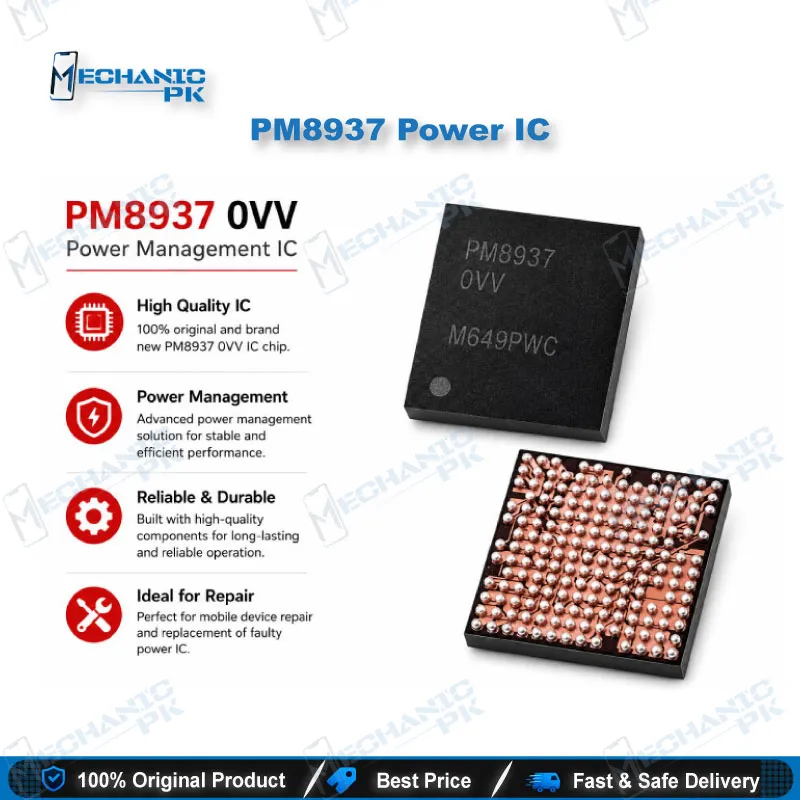
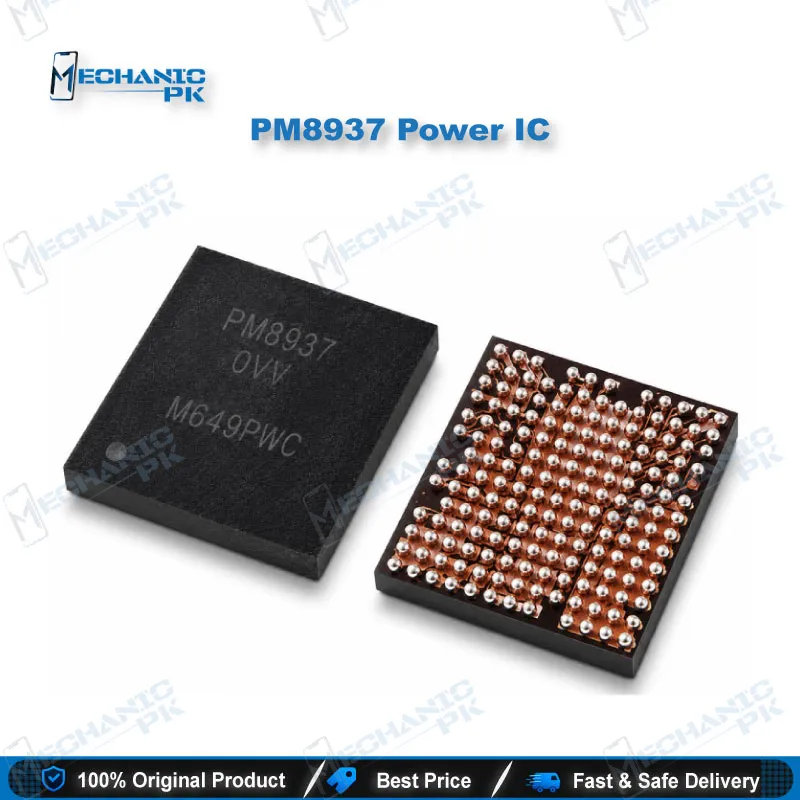
PM8937 Power IC – Qualcomm PMIC for Snapdragon 425/430/435
₨ 200
PM8937 Power IC – Qualcomm Main PMIC for Snapdragon 425, 430 and 435 Boards
The PM8937 Power IC is the primary Qualcomm power management chip on boards built around the MSM8917, MSM8937 and MSM8940 processors. It runs the power-on sequence and feeds the core regulator rails that the CPU, memory and peripherals depend on. When a board shows zero current draw, a shorted main rail, or a dead phone after water damage, a failed PMIC often sits at the root of the fault. Mechanicpk supplies the PM8937 for technicians who need a direct board-level replacement on Samsung, Xiaomi, Huawei, Motorola and Nokia models running these chipsets.
PM8937 Power IC: Main Power Management for Qualcomm MSM8917, MSM8937 and MSM8940 Boards
The PM8937 Power IC serves as the main PMIC on Qualcomm’s Snapdragon 425 (MSM8917), Snapdragon 430 (MSM8937) and Snapdragon 435 (MSM8940) platforms. Every regulated rail that wakes the processor, the eMMC and the RF section starts here, which makes this chip one of the first suspects on any board that refuses to power up. Technicians who work on budget and mid-range Qualcomm handsets meet this IC constantly, because these three chipsets shipped in a large number of Samsung Galaxy J-series, Xiaomi Redmi, Huawei Y-series, Motorola and Nokia models that still come through Pakistani service centers today.
How the PM8937 Controls the Power-On Sequence
The PM8937 owns the system power-on sequence. When you press the power key, it brings up its LDO and buck regulators in a defined order and then hands control to the processor. One of its LDO outputs also wakes the companion PMI, so a PM8937 that never completes its sequence leaves the entire board silent. This explains why a single failed PMIC produces a completely dead phone even when the battery, charging port and CPU remain healthy.
PM8937 and Its Companion PMI: Where Charging Actually Happens
On these platforms, Qualcomm splits power duties across two chips. The PM8937 handles the main regulators and the boot sequence, while a companion PMI (PMI8937, PMI8940 or PMI8950, depending on the board design) handles battery charging, USB input and OTG. Knowing this split saves you time on the bench. A charging issue with normal boot usually points toward the PMI, while a no-power fault with no current draw at the power key points toward the PM8937 Power IC.
Fault Symptoms That Point to the PM8937 Power IC
Several field symptoms lead technicians to this chip. A dead phone that pulls no current on a DC power supply, a phone that hangs on logo and restarts randomly, a shorted regulator rail that heats the PMIC within seconds, and a device that turns dead after flash or after water exposure all justify checking the PM8937. Unstable main rails can also mimic a boot loop issue, so a technician who has already reflashed firmware without success should move to hardware fault diagnosis around the power section.
Diagnosing Before You Replace the IC
Confirm the fault before you lift the chip. Check the battery connector rails and the power key line with a quality multimeter, then inject a low controlled voltage into any shorted rail and use a thermal camera or a rosin test to locate the hot component. Often a shorted capacitor around the PMIC causes the fault rather than the IC itself, and removing that capacitor restores the board. If the short traces back to the PM8937 body, or the chip completes no sequence despite clean inputs, replacement becomes the correct repair.
Replacement Workflow on the Repair Bench
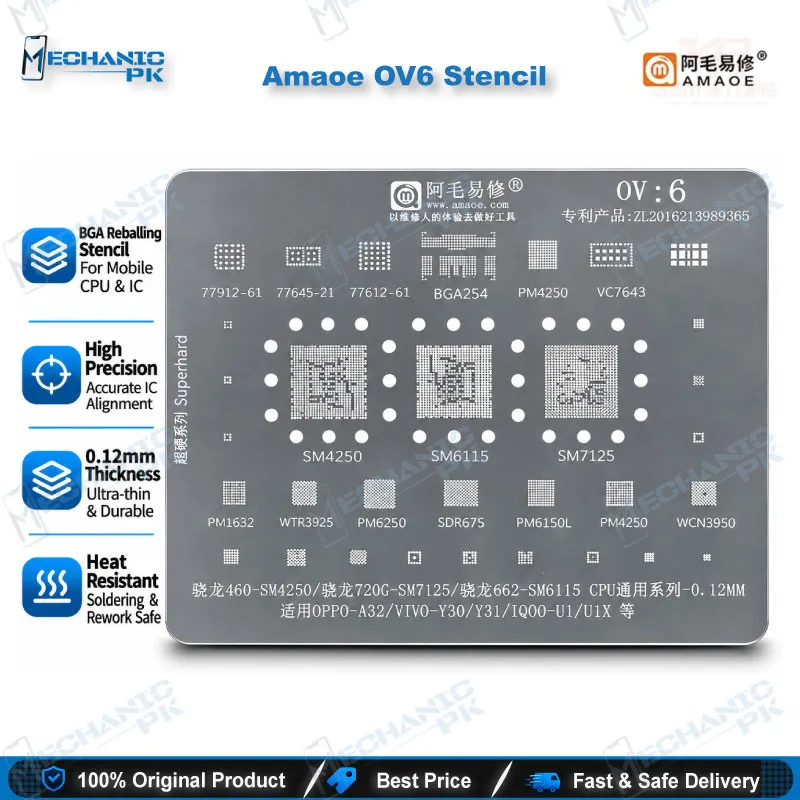
PMIC replacement on these boards follows a standard BGA rework process. Secure the board in a PCB holder, shield nearby plastic connectors, and remove the underfill carefully before applying heat. Lift the old IC with a calibrated hot air station, clean the pads flat with a soldering station and desoldering wick, then prepare the new PM8937 with the correct reballing kit stencil. Inspect pad alignment under a microscope before reflow, and check every main rail with a multimeter before you reassemble the phone. Matching the original chip marking on the board protects you from fitting the wrong PMIC, since some board revisions in the same model family use different power ICs.
Why Source the PM8937 from Mechanicpk
Mechanicpk stocks the PM8937 alongside the complete rework chain the repair needs, including hot air stations, soldering stations, reballing kits, microscopes, multimeters and PCB holders. For the firmware side of the same job, our ISP pinout tools, eMMC programmers, UFS adapters and test boxes cover the steps that follow a successful hardware repair. Technicians, repair shop owners and service centers across Pakistan rely on this single-source approach to complete Qualcomm power section repairs without waiting on multiple suppliers.PM8937 Power IC by Qualcomm, the main PMIC for MSM8917, MSM8937 and MSM8940 boards. Fix dead phone and no power faults. Order from Mechanicpk.
| Weight | 0.1 kg |
|---|
Key Features
- Main Qualcomm PMIC for Snapdragon 425 (MSM8917), Snapdragon 430 (MSM8937) and Snapdragon 435 (MSM8940) platforms
- Controls the full system power-on sequence from power key press to processor handover
- Supplies the main LDO and buck regulator rails for the CPU, memory and peripheral sections
- Works alongside PMI8937, PMI8940 or PMI8950 companion PMICs that manage charging and USB input
- Direct board-level replacement for dead phone and no-power faults traced to the power section
- Same part number across all three chipset platforms, which simplifies stock for repair shops
- Suits standard BGA rework with hot air, reballing stencil and microscope inspection
- Fits Samsung, Xiaomi, Huawei, Motorola and Nokia boards built on these Qualcomm chipsets
Specifications
| Brand | Qualcomm |
|---|---|
| Model | PM8937 |
| Category | Power Management IC (PMIC) |
| Compatibility | Qualcomm MSM8917 (Snapdragon 425), MSM8937 (Snapdragon 430), MSM8940 (Snapdragon 435) |
| Technology | Main PMIC with power-on sequencing and regulator rails; pairs with PMI8937 / PMI8940 / PMI8950 companion PMIC |
Common Repair Uses
- Dead phone repair with zero current draw on power key press
- Shorted main regulator rail traced to the PMIC body
- Phone dead after flash where firmware recovery fails to restore boot
- Water-damaged boards with corroded or failed power sections
- Random restarts and hang on logo caused by unstable main rails
- PMIC replacement after a failed previous rework attempt
- Donor-free board restoration during BGA reballing jobs
- Power section rebuild on MSM8917, MSM8937 and MSM8940 logic boards
Compatible Devices
- Qualcomm MSM8917 (Snapdragon 425) based boards
- Qualcomm MSM8937 (Snapdragon 430) based boards
- Qualcomm MSM8940 (Snapdragon 435) based boards
- Samsung Galaxy J2 Pro 2018 (J250F) and Galaxy J4 Core (J410F)
- Samsung Galaxy J4+ (J415F) and Galaxy J6+ (J610F)
- Huawei Y7 Prime 2018 (LDN-L21)
- Nokia 6 (TA-1033)
- Xiaomi Redmi 4A and Motorola Moto E4 (MSM8917 variants)
FAQ
What is the product name?
What is the brand of this product?
What is the model of this product?
What is this product used for?
Which devices are compatible with this product?
Who should use this product?
Does the PM8937 handle battery charging on MSM8937 boards?
Can the same PM8937 replace the PMIC on both Snapdragon 425 and Snapdragon 430 boards?
Related products