
















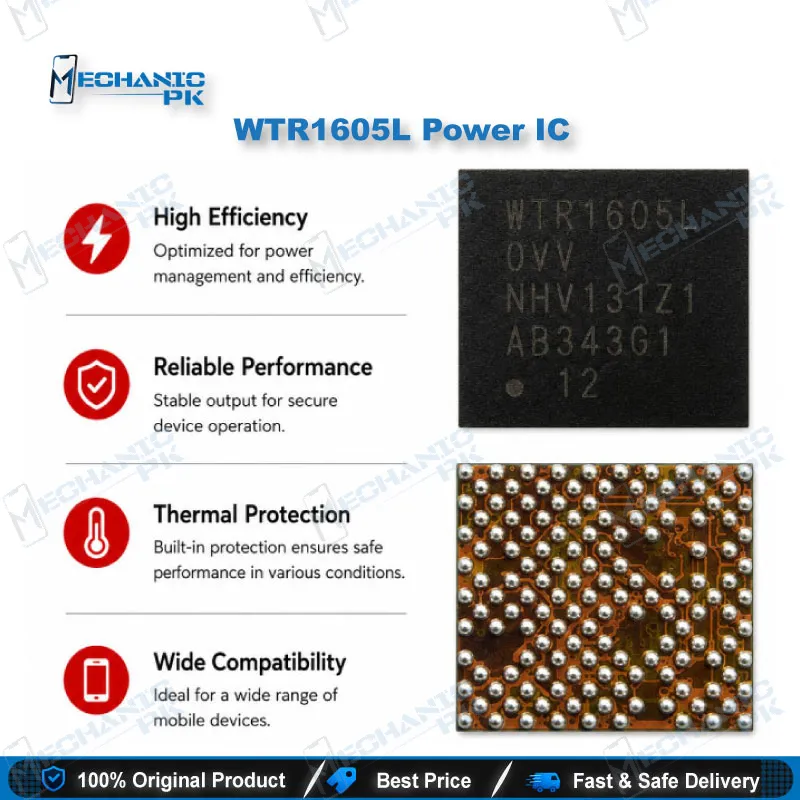
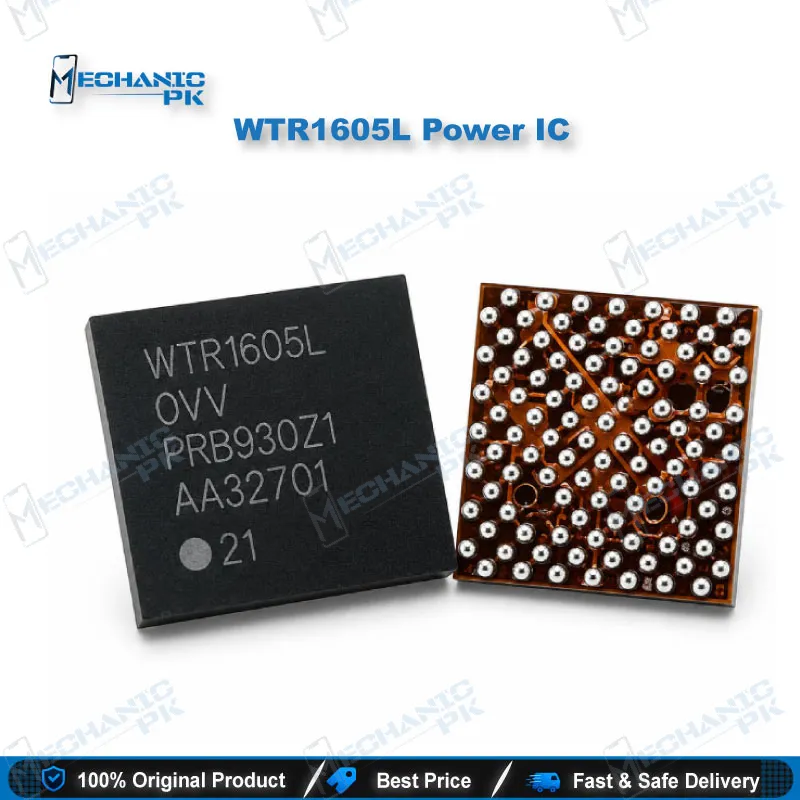
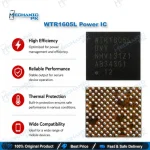
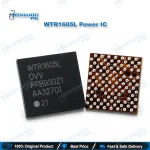
Qualcomm WTR1605L RF Transceiver IC – LTE Network IC
₨ 200
Qualcomm WTR1605L Network IC for LTE Board Repair
The Qualcomm WTR1605L handles RF-to-baseband conversion on a generation of LTE smartphones, including the iPhone 5S, Nexus 5, Nexus 4, LG Optimus G and the 2013 Moto X. When a board shows no service, weak signal across every network mode, or GPS lock failure after a drop or water damage, a faulty transceiver often sits at the root. Mechanicpk supplies this IC for technicians who confirm the fault through rail checks and reflow tests and need a clean part to finish the IC change. Match the marking on your board before you order, since the WTR1605L shares board space with several similar Qualcomm RF parts.
WTR1605L RF Transceiver IC: Where It Sits in the Network Chain
The WTR1605L RF transceiver IC is Qualcomm’s 28 nm multimode transceiver that sits between the antenna front end and the baseband modem on a full generation of LTE handsets. On the receive side, it downconverts incoming RF into I/Q data for the baseband. On the transmit side, it takes I/Q data from the baseband and synthesizes the RF signal that the power amplifiers push to the antenna. Qualcomm built it to cover LTE, HSPA+, CDMA2000, TD-SCDMA, EDGE and GPS on one die, which let OEMs ship a single board design across many carriers. For a Pakistani technician, that means one part number covers network faults on several boards that still reach your counter, from the iPhone 5S to the Nexus 5.
Multimode Coverage and Band Port Layout
The WTR1605L groups its ports into up to three low bands below 1 GHz, three high bands above 1 GHz and one very high band around 2.5 GHz. That layout gave it an edge over the older RTR8600, which offered only two low bands. Keep in mind that the transceiver alone does not decide which bands a phone actually uses. The baseband, power amplifiers, antenna switches and filters on each board define the final band set. The Nexus 4 proves the point: it carries a WTR1605L but no LTE power amplifier, so it stays on HSPA+ even though the transceiver supports LTE. The chip also runs primary and diversity receive paths, and it carries the GPS signal path, so a failed WTR1605L can kill GPS lock along with cellular service. On the iPhone 5S, Apple pairs it with the Qualcomm MDM9615M modem and the PM8018 RF power management IC.
Diagnosing a WTR1605L Network IC Fault Before You Change It
Change the IC only after you rule out the cheaper faults. A network issue with a valid IMEI and baseband version usually points to the RF section rather than the modem. Start with antenna contacts, coaxial cables and switch ICs, then check whether the problem covers every network mode or only one band group. A single dead band usually traces back to a PA or filter, not the transceiver. If 2G, 3G, 4G and GPS all fail together while the baseband reads correctly, the transceiver and its supply rails become your prime suspects. Check those rails with a multimeter in diode mode against a known-good board before you touch the hot air. Drop damage often cracks the solder joints under this IC, so a controlled reflow sometimes restores service without a replacement. Water damage tells a different story: corrosion under the package usually means a full IC change karna with a fresh part. Note what the phone shows in field test or service menus before and after each step, so you track real progress instead of guessing.
Removal, Reballing and Replacement Workflow
Mount the board in a PCB holder and shield nearby connectors and plastic parts with heat-resistant tape. Use a hot air station with a nozzle that matches the package footprint, apply quality flux, and lift the IC only once the solder fully melts, so you protect the pads underneath. Clean the pads with wick and a soldering station, then inspect them under a microscope for lifted pads or bridged points. If the replacement part needs balls, reball it with the correct stencil from a BGA reballing kit. Align the IC by its pin-1 marking, reflow evenly, and let the board cool naturally. Power the board on a DC supply first and watch current draw before you close the housing. A clean boot, stable current and network registration in every mode confirm a successful job. If you handle RF IC work weekly, a stereo microscope with higher magnification is the upgrade that pays back fastest on pad inspection.
| Weight | 0.1 kg |
|---|
Key Features
- Multimode coverage: LTE, HSPA+, CDMA2000, TD-SCDMA, EDGE and GPS on one chip
- 28 nm process for lower power draw than earlier Qualcomm transceivers
- Up to three low-band, three high-band and one very-high-band port
- Primary and diversity receive paths for stronger signal handling
- Integrated power management circuits for both receiver and transmitter sections
- Pairs with Qualcomm MDM9x15-generation basebands such as the MDM9615M
- One part number covers several popular LTE boards from the same platform era
- Direct replacement for boards that carry the WTR1605L marking
Specifications
| Brand | Qualcomm |
|---|---|
| Model | WTR1605L |
| Category | Mobile Phone ICs > Network / RF Transceiver ICs |
| Compatibility | Boards built around the WTR1605L transceiver (Qualcomm MDM9x15-generation LTE platforms) |
| Supported Devices | iPhone 5S, Google Nexus 5, Google Nexus 4, LG Optimus G, Motorola Moto X (2013) |
| Technology | Multimode RF transceiver — LTE, HSPA+, CDMA2000, TD-SCDMA, EDGE, GPS; 28 nm process |
Common Repair Uses
- No service / no network on all modes with valid IMEI and baseband
- Weak or dropping signal across 2G, 3G and 4G together
- GPS lock failure combined with cellular network issue
- Network loss after drop damage (cracked joints under the transceiver)
- Water-damaged boards with corrosion under the RF section
- Transceiver replacement after a failed reflow attempt
- Donor-to-board IC transfer during board-level network repair
- RF section rebuild on refurbished iPhone 5S and Nexus 5 boards
Compatible Devices
- Device-level scope verified from teardown data; always match the IC marking on your board.
- Apple iPhone 5S (paired with Qualcomm MDM9615M modem and PM8018)
- Google Nexus 5 (LG-built)
- Google Nexus 4 (LG-built; LTE path inactive on stock hardware)
- LG Optimus G
- Motorola Moto X (2013, first generation)
- Qualcomm MDM9x15-generation LTE boards carrying the WTR1605L marking
FAQ
What is the product name?
What is the brand of this product?
What is the model of this product?
What is this product used for?
Which devices are compatible with this product?
Who should use this product?
Is the WTR1605L a power IC or a network IC?
Which bands does the WTR1605L support?
Related products