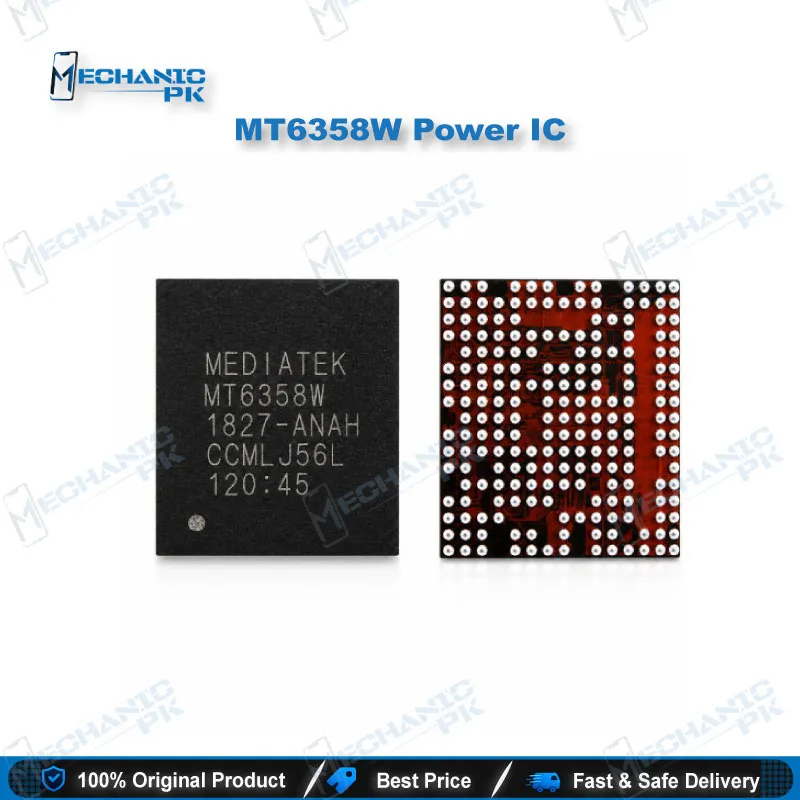
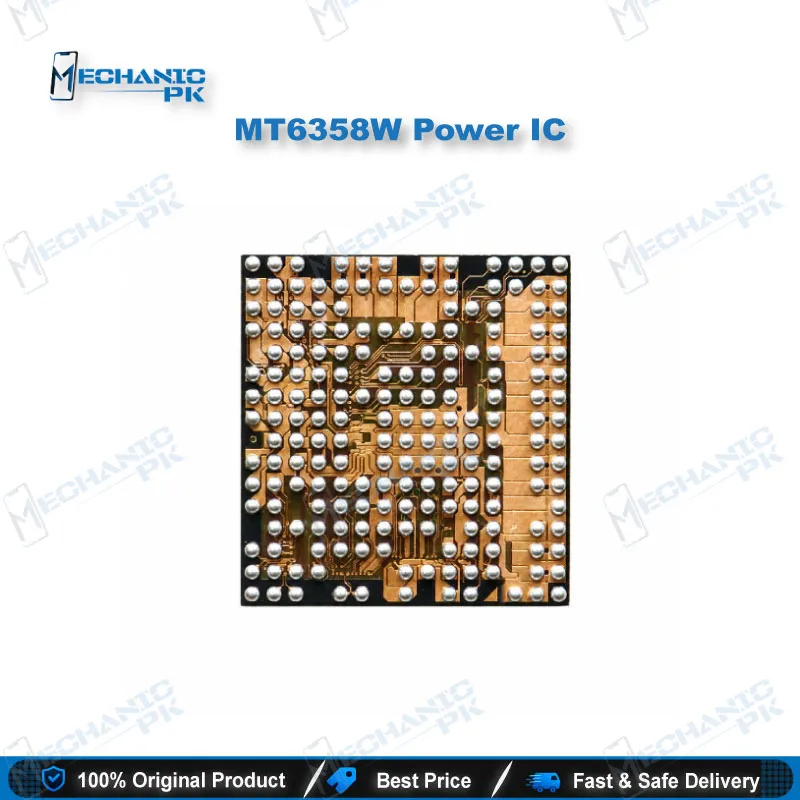
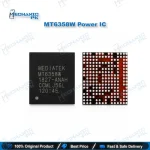
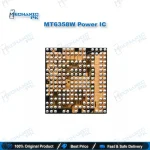
MT6358W Power IC – MediaTek PMIC for Helio Board Repair
₨ 600
MT6358W Power IC – Multi-Rail MediaTek Power Management Chip
The MT6358W Power IC is a MediaTek power management chip that generates the main supply rails on compatible MediaTek logic boards. It integrates 9 buck converters, 33 LDO regulators, a full audio codec, an RTC oscillator, and a fuel gauge in one 194-pin WLCSP package with a 2.6V–5V input range. Technicians replace this PMIC during board-level diagnosis of dead phones, no-power faults, hang on logo cases, and combined power-and-audio failures. It suits repair shops and service centers that handle MediaTek-based Oppo, Meizu, and Helio-platform handsets and need a dependable IC-level replacement part.
MT6358W Power IC: MediaTek PMIC Built for Full-Rail Board Control
The MT6358W Power IC sits between the battery and almost every subsystem on a compatible logic board. When you install an MT6358W MediaTek PMIC, you replace the chip that creates the processor, memory, and audio supply rails, runs the real-time clock, and tracks battery voltage and temperature. MediaTek pairs the MT6358 family with platforms such as the MT8183 and the Helio G80 (MT6769) class, and distributors list the W-marked variant for Oppo and Meizu MediaTek boards. For a technician, this makes the chip a frequent suspect in dead phone and hang on logo cases.
Verified Architecture of the MT6358W
MediaTek builds 9 buck converters and 33 LDO regulators into this chip, and each one targets a specific board subsystem. The IC accepts an input range of 2.6V to 5V, so it runs directly from the single-cell battery line. A 32K crystal-less RTC oscillator handles system timing, and the chip outputs 1.8V and 2.8V clock buffers for the rest of the board. MediaTek also places a full uplink and downlink audio codec inside the same package. That design explains why one damaged PMIC on these boards can cause power and audio faults together. The part ships in a 194-pin MIFO WLCSP package rated for -30°C to +85°C operation.
Protection and Monitoring Functions
The MT6358W carries over-current protection and thermal overload protection on its outputs. Programmable under-voltage lockout stops the board from running on a collapsing battery line. Watchdog reset, a hardware PMIC reset function, and a power-on reset with start-up timer control how the phone powers up and recovers from a hang. The integrated fuel gauge measures voltage, temperature, and current with precision, so a faulty PMIC can show up as wrong battery percentage or a charging issue that a new battery does not fix. Storage card plug-out protection rounds out the feature set.
Where the MT6358W MediaTek PMIC Fits in Your Repair Workflow
Diagnosis starts at the DC power supply. A dead phone that pulls no current, or one that shows a fixed short the moment you connect power, points you toward the PMIC area. Check buck coil outputs and LDO capacitors against ground with a multimeter in diode mode, and compare the readings with a known-good board. If a rail reads shorted and the short traces back to the PMIC, replacement becomes the logical step.
For removal, lock the board in a PCB holder and preheat it evenly. Lift the old chip with a hot air station at a controlled temperature, then clean the pads with a soldering station and desoldering wick. Because this IC uses a WLCSP ball array, reball it with a suitable reballing kit and align it under a microscope before reflow. After replacement, measure every main rail again before you connect a battery. If the board powers up but sits in a boot loop, move to a test box for software diagnosis and flashing.
Symptoms That Point to This PMIC
On MediaTek boards that carry this chip, technicians commonly trace these faults to the PMIC: a dead phone with no current draw, a short on a primary supply rail, hang on logo after a drop or liquid exposure, battery percentage that freezes or jumps, and missing earpiece or microphone audio alongside power instability. Each symptom has other possible causes, so confirm with rail measurements before you commit to an IC change.
Selection Notes for Professional Benches
MediaTek uses suffix letters to separate variants, and you will find MT6358W, MT6358V, and MT6358VW markings in the market. Match the exact marking on the original chip and confirm against the board schematic before swapping. Store spare units in ESD-safe packaging, because WLCSP parts tolerate rough handling poorly. For shops that service high volumes of Oppo, Meizu, and Helio-platform phones, keeping MT6358 power management IC stock on hand cuts turnaround on no-power jobs.
| Weight | 0.1 kg |
|---|
Key Features
- 9 buck converters and 33 LDO regulators that cover processor, memory, and subsystem supply rails
- 2.6V to 5V input range that runs directly from a single-cell battery line
- Integrated uplink/downlink audio codec inside the PMIC package
- 32K crystal-less RTC oscillator with 1.8V and 2.8V clock buffer outputs
- Over-current, thermal overload, and programmable under-voltage lockout protection
- Precision fuel gauge for battery voltage, temperature, and current measurement
- Watchdog reset, hardware PMIC reset, and power-on reset with start-up timer
- 194-pin MIFO WLCSP package rated for -30°C to +85°C operation
Specifications
| Brand | MediaTek |
|---|---|
| Model | MT6358W |
| Category | Power Management IC (PMIC) |
| Compatibility | MediaTek platforms that use the MT6358 PMIC, including MT8183 and Helio G80 (MT6769) class boards |
| Supported Devices | Distributor-listed for Oppo F9 Pro, Oppo F7, Oppo F5, Oppo A79, Meizu 7 Pro |
| Technology | 9 buck converters, 33 LDOs, integrated audio codec, 32K crystal-less RTC, fuel gauge, SPI interface, 194-pin MIFO WLCSP package |
| Input Voltage | 2.6V – 5V |
Common Repair Uses
- Board-level power section repair on MediaTek smartphones
- Dead phone repair with no current draw on the DC power supply
- Shorted primary supply rail traced to the PMIC
- Hang on logo and boot loop faults after drops or liquid damage
- Battery percentage and charging issue faults linked to the fuel gauge
- Combined power and audio faults (earpiece, microphone)
- RTC and power-on sequence failures
- PMIC replacement during reballing and IC-level rework
- Donor-board recovery and parts replacement in service centers
Compatible Devices
- MediaTek-platform boards that carry an MT6358W-marked PMIC (confirm the marking on the board before replacement)
- MediaTek MT8183 platform boards (MT6358 serves as the primary PMIC)
- Helio G80 / MT6769 boards such as Xiaomi Redmi 9 (MT6358-based)
- Oppo F9 Pro (distributor-listed)
- Oppo F7 (distributor-listed)
- Oppo F5 (distributor-listed)
- Oppo A79 (distributor-listed)
- Meizu 7 Pro (distributor-listed)
- Other MediaTek boards with a matching MT6358W marking
FAQ
What is the product name?
What is the brand of this product?
What is the model of this product?
What is this product used for?
Which devices are compatible with this product?
Who should use this product?
What input voltage does the MT6358W PMIC accept?
Can a faulty MT6358W cause both no power and no audio?
Related products