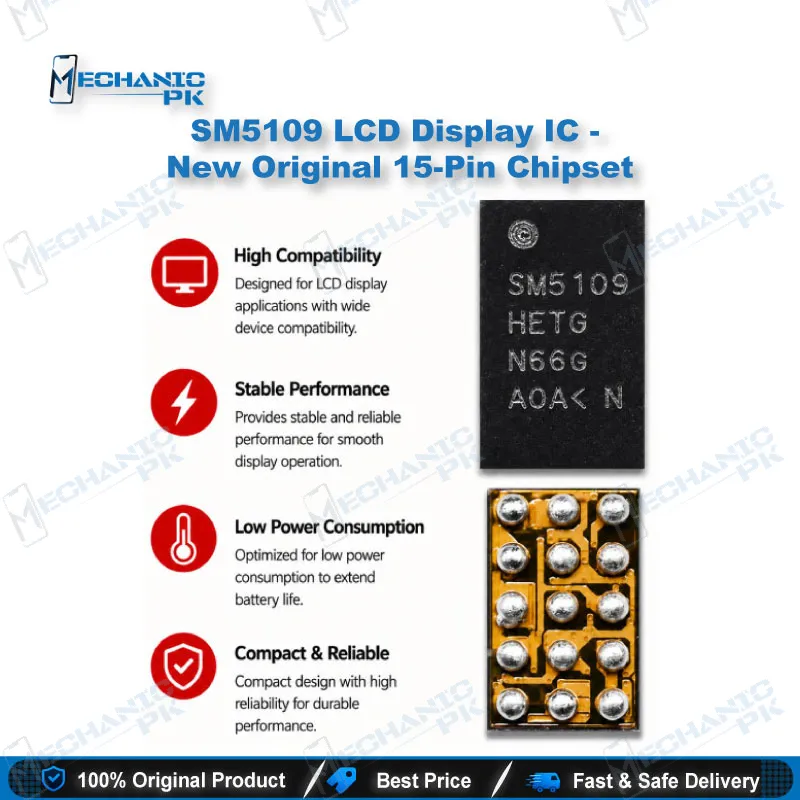
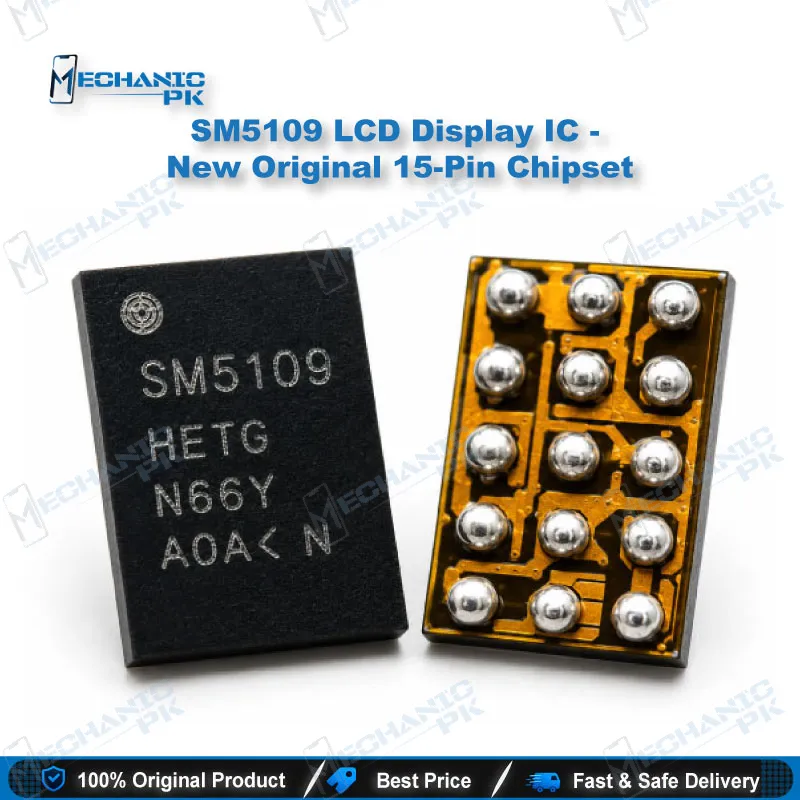
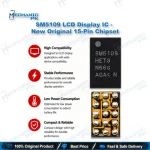
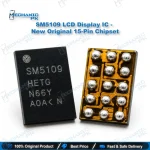
SM5109 LCD Display IC – New Original 15-Pin Chipset
₨ 300
SM5109 LCD Display IC – Original Dual-Output Bias Power Chip
The SM5109 LCD Display IC – New Original 15-Pin Chipset is a Silicon Mitus dual-output bias regulator that powers the TFT LCD panel in smartphones. From a single inductor, it generates a programmable positive rail from 4.0 V to 6.5 V and a matching negative rail from -4.0 V to -6.5 V, both set in 0.1 V steps through a 400 kHz I2C interface. The chip runs from a 2.7 V to 5.0 V input, holds 1.5% output accuracy, and delivers over 85% efficiency above 10 mA load. Its 15-bump WLCSP body measures 1.23 mm x 2.03 mm with a 0.4 mm pitch, built for board-level display power repair.
Out of stock
SM5109 LCD Display IC: Dual-Output Bias Power for Smartphone LCD Screens
The SM5109 LCD Display IC – New Original 15-Pin Chipset belongs to the power side of the display circuit, not the image side. Silicon Mitus designed this SM5109 LCD bias power IC to create the two supply rails a TFT LCD source driver needs before it can put a picture on the glass. When this chip fails, the phone often boots normally and the backlight may still glow, yet the screen shows no image. That fault pattern appears regularly on budget and mid-range LCD phones that reach Pakistani repair benches, which makes this part a standard stock item for display repair work.
How the SM5109 Generates Positive and Negative Bias Rails
The chip uses a single inductor to produce two outputs: OUTP on the positive side and OUTN on the negative side. You get a positive rail programmable from 4.0 V to 6.5 V and a negative rail from -4.0 V to -6.5 V, each adjustable in 0.1 V steps. The phone’s processor sets these values over a 400 kHz full-speed I2C interface, so the panel receives the exact voltages its driver expects. Output accuracy stays within 1.5%, which keeps contrast and gray levels consistent across the screen. Efficiency exceeds 85% once output current passes 10 mA, and the low quiescent current design keeps idle drain minimal.
Protection and Power-Sequencing Behavior
Two built-in functions matter during diagnosis. Under-voltage lockout (UVLO) with separate rising and falling thresholds stops the regulator when input voltage drops too low, protecting the panel during weak-battery conditions. Active discharge pulls both outputs down when the display switches off, so stored charge does not linger on the panel lines. On a healthy board, the bias rails appear only after the processor enables the display, and they collapse quickly at screen-off. A rail that never rises, or rises on only one side, points you toward this SM5109 display IC, its inductor, or the I2C lines.
Where This IC Fits in the Display Repair Workflow
Display faults fall into three groups: panel damage, flex and connector problems, and board-side power faults. The SM5109 sits in the third group. A solid diagnosis starts with a known-good screen test. If a fresh LCD still shows no image, check the display connector for the bias voltages with a multimeter. A missing positive or negative rail, combined with a healthy 2.7 V to 5.0 V input at the chip, makes IC replacement the logical next step. Test the inductor and output capacitors first, because a shorted capacitor on the output can mimic a dead regulator. The whole job stays at component level and involves no test box, eMMC programmer, or UFS adapter.
Package Details and Soldering Guidance
Sellers list this part as a 15-pin chipset, but the manufacturer package is a 15-bump wafer-level chip-scale package (WLCSP) measuring 1.23 mm x 2.03 mm with a 0.4 mm ball pitch. That footprint calls for hot air rework under a microscope rather than iron work. Lift the old chip with controlled airflow, clean the pads with flux and desoldering wick, tin the pads lightly, and seat the new chip with correct orientation. A PCB holder keeps the board flat during heating, and a reballing kit with a matching stencil helps when a pad needs rebuilding. Keep heat focused, since nearby display and power components share the same board area.
Compatibility Scope and Board Verification
Silicon Mitus lists smartphone and portable-device TFT LCD panels as the target application for this LCD bias IC for mobile phones. Repair parts distributors report it on several Oppo and Vivo LCD models, along with some Samsung and Huawei boards. Phone makers often source display bias regulators from more than one vendor, so the same model can carry different chips across production batches. Match the marking on the board, or confirm the part through schematic and board-view references, before you replace it.
Sourcing the SM5109 LCD Bias Power IC in Pakistan
Mechanicpk supplies the SM5109 LCD bias power IC as new original stock for repair shops, service centers, and training institutes across Pakistan. Pair it with a precise hot air station, soldering station, and stereo microscope from our catalog to build a dependable bench for display power repairs.
| Weight | 0.1 kg |
|---|
Key Features
- Genuine Silicon Mitus SM5109 dual-output LCD panel bias regulator
- Programmable positive output from 4.0 V to 6.5 V in 0.1 V steps
- Programmable negative output from -4.0 V to -6.5 V in 0.1 V steps
- Single-inductor topology with over 85% efficiency above 10 mA load
- 1.5% output voltage accuracy for stable panel contrast
- Wide 2.7 V to 5.0 V input range with rising and falling UVLO
- Active discharge on both outputs at display power-off
- Compact 15-bump WLCSP (1.23 mm x 2.03 mm, 0.4 mm pitch) with 400 kHz I2C control
Specifications
| Brand | Silicon Mitus |
|---|---|
| Model | SM5109 |
| Category | LCD Bias Power Supply IC (Mobile Display Power IC) |
| Compatibility | Smartphone and portable-device TFT LCD panels |
| Technology | Low-Iq single-inductor, dual-output DC-DC converter with I2C programming, UVLO and active discharge |
| Input Voltage | 2.7 V to 5.0 V |
| Output Voltage | +4.0 V to +6.5 V (OUTP) and -4.0 V to -6.5 V (OUTN), programmable in 0.1 V steps |
| Dimensions | 1.23 mm x 2.03 mm, 15-bump WLCSP, 0.4 mm pitch |
Common Repair Uses
- No image on screen while the phone boots and the backlight still works
- Missing positive or negative bias rail at the LCD connector
- No display after replacing the LCD with a known-good screen
- Display power fault on boards with liquid damage near the display circuit
- Replacing a shorted or burnt bias IC after a connector short during screen installation
- Abnormal contrast or unstable image caused by an incorrect bias output
- Component-level display power restoration in service centers
- Spare stock for training institutes teaching board-level display repair
Compatible Devices
- Smartphones and portable devices with TFT LCD panels that use the SM5109 in the display bias circuit (model list reported by repair parts distributors; confirm board marking before replacement)
- Oppo A5s
- Oppo A92s
- Vivo Y83
- Vivo Y93
- Vivo Y97
- Samsung LCD-panel models that carry the SM5109 bias regulator
- Huawei LCD-panel models that carry the SM5109 bias regulator
- Any smartphone or portable TFT LCD board with SM5109 marked in the LCD bias position
FAQ
What is the product name?
What is the brand of this product?
What is the model of this product?
What is this product used for?
Which devices are compatible with this product?
Who should use this product?
What output voltages does the SM5109 LCD bias IC provide?
Can I replace the SM5109 with a soldering iron or do I need hot air?
Related products