


















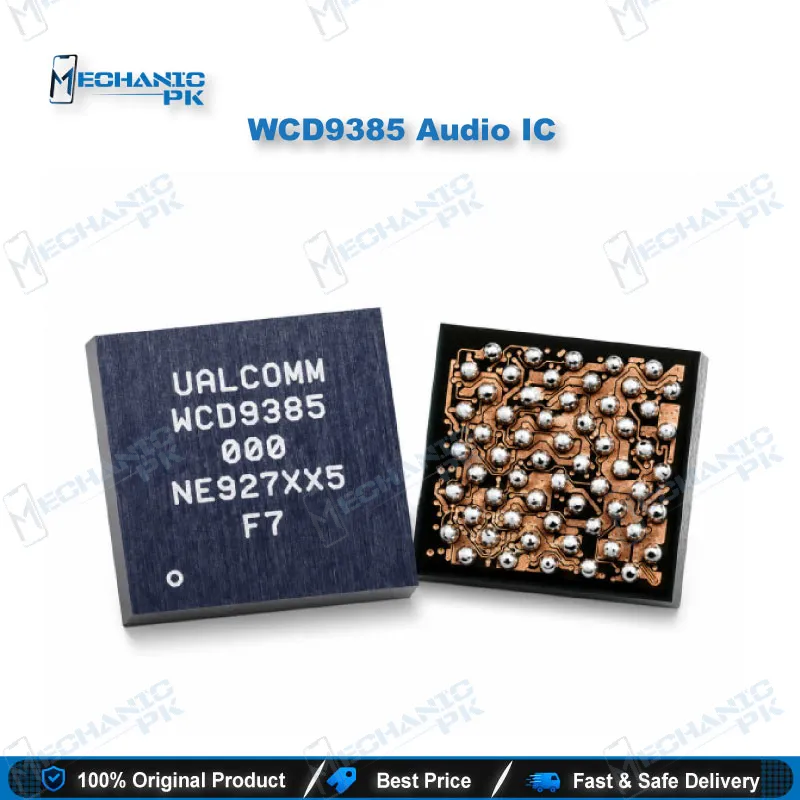
Qualcomm WCD9385 Audio Codec IC for Mobile Repair
₨ 350
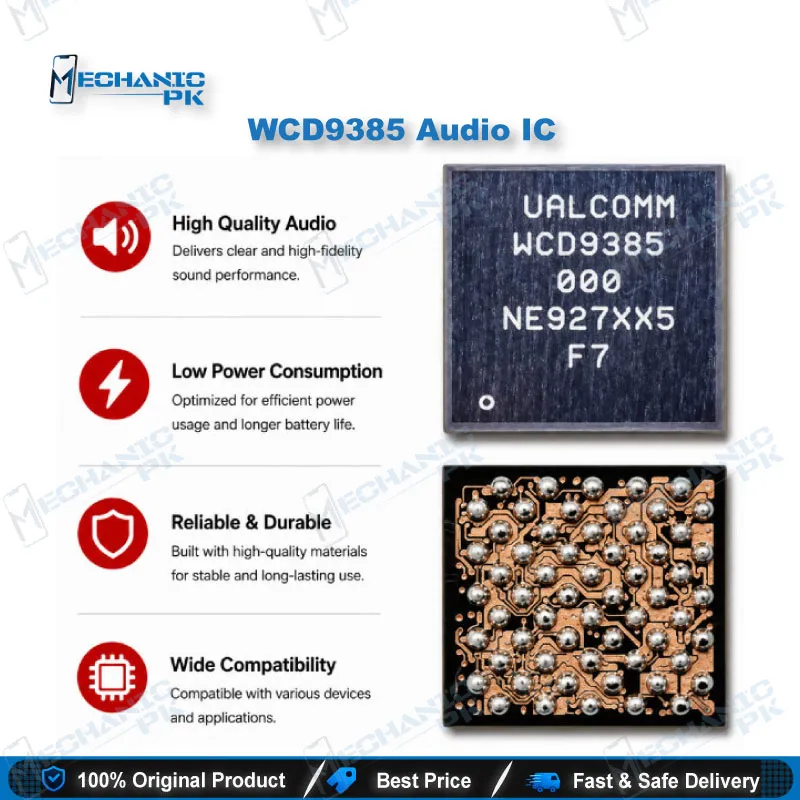
WCD9385 Audio IC for Snapdragon Board Repair
The WCD9385 audio IC is a Qualcomm Aqstic standalone Hi-Fi codec that handles the analog side of audio on Snapdragon-based boards. It links to the processor over two SoundWire interfaces, one for playback (RX) and one for capture (TX). It drives microphone inputs, earpiece output, headphone channels and headset button detection. When a phone shows no mic in calls, a silent earpiece or a dead headset path after liquid damage or a drop, this codec sits high on your suspect list. Mechanicpk supplies this part for technicians who handle IC change karna work at board level with hot air, flux and proper reballing.
WCD9385 Audio IC: Qualcomm Aqstic Codec Explained for Board-Level Technicians
The WCD9385 audio IC is Qualcomm’s standalone Hi-Fi audio codec from the Aqstic family, and it carries most of the analog audio work on boards that use it. The processor sends and receives digital audio, while the codec converts it for the microphones, earpiece and headphone path. Qualcomm built its DAC around a customizable digital filter tuned with its expert listening panel, and the converter plays native DSD content with very low THD+N. For a repair technician, one practical fact matters more: when this chip fails, the phone loses voice and audio functions that no software flash can restore. You need the correct replacement part, a clean rework process and a methodical check of its supply rails.
Inside the WCD9385: Channels, Converters and SoundWire Links
The WCD9385 talks to the Snapdragon processor over two SoundWire slave interfaces. The RX link carries playback data and the TX link carries capture data, and only the TX side reaches the codec’s main control and status registers. That detail explains why a fault on the TX lines can take the whole codec offline, not only the microphones. On the analog side, the chip integrates four ADCs, a Class-H headphone stage, an earpiece driver, an auxiliary power amplifier and two headphone channels. It accepts seven differential TX inputs and up to eight digital microphones, and its MBHC block detects headset insertion and button presses. Linux kernel device trees place it on Snapdragon reference platforms including SM8250 (Snapdragon 865) development boards, SM8550 (Snapdragon 8 Gen 2) MTP and AIM300 boards, SC7280 CRD boards and the X1E80100 (Snapdragon X Elite) CRD. Lantronix also sells it as an audio codec module for its Open-Q 865XR system-on-module. Treat these as verified platform references, then confirm the exact part number on your phone’s boardview before you order.
Fault Patterns That Point to the WCD9385 Audio IC
Codec failures show up as audio faults that survive a factory reset and a firmware reflash. The customer reports that the other side cannot hear them on calls, voice notes record silence, or the earpiece stays dead while the loudspeaker still plays music. Many flagship designs drive the loudspeaker through a separate smart amplifier, so a working speaker alongside a dead mic and earpiece narrows the fault toward the codec area. Headset faults follow the same logic: if the phone ignores a wired headset or its buttons, the MBHC section deserves inspection. Liquid damage near the codec, a dropped phone with a stressed board corner and a careless earlier rework job all produce these symptoms. Before you commit to an IC change, rule out the cheaper causes: blocked mic ports, a faulty sub-board flex, a damaged USB-C port and corroded passives around the codec. Software marna fixes none of these, so a clean hardware diagnosis saves you a wasted flash cycle.
Checking Supply Rails Before You Replace the Qualcomm Aqstic Audio Codec
Reference designs feed the WCD9385 from separate 1.8 V buck, RX/TX and I/O supply inputs, plus a dedicated mic-bias supply that the Linux binding lists at 3.8 V. The codec then generates programmable mic-bias outputs, which reference boards set to 1.8 V. Measure each rail with a multimeter against your boardview values, and check the reset line from the processor, because a missing reset signal keeps the codec offline even when the chip itself works. A short on a supply rail usually traces to a ceramic capacitor; inject voltage and find the hot spot with a thermal camera or rosin before you lift the IC. Once you confirm a chip-level fault, mount the board in a PCB holder, work under a stereo microscope and remove the codec with a hot air station using a profile suited to the board’s shielding and underfill. Clean the pads, reball with the correct stencil from a reballing kit, and seat the new chip on fresh flux. The step up from manual hot air work is a dedicated BGA rework station, which gives you repeatable preheating on multilayer flagship boards.
| Weight | 0.1 kg |
|---|
Key Features
- Qualcomm Aqstic standalone Hi-Fi audio codec
- Dual SoundWire slave interfaces for separate playback (RX) and capture (TX)
- Four integrated ADCs for microphone capture
- Class-H headphone stage, earpiece driver and auxiliary PA
- Seven differential TX inputs with support for up to eight digital mics
- MBHC block for headset insertion and button detection
- Integrated DAC with native DSD playback and very low THD+N
- Programmable mic-bias outputs on four channels
Specifications
| Brand | Qualcomm |
|---|---|
| Model | WCD9385 |
| Category | Mobile Phone ICs > Audio ICs |
| Compatibility | Qualcomm Snapdragon platforms designed around the WCD9385 codec |
| Supported Devices | Boards that list WCD9385 at the codec position (confirm on boardview) |
| Technology | Qualcomm Aqstic Hi-Fi audio codec, dual SoundWire (RX/TX) interface, integrated DAC with native DSD playback |
| Input Voltage | 1.8 V buck, RX/TX and I/O supplies; 3.8 V mic-bias supply (reference designs) |
Common Repair Uses
- Board-level audio codec replacement and diagnosis
- No microphone audio during calls
- Voice recorder and voice notes saving silence
- Dead earpiece while the loudspeaker still works
- Wired headset not detected by the phone
- Headset buttons not responding
- Audio failure after liquid damage near the codec area
- Replacing a codec damaged during an earlier rework attempt
- Audio section restoration after drop damage to the board
Compatible Devices
- Verified at chipset-platform level; device-level fitment requires boardview confirmation
- Qualcomm Snapdragon 865 (SM8250) platform boards using WCD9385
- Qualcomm Snapdragon 8 Gen 2 (SM8550) MTP reference boards
- Qualcomm SM8550 AIM300 boards
- Qualcomm SC7280 CRD platform boards
- Snapdragon X Elite (X1E80100) CRD devices
- Lantronix Open-Q 865XR SOM carrier boards
- Smartphone boards whose boardview lists WCD9385 at the audio codec position
- Development boards carrying the qcom,wcd9385-codec device-tree node
FAQ
What is the product name?
What is the brand of this product?
What is the model of this product?
What is this product used for?
Which devices are compatible with this product?
Who should use this product?
Can I replace a WCD9385 with a WCD9380 on a phone board?
Which voltages should I check before changing the WCD9385 audio IC?
Related products