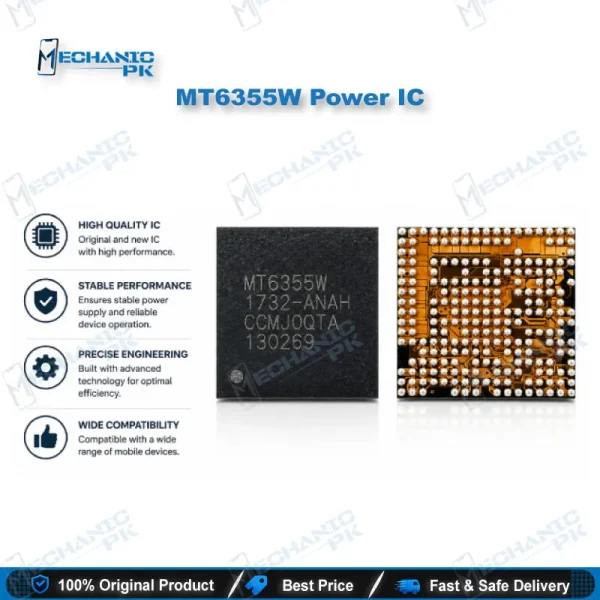


















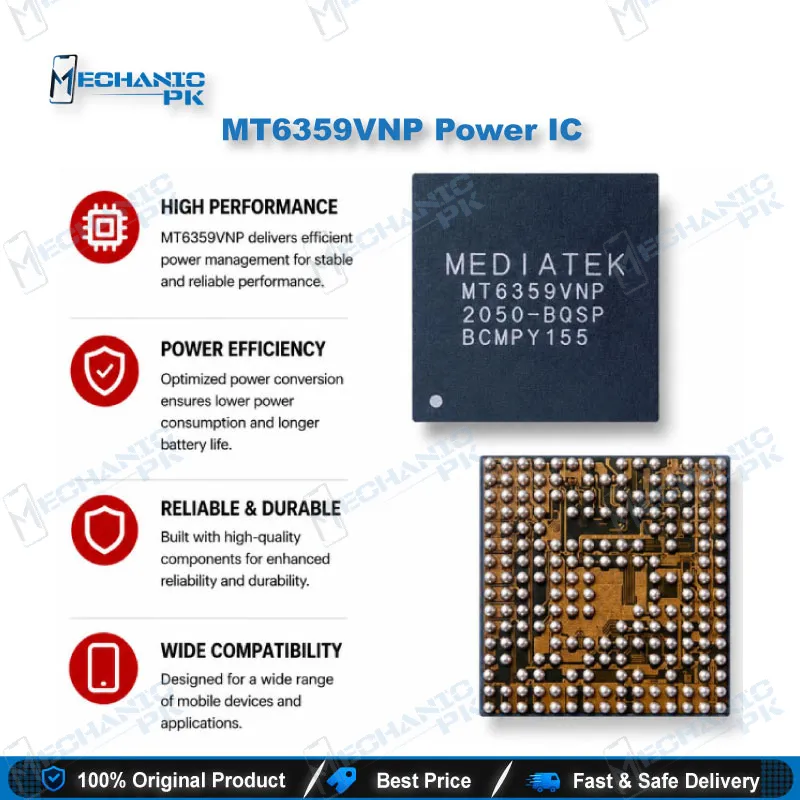
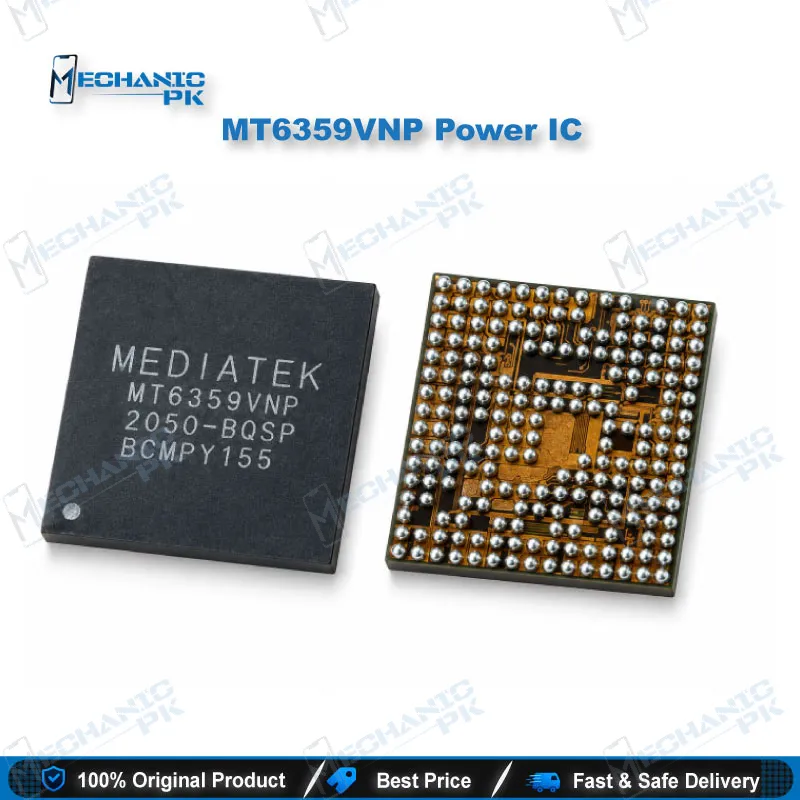
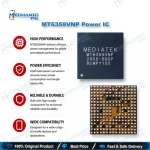
MT6359VNP Power IC – MediaTek PMIC for Mobile Repair
₨ 500
MT6359VNP Power IC for MediaTek Board-Level Repair
The MT6359VNP power IC belongs to MediaTek’s MT6359 PMIC family and drives the main power rails on MediaTek smartphone logic boards. It feeds the CPU, GPU, modem, storage, connectivity, and camera I/O rails, and it also houses the audio codec and real-time clock. A failed unit leaves you with a dead phone, a shorted VBAT line, or a board that hangs on logo with missing rails. Mechanicpk supplies the exact MT6359VNP marking, so you replace like with like and avoid near-match guesswork on Helio-platform boards. It is built for technicians who already handle BGA rework and want a precise PMIC swap.
MT6359VNP Power IC: Technical Overview for Board-Level Repair
The MT6359VNP power IC is a marking variant within MediaTek’s MT6359 PMIC family, the power management chip that works alongside MediaTek application processors on smartphone mainboards. One package generates the processor core voltages, storage supply rails, RF and connectivity rails, and audio supplies, and it keeps the real-time clock running. When this chip fails, no box chalana or software flash brings the phone back, because the board never reaches a stable power-on state. Mechanicpk stocks the exact MT6359VNP marking for technicians who work at IC level and want to match the original part on the board rather than substitute a neighbouring variant.
Inside the MT6359 PMIC: Rails, Codec, and RTC
The MT6359 PMIC acts as a slave device on the SoC’s power bus. It communicates with the processor over SPI through MediaTek’s PMIC wrapper interface, so the application processor commands every rail change instead of the PMIC running independently. Upstream Linux support describes the chip as a multifunction device with four blocks: audio codec, interrupt controller, regulators, and RTC. The regulator block carries most of the repair value. Buck converters generate VPROC1 and VPROC2 for the CPU clusters, VGPU11 for graphics, VCORE and VMODEM for the SoC fabric and modem, plus VPU, VS1, VS2, and VPA for the RF power amplifier. LDO outputs cover VEMC for eMMC, VUFS for UFS storage, VUSB, VCAMIO for camera I/O, VXO22 and VRFCK for clock references, VEFUSE, VIBR for the vibration motor, and the VCN rails that power Bluetooth and Wi-Fi. One missing output can imitate a dead CPU, a dead storage chip, or a network issue, so rail-by-rail measurement must come before you condemn anything else on the board.
Diagnosing a Faulty MT6359VNP Power IC
A failing MT6359VNP usually shows up as a dead phone with zero current on the DC supply, a VBAT short that heats the PMIC first under rosin or a thermal camera, or a current reading that climbs on power key press and then drops back to zero. Partial failures produce boot loop issues, hang on logo with the storage rail missing, no audio from the codec section, Wi-Fi or Bluetooth that refuses to switch on, and time and date resets from the RTC block. Start with a bench power supply and record current behaviour on power key press. Measure each buck output at its inductor and each LDO output at its decoupling capacitor, then compare against a known-good board of the same model. Check the small capacitors around the PMIC before you plan an IC change karna, because a shorted cap pulls a rail down exactly like a dead regulator. When VPROC reads low, lift the rail inductor to separate a CPU-side short from a PMIC fault. On many MediaTek boards a separate charger IC handles the USB input path, so test that stage before you blame the PMIC for a charging issue.
Replacement Workflow and Bench Setup
The MT6359VNP sits in a fine-pitch ball-grid package, so a clean swap depends on controlled heat and accurate alignment. Mount the board in a PCB holder, apply preheat from below, and lift the old chip with a hot air station at a profile suited to your board. Soften and remove any underfill carefully so you do not tear pads. Clean the pads with flux and solder wick, then inspect them under a stereo microscope for lifted or bridged pads. Reball the new MT6359VNP with the correct stencil from a BGA reballing kit, align it to the pin-1 marker, and reflow. Let the board cool naturally, then measure every major rail with a multimeter before you reconnect the display and battery. Technicians who change PMICs and CPUs regularly often move up to an IR rework or preheating station for more even heat on multi-layer boards, which cuts the risk of pad damage around large BGA parts.
| Weight | 0.1 kg |
|---|
Key Features
- Exact MT6359VNP marking for like-for-like replacement
- Generates CPU, GPU, core, and modem buck rails from a single package
- Supplies eMMC, UFS, USB, camera I/O, and clock-reference LDO rails
- Integrated audio codec, interrupt controller, and real-time clock
- SPI control through MediaTek’s PMIC wrapper interface
- Powers Bluetooth and Wi-Fi connectivity rails
- Fine-pitch ball-grid package for professional BGA rework
- Suited to Helio-platform board-level and IC-level repair
Specifications
| Brand | MediaTek |
|---|---|
| Model | MT6359VNP |
| Category | Power Management IC (PMIC) |
| Compatibility | MediaTek smartphone platforms that use the MT6359-series PMIC with MT6359VNP marking |
| Supported Devices | Boards carrying the original MT6359VNP marking |
| Technology | Multi-output buck and LDO PMIC with integrated audio codec, interrupt controller, and RTC; SPI interface via MediaTek PMIC wrapper |
Common Repair Uses
- Dead phone with no current draw on power key press
- VBAT short with the PMIC heating first
- Hang on logo caused by a missing eMMC or UFS supply rail
- Boot loop from unstable VPROC or VCORE rails
- No audio or microphone fault traced to the codec section
- Wi-Fi or Bluetooth not switching on due to missing VCN rails
- Time and date reset from an RTC failure
- PMIC replacement after water damage or corrosion under the chip
Compatible Devices
- Verified at chipset-family and marking level — match the original board marking before replacement.
- MediaTek boards whose original PMIC reads MT6359VNP
- MediaTek MT6779 platforms (Helio P90 family)
- MediaTek Helio G90T platforms
- Xiaomi Redmi Note 8 Pro (Helio G90T)
FAQ
What is the product name?
What is the brand of this product?
What is the model of this product?
What is this product used for?
Which devices are compatible with this product?
Who should use this product?
Can I replace MT6359VNP with MT6359VKP or MT6359VPP?
Which voltages should I check after changing the MT6359VNP power IC?
Related products