
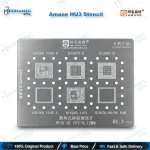
Amaoe HU3 Stencil – 0.12mm Huawei HiSilicon BGA Reballing
₨ 599
Amaoe HU3 Stencil for HiSilicon CPUs
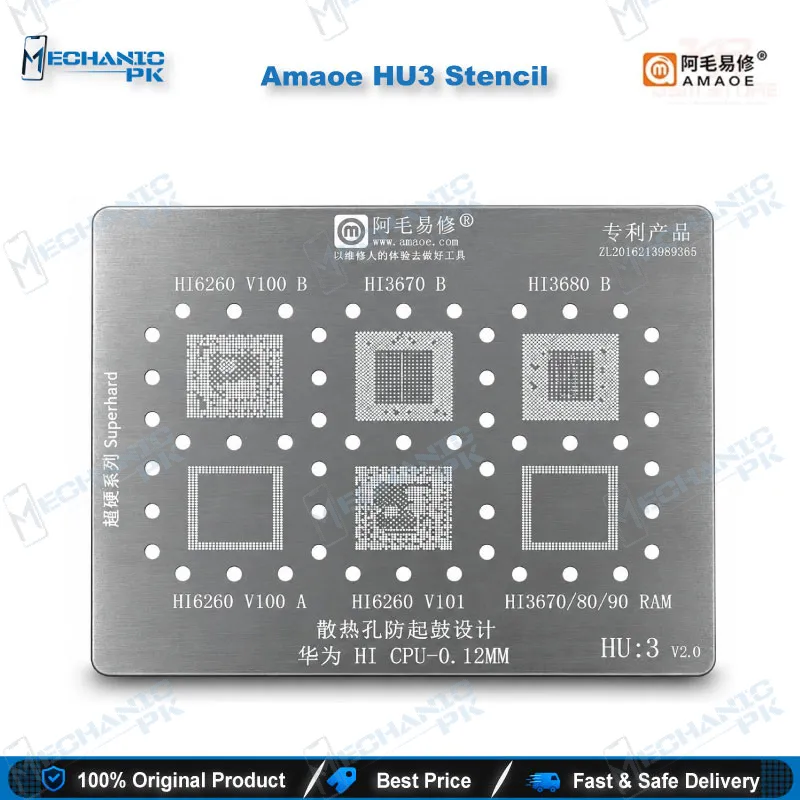
The Amaoe HU3 stencil gives your repair bench a dedicated 0.12mm BGA reballing template for Huawei HiSilicon processors. It covers the HI6260 V100, HI6260 V101, HI3670 and HI3680 chip codes. After you lift the CPU, you use the stencil to print an evenly spaced ball grid back onto the chip, then reflow it onto the board with your hot air station. Choose the HU3 when the marking on your Huawei board matches its listed codes. Keep the neighbouring HU1, HU2 and HU4 templates for other HiSilicon chips. A microscope and a PCB holder make the job repeatable.
In stock
Amaoe HU3 Stencil: Precision Reballing for Huawei HiSilicon CPUs
The Amaoe HU3 stencil is a 0.12mm BGA reballing template built for a defined group of Huawei HiSilicon processors: HI6260 V100, HI6260 V101, HI3670 and HI3680. Amaoe cuts each stencil in its HU series for a specific footprint set. You match the template to the chip code instead of forcing a universal pattern onto the pad array. If your bench handles Huawei boards, the HU3 gives you a dedicated tool for the CPU stage of the job: lift the chip, clean the pads, print the balls and return the processor with a clean grid.
Chip Coverage and Stencil Specification
Amaoe splits Huawei HiSilicon coverage across four numbered templates. The HU3 covers HI6260 V100, HI6260 V101, HI3670 and HI3680, and the manufacturer groups HI3670 and HI3680 together as HI3670/80. The neighbouring templates serve different chip codes. HU1 lists HI3650, HI3660 and HI3630. HU2 lists HI6250, HI3660 and HI6220. HU4 lists HI6290, HI3690 and HI6280. Read the marking on the chip under your microscope and confirm the code against this list before you order, because the HU number must match the processor on the board.
The HU3 measures 0.12mm thick. The manufacturer describes the steel mesh as deformation resistant, with precise pin location for the ball apertures. A flat, rigid template matters here. A stencil that bows under heat leaves uneven balls and bridged joints, and you waste a chip on the second attempt.
Where the HU3 Fits in Your Reballing Workflow
Reballing follows a fixed sequence, and the stencil sets the quality of the result. You remove the CPU with your hot air station, clean the old solder off the chip with flux and desoldering wick, then align the HU3 over the pads and hold it flat. Brush solder paste or drop solder balls through the apertures, reflow the chip so the balls form, and lift the stencil away. Inspect the finished grid under your microscope for missing or bridged balls before you place the chip back on the board.
A PCB holder keeps the board steady through the removal stage. A temperature-controlled soldering station handles pad clean-up on the board side. Browse the Reballing Kits category for platforms and solder balls that pair with this stencil, and the Hot Air Stations category for the reflow stage.
Repair Scenarios Where Technicians Reach for It
CPU solder-joint faults sit behind some of the hardest jobs on Huawei boards. A dead phone that draws current and never boots, a boot loop issue, or a handset that hangs on logo after a drop can all trace back to the processor joints. Rule out the cheaper causes first. Run a test box, an ISP pinout tool or an eMMC programmer to check storage and software, and use your multimeter to check the power rails and charging issue symptoms on the board. When the evidence points at the CPU, reballing with the correct stencil gives you a hardware repair to try before you write the board off.
The same stencil also serves workshops that recover chips from donor boards. You clean the donor chip, print a fresh grid with the HU3 and fit it to a working board. That workflow only works with a template that matches the chip code exactly, which is why a numbered series suits a busy bench better than a single universal pattern.
Why Technicians Choose This Stencil
The HU3 narrows your choice to one template per chip group, so you spend less time testing patterns on a loose chip. It handles four HiSilicon codes with one tool, which keeps your drawer small. Reballing demands a flat template, steady heat and clean pads, and the HU3 supplies the first of those three. Add the right flux, a stable holder and patient heat control, and you get a repeatable result chip after chip on Huawei boards.
| Weight | 0.1 kg |
|---|
Key Features
- 0.12mm thickness for controlled ball height
- Covers HI6260 V100, HI6260 V101, HI3670 and HI3680
- Steel mesh built to resist deformation
- Precise pin location for aligned apertures
- Part of Amaoe's numbered HU series for Huawei HiSilicon chips
- Works with solder paste or solder ball reballing methods
- Reusable template for repeat jobs on the same chip codes
- Pairs with reballing platforms, PCB holders and microscopes
Specifications
| Brand | Amaoe |
|---|---|
| Model | HU3 (HU:3) |
| Category | BGA Reballing Stencil |
| Compatibility | Huawei HiSilicon CPU series |
| Supported Devices | HiSilicon HI6260 V100, HI6260 V101, HI3670, HI3680 |
| Technology | 0.12mm BGA reballing steel mesh |
Common Repair Uses
- Huawei HiSilicon CPU reballing at board level
- CPU reballing after chip removal
- Tin planting a fresh ball grid onto a cleaned processor
- Chip recovery from donor boards
- Repair of a dead phone caused by CPU solder-joint faults
- Boot loop issue repair when the CPU joints are the confirmed fault
- Hang on logo repair after drop damage to the processor joints
Compatible Devices
- Huawei HiSilicon CPU chip codes (chip-level compatibility; the listing names no phone models)
- HiSilicon HI6260 V100
- HiSilicon HI6260 V101
- HiSilicon HI3670
- HiSilicon HI3680
FAQ
What is the product name?
What is the brand of this product?
What is the model of this product?
What is this product used for?
Which devices are compatible with this product?
Who should use this product?
Which HiSilicon chip codes does the Amaoe HU3 stencil cover?
Can the Amaoe HU3 stencil reball the Huawei HI3690 CPU?
Related products