
















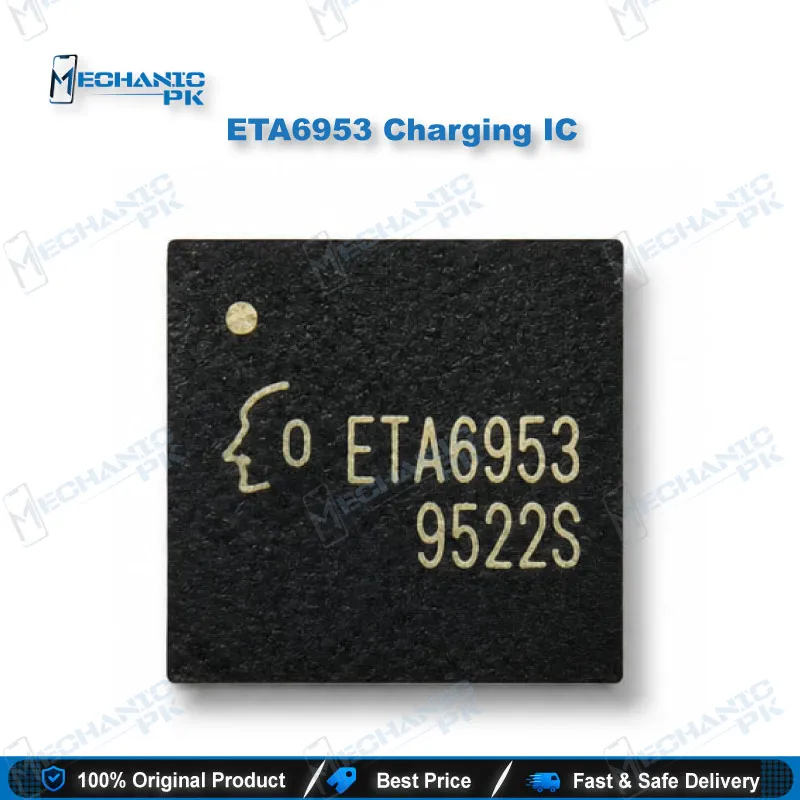
ETA6953 Charging IC – I2C 3A Battery Charger QFN
₨ 300
ETA6953 Charging IC for Redmi 9A, 9C and Note 9 Boards
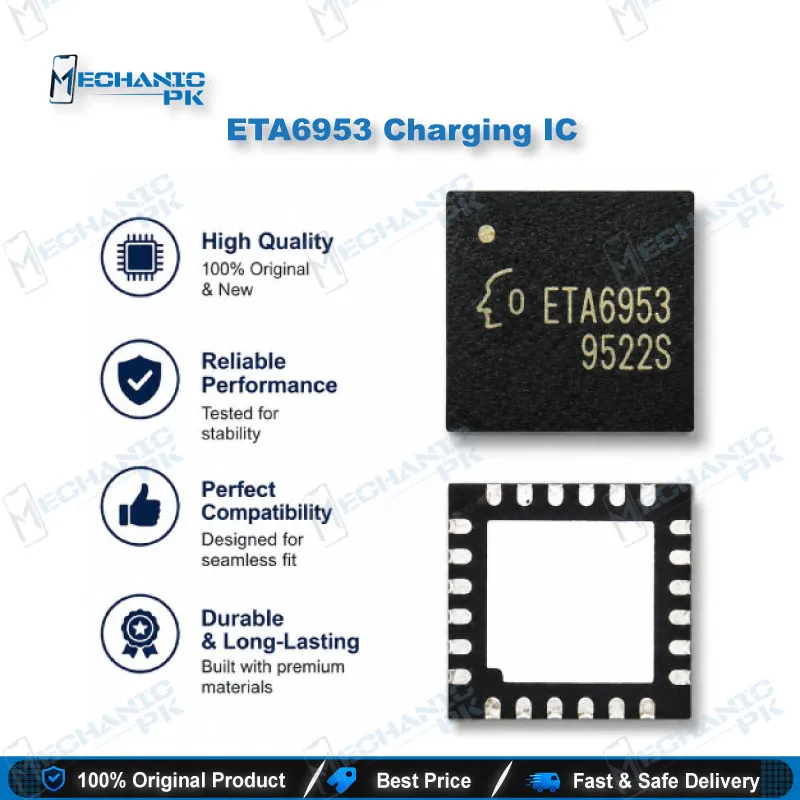
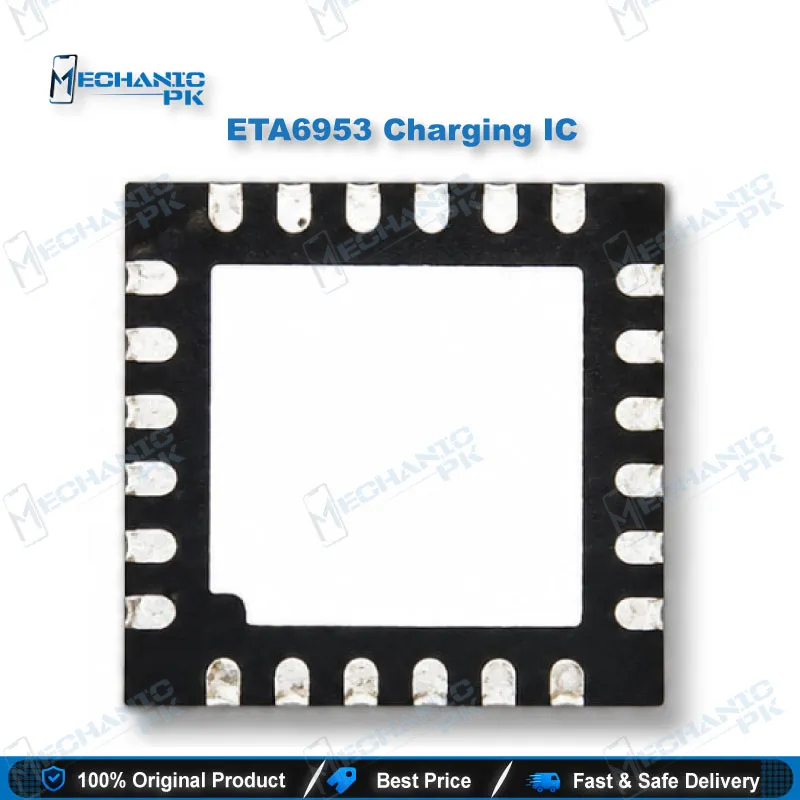
The ETA6953 is an I2C-controlled 3A switch-mode battery charger IC for single-cell Li-Ion and Li-Po batteries. It combines the input reverse-blocking FET, both switching FETs, and the battery FET in one QFN4x4-24 package. Your repair bench will see it most often on Redmi 9A, Redmi 9C, Redmi Note 9, POCO C3, and Redmi A3 boards. The chip accepts input up to 13.5V and supports OTG boost output up to 1.2A. Use it when you troubleshoot a charging fault, slow charging, or a battery that does not increase while plugged in.
ETA6953 Charging IC: Electrical Role and Repair Workflow
The ETA6953 charging IC controls how power enters the battery on Redmi and POCO boards. ETA designs it as a single-cell switch-mode charger with I2C control, so the host processor can adjust charge settings in software. Because the chip handles both the charge path and the power path, a fault here can look like a simple charging problem while the root cause sits deeper in the power sequence. This guide covers the key electrical figures, the I2C control model, and the protection features you need when you test or replace the part. Each section connects to a step you perform on your repair bench.
Key Electrical Figures
The ETA6953 accepts input from 3.9V up to 13.5V, which covers standard USB ports and high-voltage adapters. Charge current is programmable from 0mA to 3000mA in 60mA steps, so you can match the charge rate to the battery and the board design. The IC reaches 90% efficiency at 2A from a 5V input, which keeps heat lower during fast charging sessions. A synchronous 1.5MHz buck converter drives the charge stage, and all four power FETs sit inside the QFN4x4-24 package. When a board charges but runs hot, these figures help you judge whether the IC operates within its normal range. Check the input path first, then compare the measured behavior against these numbers before you decide on replacement.
I2C Control and Autonomous Charging
The chip communicates with the host over I2C at slave address 0xD6, and it supports both 100kHz standard mode and 400kHz fast mode. Through this interface, your software sets the charge current, the input current limit, and the charge voltage. When the host does not manage the chip, it switches to a default autonomous mode that still charges the battery. That autonomous mode includes a built-in 10-hour safety timer, which protects the battery during long charging cycles. This behavior explains why some boards show partial charging even when the software side has a fault. Before you condemn the IC, check the SDA and SCL lines for shorts, because a host-side bus fault can mimic a dead charger.
Protection Features and Board-Level Repair Use
The ETA6953 includes input overvoltage protection, battery overvoltage protection, and battery over-discharge cutoff with automatic BATFET disconnect. Thermal regulation starts at 110°C, and thermal shutdown engages at 160°C. A dedicated TS pin reads battery temperature and adjusts charge current and voltage through JEITA profiles, so charging can drop off once the phone warms up. On Redmi 9A, Redmi 9C, and Redmi Note 9 boards, technicians replace this IC for charging that does not increase, slow charging, and dead-after-flash faults. A faulty chip can also cause boot loop symptoms when the system rail fails to stabilize at power-up. Reflow with proper preheat, confirm ground contact on the thermal pad, and verify the I2C lines before you finalize the diagnosis.
| Weight | 0.1 kg |
|---|
Key Features
- Genuine ETA6953 charging IC in QFN4x4-24 package
- 3.0A programmable charge current in 60mA steps
- Input range from 3.9V to 13.5V
- Integrated reverse-blocking, switching, and battery FETs
- I2C control with autonomous fallback mode
- OTG boost output up to 1.2A at 5.15V
- JEITA temperature profiles through the TS pin
- Input OVP, battery OVP, and thermal shutdown protection
Specifications
| Brand | ETA |
|---|---|
| Model | ETA6953Q4Y |
| Category | Mobile Phone ICs |
| Compatibility | Redmi 9A, Redmi 9C, Redmi Note 9, POCO C3, Redmi A3 charging circuits |
| Supported Devices | Single-cell Li-Ion and Li-Po smartphone and tablet charging circuits |
| Technology | I2C-controlled switch-mode battery charger with power path management |
| Input Voltage | 3.9V to 13.5V |
| Dimensions | QFN4x4-24 (4 x 4 mm) |
| Weight | 0.01 kg |
Common Repair Uses
- Charging not increasing while plugged in
- Slow charging and charge drop-off
- Dead after flash charging faults
- Overheating during charge
- OTG or external USB device detection failure
- Boot loop symptoms tied to power-up rail failure
Compatible Devices
- Xiaomi and POCO boards using a single-cell I2C charging circuit
- Redmi 9A
- Redmi 9C
- Redmi Note 9
- POCO C3
- Redmi A3
FAQ
What is the product name?
What is the brand of this product?
What is the model of this product?
What is this product used for?
Which devices are compatible with this product?
Who should use this product?
What I2C address does the ETA6953 use?
What is the maximum input voltage for the ETA6953?
Related products