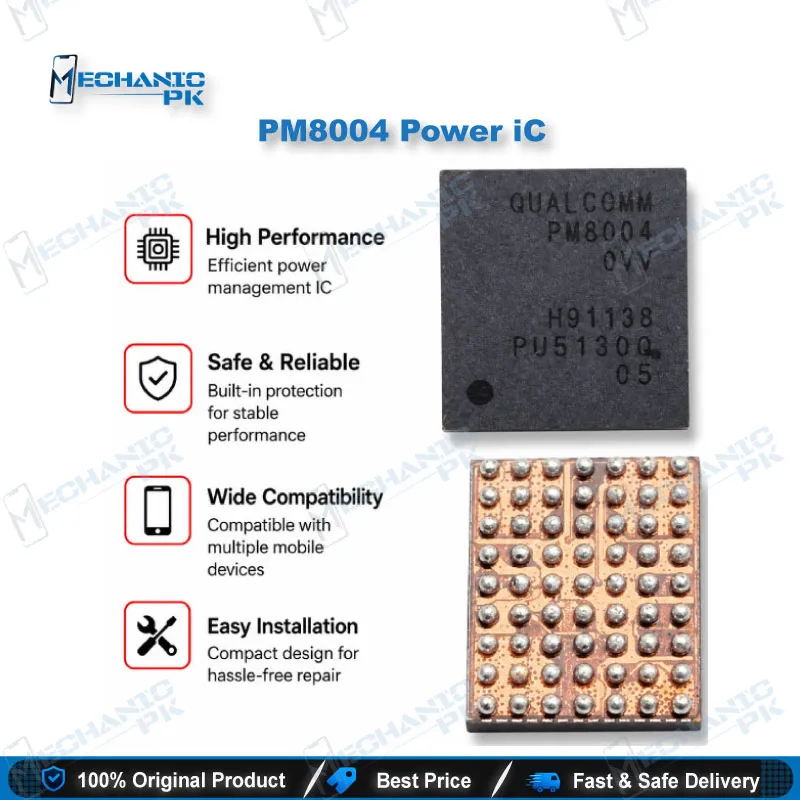
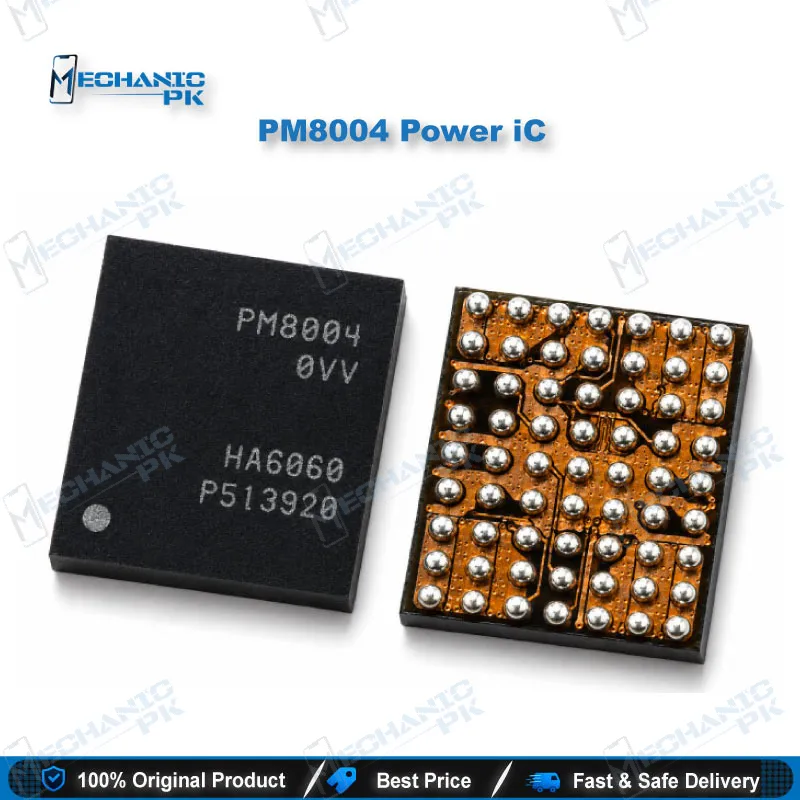
PM8004 Power IC – Qualcomm GPU/CPU Rail PMIC for Snapdragon
₨ 300
PM8004 Power IC for Snapdragon Board-Level Repair
The PM8004 Power IC is a Qualcomm secondary power management chip that drives dedicated switching rails for the GPU and CPU clusters on Snapdragon motherboards. Kernel documentation ties it to MSM8992, MSM8994, MSM8996, MSM8956 and MSM8976 platforms, where it runs alongside the main PMIC set over the SPMI bus. When this chip fails, the processor loses core power and the handset reaches your bench as a dead phone, a boot loop issue, or a unit that crashes under graphics load. Mechanicpk supplies the PM8004 for technicians who diagnose power-tree faults at IC level and need the exact part number for a clean, first-time repair.
PM8004 Power IC: Dedicated Supply Rail Chip for Qualcomm Snapdragon Boards
The PM8004 Power IC is a Qualcomm secondary power management chip that works alongside the main PMIC set on a range of Snapdragon motherboards. Its job is narrow and critical: it drives the high-current switching rails that feed the GPU and, on many boards, the CPU clusters (APC0/APC1). When this chip fails, the application processor loses its core supply, and the handset typically arrives at your bench as a dead phone or a unit stuck with hang on logo behavior. Mechanicpk supplies the PM8004 for technicians who diagnose power-tree faults at IC level and need the correct part number, not a guess.
Where the PM8004 Power IC Sits in the Snapdragon Power Tree
Qualcomm platforms of this generation split power delivery across several chips. The main PMIC handles housekeeping, LDO regulators and power sequencing, a companion PMIC handles charging and display power, and the PM8004 takes over dedicated buck (SMPS) rails. Linux kernel documentation lists two regulators on this part, S2 and S5, and places the chip at address 0x5 on the SPMI bus. That SPMI link matters during diagnosis: the SoC and main PMIC communicate with the PM8004 over this two-wire bus, so a fault on the bus lines can mimic a failed IC. Check the SPMI clock and data lines before you commit to a chip swap.
Chipset Platforms That Use PM8004
Kernel driver records tie the PM8004 to boards built on MSM8992 (Snapdragon 808), MSM8994 (Snapdragon 810), MSM8996 (Snapdragon 820), MSM8956 (Snapdragon 650) and MSM8976 (Snapdragon 652). Sony’s Xperia X and Xperia X Compact, both on the Loire platform, carry this chip in their mainline device trees. Not every board on these chipsets populates a PM8004, and OEMs choose different PMIC combinations, so confirm the marking on the original chip and the board schematic before you order. That single check saves you a wasted reballing session.
Fault Symptoms That Point to This IC
A shorted S2 or S5 rail usually shows up as heavy current draw the moment you connect a DC power supply, often with the chip itself heating up under a thermal camera or a drop of isopropyl alcohol. An open or weak rail produces a different picture: the phone powers on partially, then reboots, sits in a boot loop, or crashes under GPU load during games and video playback. Measure the output inductor of each rail in diode mode and compare it against a known-good board. Abnormal readings on these lines, combined with clean readings on the main PMIC rails, narrow the fault to the PM8004 or its surrounding capacitors.
Replacement Workflow on the Repair Bench
Treat the PM8004 like any BGA power IC. Mount the board in a PCB holder, shield nearby components, and preheat the board on a bottom heater to cut thermal stress. Remove the old chip with a hot air station, clean the pads with low-melt solder and desoldering wick, and inspect under a stereo microscope for lifted or torn pads. Reball the new IC with the correct stencil from your reballing kit, align it carefully, and reflow with controlled airflow. After the swap, measure each rail with a multimeter, then power the board through a test box or DC supply and watch the current curve through the full boot.
Building a Complete Power-Repair Toolkit
Board-level power work rewards a matched set of tools. Technicians who stock this IC usually pair it with a hot air station, a temperature-controlled soldering station, a BGA reballing kit, a quality microscope and a DC power supply with a clear ammeter. For data recovery on the same boards once the power fault clears, eMMC programmers, UFS adapters and ISP pinout tools complete the workflow. Browse those categories on Mechanicpk to build your Snapdragon repair bench from one distributor.
Why Source the PM8004 Power IC from Mechanicpk
Salvaged power ICs often carry hidden heat stress from a previous failure. Mechanicpk focuses on correct part numbers and clear technical data, so you can quote IC-level repairs with confidence and return devices to customers without a second visit.
| Weight | 0.1 kg |
|---|
Key Features
- Genuine Qualcomm part number PM8004 for exact-match board replacement
- Drives two SMPS buck regulators, S2 and S5, for high-current core rails
- Supplies the GPU and/or CPU clusters (APC0/APC1) depending on board design
- Communicates with the SoC and main PMIC over the SPMI bus at address 0x5
- Pairs with the main PMIC set on Snapdragon 808, 810, 820, 650 and 652 platforms
- Restores core processor power on dead phones with a confirmed PM8004 fault
- BGA package suits standard hot air and reballing workflows on the repair bench
- Supported in mainline Linux regulator drivers, which documents its rail layout clearly
Specifications
| Brand | Qualcomm |
|---|---|
| Model | PM8004 |
| Category | Power Management IC (Secondary PMIC / Power IC) |
| Compatibility | Qualcomm MSM8992, MSM8994, MSM8996, MSM8956, MSM8976 platforms |
| Supported Devices | Sony Xperia X, Sony Xperia X Compact, and other boards that populate PM8004 per schematic |
| Technology | SPMI-controlled SMPS regulators (S2, S5) supplying GPU and/or CPU cluster rails |
Common Repair Uses
- Dead phone repair with no boot due to a failed GPU or CPU supply rail
- Short-circuit repair on the S2 or S5 rail with heavy current draw at power-on
- Boot loop repair where the phone restarts during processor power-up
- Hang on logo faults traced to an unstable core supply rail
- Crash and reboot under GPU load in games or video playback
- IC replacement after liquid damage corrodes the power IC area
- BGA reballing of a PM8004 with cracked solder joints from drops or heat
- Power-tree diagnosis alongside main PMIC and SPMI bus line checks
Compatible Devices
- Qualcomm Snapdragon boards that populate PM8004 as the secondary power IC (verify part marking and schematic)
- Snapdragon 808 (MSM8992) boards using PM8004
- Snapdragon 810 (MSM8994) boards using PM8004
- Snapdragon 820 (MSM8996) boards using PM8004
- Snapdragon 650 (MSM8956) boards using PM8004
- Snapdragon 652 (MSM8976) boards using PM8004
- Sony Xperia X (Loire platform)
- Sony Xperia X Compact (Loire platform)
- Any Qualcomm board whose schematic lists PM8004 at SPMI address 0x5
FAQ
What is the product name?
What is the brand of this product?
What is the model of this product?
What is this product used for?
Which devices are compatible with this product?
Who should use this product?
Which Snapdragon chipsets use the PM8004 power IC?
How do I confirm a PM8004 fault before replacing the IC?
Related products