



















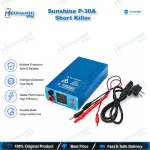
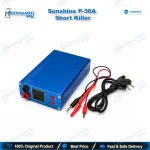
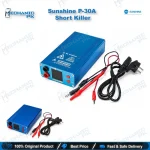
Sunshine P-30A 30A PCB Short Circuit Detector
₨ 16,500
Sunshine P-30A 30A PCB Short Circuit Detector
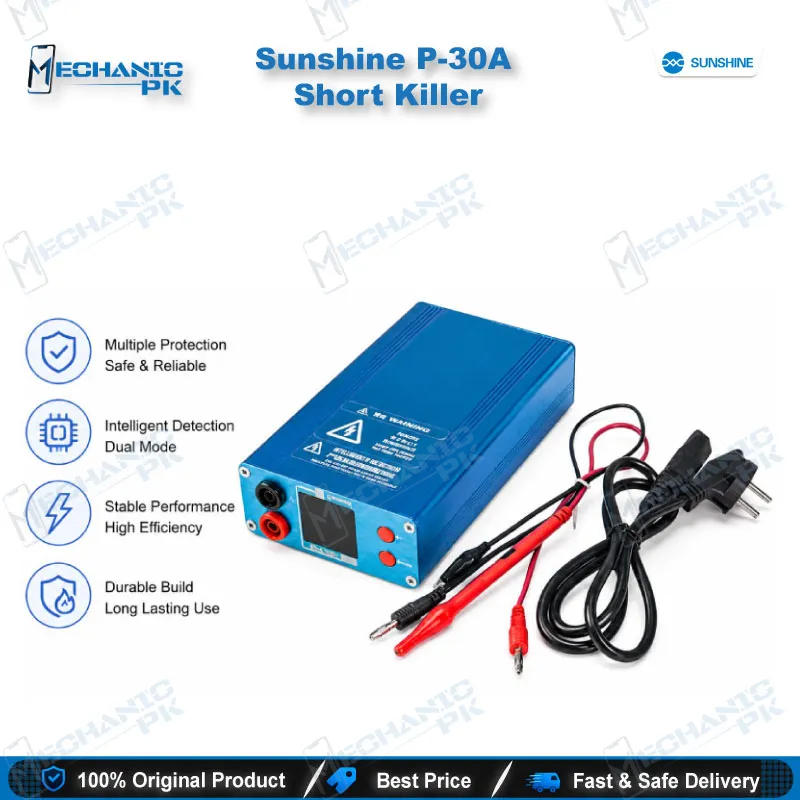
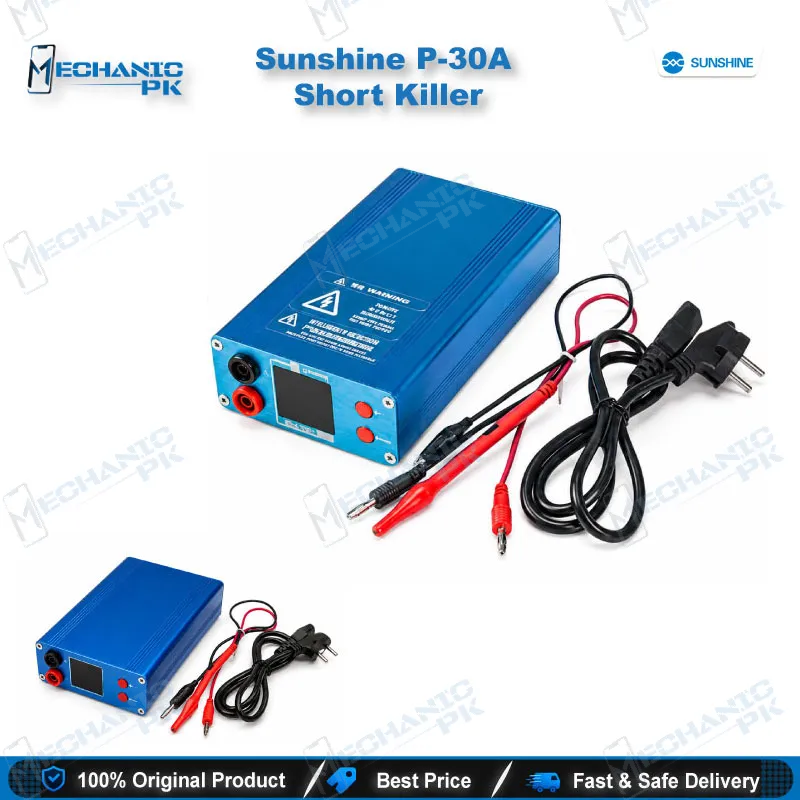
The Sunshine P-30A is a 30A PCB short circuit detector for locating shorted rails on mobile phone and laptop motherboards. It injects current into the faulty path and shows the reading on an LCD, so you can track the short as you move the probe. Overheating protection, polarity recognition, and a sound prompt support steady probing during use. The stainless steel body and compact 10 x 10 x 10 cm size suit daily bench work. It comes in 110V and 220V variants, and the 220V version matches standard Pakistani mains supply.
In stock
30A PCB Short Circuit Detector for Motherboard Fault Location
A shorted power rail can keep a motherboard from powering on, and without a precise locator you end up probing blindly across dozens of components. The Sunshine P-30A is a 30A PCB short circuit detector built for exactly that diagnostic step. It connects to the board under test, injects current into the suspect rail, and reports the reading on its LCD. As you move the probe across the layout, the readout changes, which lets you narrow the search before you lift any IC. The sections below cover where the tool fits in your workflow, how current injection works in practice, what the protection features do, and how to choose the right voltage variant for your bench.
Where the P-30A Fits in Your Diagnostic Workflow
A board that draws abnormal current on the bench supply tells you something is wrong, but not where. You watch the current climb, confirm a rail is shorted, and then decide how to find the fault. The P-30A handles that localization step. It works after you have established that a short exists and before you commit to hot air removal or trace repair. Once the probe shows the area of concentration, you move to a microscope for visual inspection, use a multimeter to check suspect traces, or pair the tool with thermal imaging to see which component heats up under fault current. Each method answers a different question, and the P-30A answers the first one: roughly where on the board the fault sits. Technicians working on dead-after-flash boards and no-power phones use it to avoid tearing down areas that were never involved.
How Current Injection Narrows Down a Short
Current injection pushes a controlled current through the shorted path so the fault shows up as a measurable reading. With the P-30A, that reading appears on the LCD, giving you a live reference as you probe. Move the probe across the board and watch how the value changes. When the reading changes most sharply near one area, the short is likely nearby. This approach gives a clearer picture than checking each capacitor or IC with a multimeter, especially on dense mobile motherboards where many components share the same rail. The reading tells you about the path, not the component. A shorted decoupling capacitor, a damaged PMIC, and a cracked trace can all produce similar readings, so you still confirm the cause with a microscope or direct testing. Read the display together with your board knowledge and the schematic if you have one.
Protection Features: Overheating Control and Polarity Recognition
Probing live current on a board brings two practical risks: heat buildup in the tool and reversed probe connections that give misleading readings. The P-30A includes overheating protection to reduce heat stress during extended use. Polarity recognition identifies probe orientation, so a reversed connection does not produce a false reading. A sound prompt gives audible feedback, letting you keep your attention on the probe tip rather than the display. Together, these features make the tool more predictable on a busy bench, where you may switch between boards and probe points quickly. They do not replace careful practice. Verify polarity before you apply current, confirm your probe points, and keep the board supported on an insulated surface while you work.
Build Quality, Voltage Variants, and Bench Setup
The P-30A has a stainless steel body that holds up to the knocks and wear of daily workshop use. Its compact 10 x 10 x 10 cm footprint leaves room on a crowded bench and fits easily into a toolbox for repair work at another location. The unit comes in 110V and 220V variants. Pakistan’s standard mains supply is 220V, so the 220V version matches most local workshops directly. Check the voltage specified on your order before you buy to avoid a mismatch. The package includes the main host unit and a probe line, so you can start testing as soon as you unbox it. Pair it with a bench power supply, a microscope, and a hot air station to build a practical short circuit diagnostic setup.
| Weight | 0.9 kg |
|---|
Key Features
- Locates PCB shorts using 30A current injection with a live LCD readout
- Overheating protection for extended high-current probing
- Polarity recognition prevents false readings from reversed probes
- Sound prompt lets you keep your eyes on probe placement
- Stainless steel body built for daily workshop wear
- Compact 10 x 10 x 10 cm size for bench or on-site use
- 110V and 220V variants to match your power supply
- Ships with the main host unit and probe line, ready to use
Specifications
| Brand | Sunshine |
|---|---|
| Model | P-30A |
| Category | PCB Diagnostic Tools |
| Compatibility | Universal, not device-specific |
| Supported Devices | Mobile phone and laptop motherboards, tablets |
| Technology | 30A current-injection short detection with LCD readout |
| Material | Stainless steel |
| Input Voltage | 110V or 220V (depends on variant) |
| Dimensions | 10 x 10 x 10 cm |
Common Repair Uses
- Real-world short-fault workflows where the tool is applied.
- Locating a short on a dead board that does not power on
- Finding the shorted rail after abnormal current draw on the bench supply
- Narrowing the fault area before IC or PMIC removal
- Isolating shorts on boards showing a dead-after-flash symptom
- Diagnosing short-circuit faults on laptop mainboards
- Pre-repair fault isolation before microscope or thermal inspection
Compatible Devices
- Universal, not device-specific. Applies to any board where a short needs locating.
- Android smartphone motherboards
- iPhone motherboards
- Tablet mainboards
- Laptop mainboards
- Desktop PC motherboards
FAQ
What is the product name?
What is the brand of this product?
What is the model of this product?
What is this product used for?
Which devices are compatible with this product?
Who should use this product?
Does the P-30A identify the exact faulty component?
Which voltage variant should a Pakistani workshop choose?
Related products