














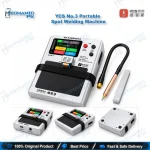
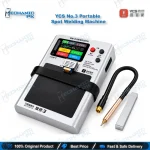
YCS No.3 Portable Spot Welding Machine
₨ 9,500
Double Pulse Battery Spot Welder
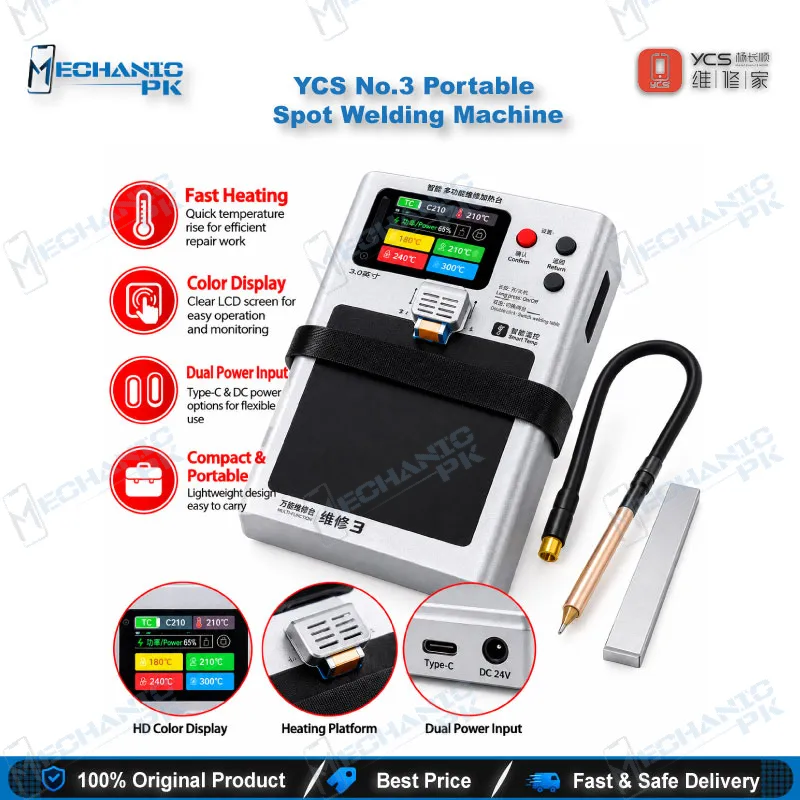
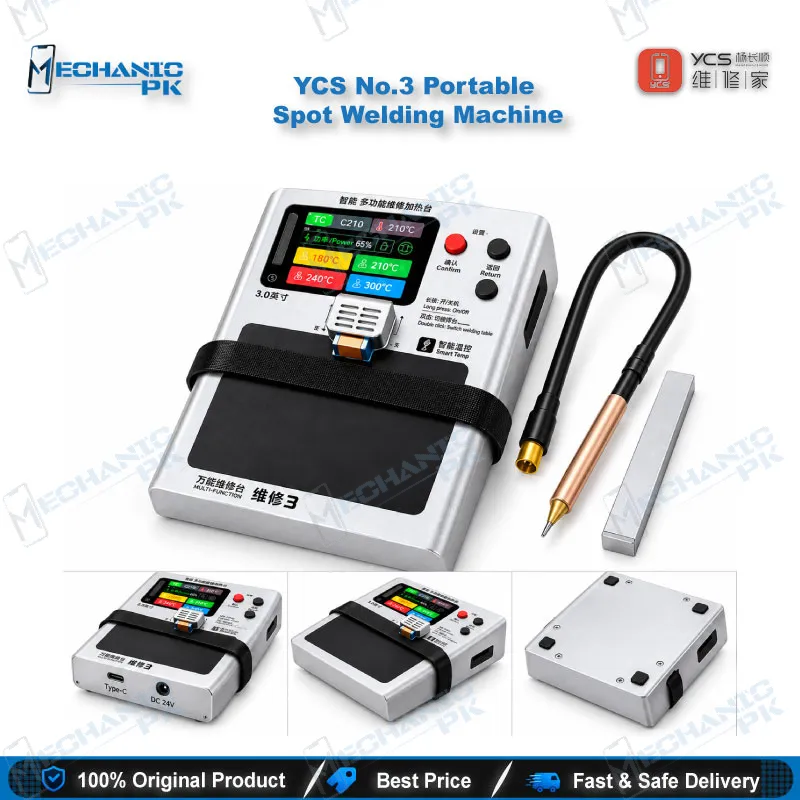
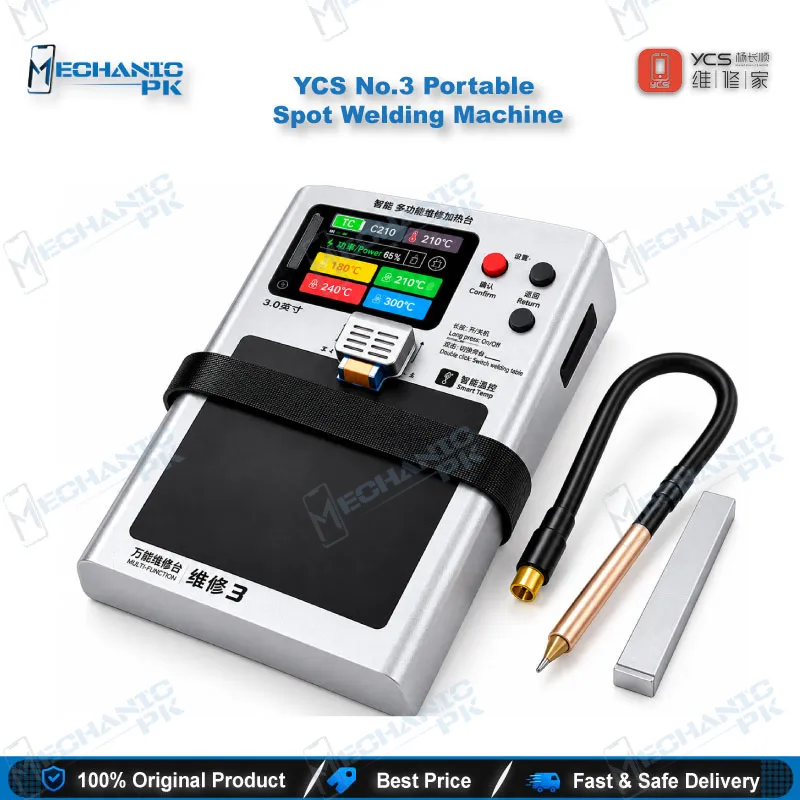
The YCS No.3 portable spot welding machine gives your repair bench a compact double pulse welder for nickel sheet and lithium cell work. It fires a preheat pulse followed by a main pulse, and you set the parameters on the color screen before every weld. The integrated body needs no external control board, and the velcro-style portable design keeps it easy to move between your bench and the counter. A built-in 5V USB output turns it into an emergency power bank when a customer’s phone runs flat. Mechanicpk supplies it with 2 welding pens and 1 nickel sheet for technicians who rebuild or repair battery tabs.
In stock
YCS No.3 Portable Spot Welding Machine for Battery Tab Work
The YCS No.3 portable spot welding machine belongs to the “parameter 3” generation of compact YCS welders, built around an integrated body with a color display and a double pulse output. You use it to join nickel sheet to lithium cells without the heat spread of a soldering iron, which protects the cell and the protection circuit around it. Technicians who handle battery tab repair, small pack rebuilds, and phone battery nickel work get a controllable welder in a package light enough to carry, at 0.50 kg. This listing covers how the pulse system works, how the screen controls fit your workflow, and where the machine sits among the other tools on a professional repair bench.
Double Pulse Output: Preheat Pulse Plus Main Pulse
Every weld on this machine runs as two pulses. The first is a preheat pulse, and the second is the main pulse that delivers the weld energy. Splitting the energy this way gives you two variables to tune instead of one, so you can match the pulse to the nickel sheet and the cell instead of accepting a fixed single-shot output. You adjust the pulse, the interval between pulses, the preheat value, and the connect setting directly on the screen.
The practical benefit shows when you work on tabs of different thickness. A thin strip and a heavier strip rarely want the same settings, and the double pulse scheme lets you change one parameter without rebuilding your whole setup. The supplier guidance for this machine stresses using the correct nickel thickness, because a strip that is too thick or too thin leads to a weak weld or overheating. Test on the supplied nickel sheet first, then move to your working strip.
Color Screen Controls and the Three-Step Routine
The color display replaces the guesswork of knob-only welders. You read the values you set, change them with the physical buttons, and repeat the same values on the next joint. The routine stays simple: place the battery, adjust the settings, start welding. Repeatable settings matter when you weld several tabs in a row, because a consistent result across joints reduces rework and protects the cells you handle.
The integrated design means no external boards sit on your bench. You get a single body with the display, the buttons, and the two welding pens in one kit. The pens give you a hands-on way to place each weld exactly where the tab needs it.
Where It Fits in Your Repair Workflow
Spot welding covers the battery side of the bench, while your board-level tools cover the motherboard side. A typical day moves between both. You diagnose a charging issue with a multimeter, inspect the board under a microscope, rework ICs with a hot air station or soldering station, and clamp the board in a PCB holder. When the fault traces back to a damaged battery tab or a worn nickel connection, the YCS No.3 handles that joint without applying soldering heat to the cell.
The machine suits three situations in particular. You replace a torn or corroded nickel tab on a lithium cell. You rebuild a small pack with 18650 or 21700 style cells. You repair the nickel connection on a phone battery when the tab, not the cell, causes the hardware fault. Shops that run several of these jobs a week save time by keeping a dedicated welder instead of improvising with a soldering iron.
Built-In 5V USB Output and Portable Design
The YCS No.3 includes a 5V USB output, and the supplier markets this as an emergency power bank function. You can charge a phone or another USB device from the unit when a customer’s phone runs flat or a power source is not available. Treat it as a convenience feature, since the core job of the machine is welding.
The velcro-style portable design and 0.50 kg weight let you move the unit between your bench, a service counter, and a field visit. Repair shop owners and service centers that run more than one bench can share a single machine or place one at each station. Pair it with a good set of nickel strips, a flat work surface, and basic safety habits, and you have a clean battery welding setup that complements your existing tools.
Why Technicians Choose the Double Pulse Format
Buyers who already know the industry compare welders by pulse control, display clarity, and kit contents. The YCS No.3 answers those points directly: adjustable double pulse parameters, a color screen, an integrated body, two pens, and a nickel sheet to start. You skip the extra purchase of a separate control board and begin welding when the unit arrives.
| Weight | 0.50 kg |
|---|
Key Features
- Double pulse output with a preheat pulse followed by a main pulse
- Color screen for adjusting pulse, interval, preheat, and connect settings
- Physical buttons for parameter control
- Integrated body with no external boards needed
- Velcro-style portable design
- Built-in 5V USB output for emergency phone charging
- Includes 2 welding pens
- Includes 1 nickel sheet
- Lightweight at 0.50 kg
Specifications
| Brand | YCS |
|---|---|
| Model | No.3 (YCS Parameter 3) |
| Category | Battery Spot Welding Machine |
| Compatibility | 18650, 21700, and similar battery cells |
| Technology | Double pulse spot welding (preheat pulse plus main pulse) |
| Weight | 0.50 kg |
Common Repair Uses
- Battery tab and small pack welding on the repair bench
- Replacing a torn or corroded nickel tab on a lithium cell
- Rebuilding a small 18650 or 21700 battery pack
- Repairing the nickel connection on a mobile phone battery
- Welding nickel sheet to battery cells without soldering heat on the cell
- Setting preheat and main pulse values for different strip thicknesses
- Emergency phone charging through the built-in 5V USB output
- Training technicians in spot welding settings and technique
Compatible Devices
- Universal battery cell scope, not specific to phone brands or models
- 18650 lithium cells
- 21700 lithium cells
- Similar cylindrical battery cells
- Nickel sheet and nickel strip tabs
- Mobile phone battery nickel tabs
- Small lithium battery pack builds
- Phones and USB devices charged through the 5V USB output
FAQ
What is the product name?
What is the brand of this product?
What is the model of this product?
What is this product used for?
Which devices are compatible with this product?
Who should use this product?
How does the double pulse on the YCS No.3 work?
Can the YCS No.3 charge a phone like a power bank?
Related products