














874B Audio IC For Phone Repair | TFA9874 NXP
₨ 350
TFA9874 Audio IC for Board-Level Audio Repair
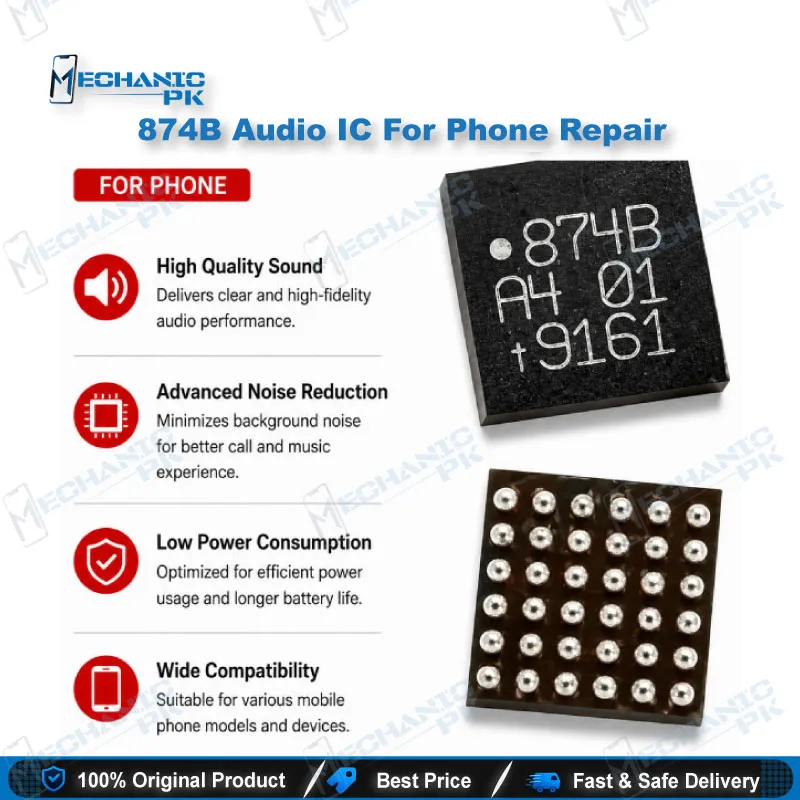
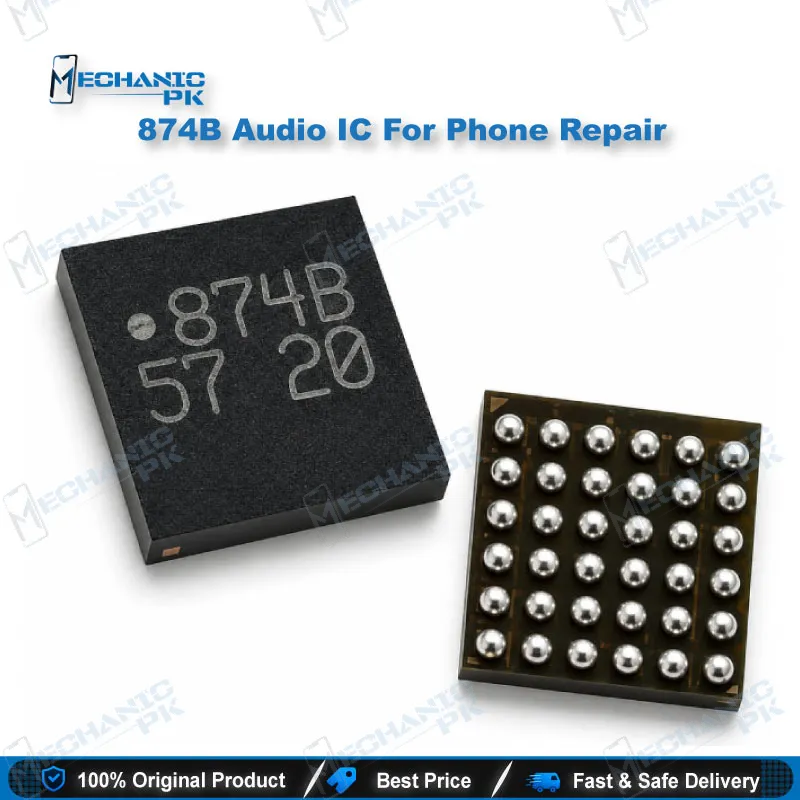
The 874B Audio IC For Phone Repair is the NXP TFA9874 audio amplifier in a BGA package, used on the board-level audio path of Xiaomi, Redmi, Poco, Oppo, Realme and OnePlus handsets. When a board shows no speaker output, low volume, or a dead microphone, this IC is one of the first components to verify under power. Replacement needs a hot air station with a controlled profile, a stencil matched to the ball pitch, and clean board preparation before reflow. Supplied as a single BGA component for technicians who reball and rework audio circuits in-house.
The 874B Audio IC For Phone Repair covers the NXP TFA9874 audio amplifier, a BGA component on the audio output path that drives the speaker and earpiece stages. Technicians working on Xiaomi, Redmi, Poco, Oppo, Realme and OnePlus boards encounter this part most often when a handset loses speaker output, shows low volume, or has a microphone that stops responding after liquid ingress or a drop. Before you order a replacement, read the surface marking under magnification and match it against the reference in your board schematic or service file, because a marking match is the first check that prevents buying the wrong part. A reliable diagnostic sequence starts with a microscope inspection for cracked or lifted balls, moves to a voltage check on the rails feeding the amplifier, and ends with a resistance test to ground. Run a current-limited bench supply during that check, because a short that clears once the IC is isolated points directly at the amplifier, while healthy rails and no short send you back toward the codec or CPU. Board replacement should never be the default answer for this symptom set, since the amplifier is a single, identifiable component with a clear test path. Hand soldering with a conventional iron is not a realistic option for a BGA package, so your workflow needs a hot air rework station with a stable temperature profile. Pair that station with a stencil matched to the ball pitch, appropriate solder paste or pre-balled stock, and a reballing kit if you prepare the chip yourself. Preheat the board in a holder so the thermal gradient across the audio section stays gentle, and keep dwell time short to protect neighboring components and the solder mask. Clean the pads with flux remover and isopropyl alcohol before and after placement, since flux residue around audio circuitry can produce hum, crackle or intermittent output. Inspect ball alignment under a microscope before reflow, because a single bridged ball beneath this footprint can create faults that are slow to diagnose. Liquid damage is the most frequent failure cause, where corrosion beneath the package breaks continuity on specific balls and produces partial audio, such as a working speaker with a silent microphone or the reverse. Mechanical stress can crack a ball connection without visible corrosion, so the fault may come and go with pressure on the back panel, and your retest should repeat that same pressure check. Software faults can imitate hardware faults, particularly after a failed flash or update that leaves the audio driver reporting errors, so rule out firmware before committing to a component change. Test the speaker, earpiece and microphone under real conditions after reassembly, including music playback for output, call mode for the earpiece, and a voice recording for the microphone path. Stocking this part lets a shop close audio jobs in one visit instead of waiting on external supply, which matters for the steady volume of Xiaomi and Oppo complaints seen in Karachi, Lahore and Islamabad workshops. Keep a log of the board revision and the supplier batch, since reworked boards from different lots can show slightly different audio behavior and tracking this makes comebacks easier to trace. Document the before and after readings for each repair, including rail voltages and resistance values, so that repeat faults on the same model can be compared against known-good baselines rather than guessed at. When a customer reports intermittent audio, reflow the amplifier only after confirming the pads are intact, because reflowing a cracked pad repeats the problem and wastes the part. For fleets or service contracts, a shared test procedure written around these same checks keeps every technician’s results consistent across the bench. Confirming each step with the same measurements every time turns a skilled repair into a repeatable one.
| Weight | 0.1 kg |
|---|
Key Features
- NXP TFA9874 audio amplifier, listed under the 874B designation
- BGA package suited to hot air rework and reballing
- Drives the speaker and earpiece output stages
- Covers microphone-path faults on supported boards
- Single-component replacement without a full board swap
- Suited to liquid-damage and drop-related audio faults
- Weight listed at 0.01 kg
- Stockable for repeat audio jobs across the listed brands
Specifications
| Brand Entity | NXP |
|---|---|
| Product Entity | 874B Audio IC / TFA9874 |
| Technology Entity | BGA audio amplifier IC |
| Compatible Device Entities | Xiaomi, Redmi, Poco, Oppo, Realme, OnePlus, Honor |
| Repair Process Entity | Hot air rework, reballing, board-level audio diagnostics |
| Industry Entity | Mobile phone repair, GSM technician tools, Pakistan repair market |
Common Repair Uses
- No speaker output on the loudspeaker path
- Low volume or distorted speaker audio
- Earpiece silence during calls
- Microphone failure after liquid ingress
- Board-level repair after corrosion under the BGA package
- Reflow of a cracked ball connection
- Hot air IC replacement during audio circuit diagnostics
- Audio verification after a firmware or flash failure
Compatible Devices
- Xiaomi Mi 9T, Mi 9T Pro, Mi CC9 Pro
- Redmi K20, K30, K30 Pro, Note 8 Pro
- Redmi Note 10, Note 10 Pro, Note 10 Lite
- Poco X2, Poco F2 Pro, Poco F4
- Oppo Reno 4 Pro, Reno 5 Pro, Reno 5 Pro Plus, Reno 6 Pro
- Oppo Find X3
- Realme X50, Realme X3
- OnePlus 9 Pro, Honor 8X, Huawei P40 Lite
FAQ
What is the product name?
What is the brand of this product?
What is this product used for?
Which devices are compatible with this product?
Does the 874B audio IC handle both speaker and microphone faults?
Is the 874B audio IC hand-solderable or does it need hot air rework?
Related products