














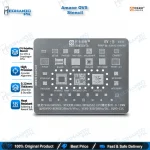
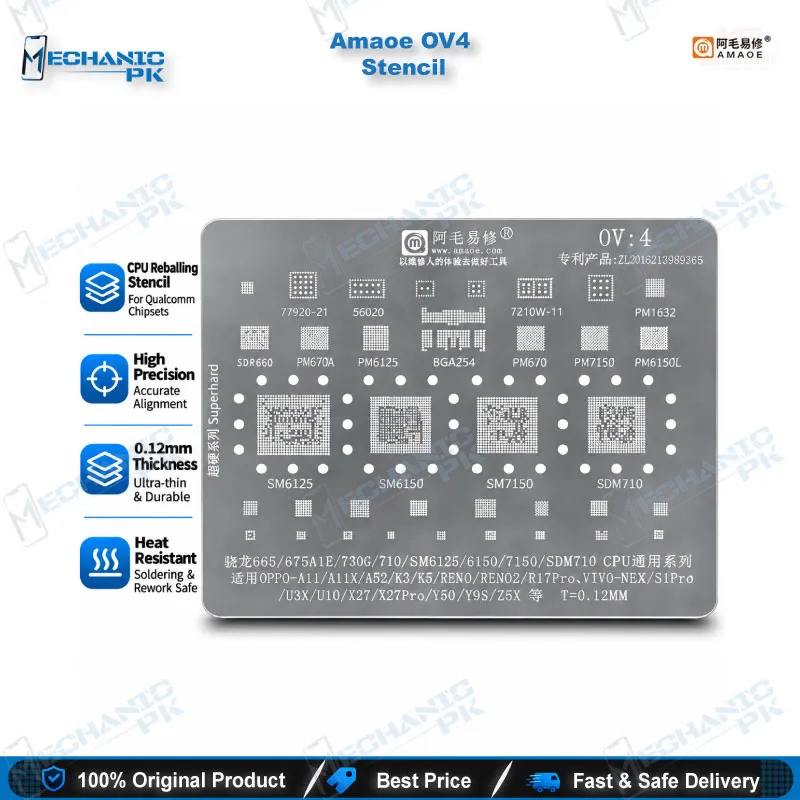
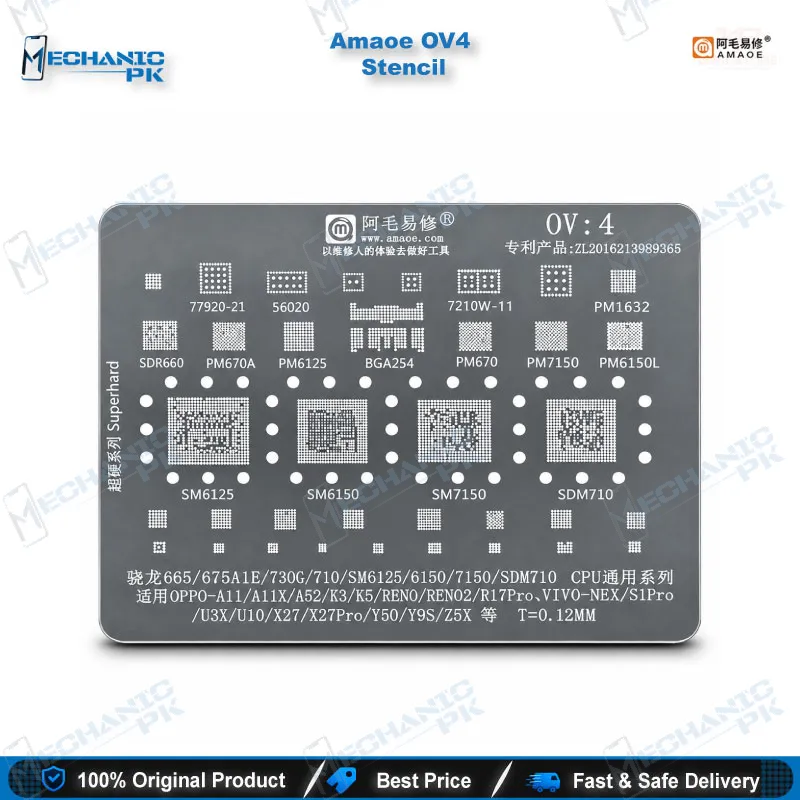
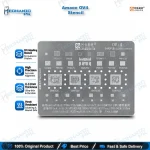
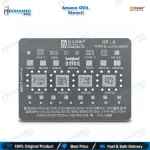
Amaoe OV4 Stencil for Oppo Vivo SM7150 Reballing
₨ 599
Amaoe OV4 Stencil for Oppo Vivo Boards
The Amaoe OV4 stencil covers Qualcomm SM6125, SM6150, SM7150 and SDM710 CPU footprints, along with PM6125, PM670, PM670A, PM7150 and PM6150L power ICs, on one reballing template built for Oppo and Vivo boards. You lay it over a cleaned BGA pad, spread paste, and heat the balls into shape after IC removal. Amaoe lists it for Vivo U3x, U10, X27, X27 Pro, Y50, Y9s and Z5x. Mechanicpk supplies the Amaoe OV4 stencil to Pakistani repair shops that want one spec-matched template instead of several single-chip stencils.
In stock
Amaoe OV4 Stencil for Oppo Vivo Qualcomm BGA Reballing
The Amaoe OV4 stencil for Oppo Vivo repair puts several Qualcomm footprints on a single template. Instead of keeping a separate stencil for every CPU and power IC, you work from one OV4 plate that carries SM6125, SM6150, SM7150 and SDM710 CPU patterns, plus PM6125, PM670, PM670A, PM7150 and PM6150L power IC patterns. Amaoe also lists PM1632, SDR660, 77920-21, 56020, 7210M-11 and a BGA254 pattern on the same sheet, so one stencil covers a wide slice of Oppo and Vivo mid-range board work.
Chipset Coverage and Footprint Scope
Qualcomm mid-range platforms drive a large share of Oppo and Vivo service volume, and the OV4 maps directly to that segment. The CPU side covers SM6125, SM6150, SM7150 and SDM710. The power side covers PM6125, PM670, PM670A, PM7150 and PM6150L. The remaining patterns are 77920-21, 56020, 7210M-11, PM1632, SDR660 and a BGA254 footprint. Match each pattern to the marking on the IC you removed before you pick the stencil. Amaoe lists the supported phones as Vivo U3x, U10, X27, X27 Pro, Y50, Y9s and Z5x. Treat that list as your confirmed starting point, and check the chip marking on any other Oppo or Vivo board before you spread paste. A stencil only works when its aperture pattern matches the package footprint of the IC you removed, so identify the part by its printed marking, not by the phone model alone. Two boards sold under the same model name can carry different chips, and a mismatched pattern wastes both paste and a pad-cleaning pass.
Where It Sits in the Reballing Workflow
A dead phone after a short, a boot loop issue traced to a lifted ball, or a charging issue that points at the power IC all end at the same bench step: you remove the part, clean the pads, and rebuild the balls. Lift the IC with a hot air station, level the pads with flux and a soldering station, then align the OV4 aperture pattern over the pads. Hold the stencil flat with a PCB holder so it cannot creep, spread paste across the apertures, and heat until the balls form. Keep the board preheated so thin mid-range pads do not lift, and hold the hot air temperature moderate while the balls form. Let the board cool before you peel the stencil away so the new balls stay seated. Inspect the result under a microscope, then check continuity with a multimeter before you refit the IC. If you reball the same parts every week, a complete reballing kit keeps your paste, flux and tweezers matched to the job. When the fault sits on the storage side instead, switch to eMMC programmers, UFS adapters or ISP pinout tools, and use a test box for the software side of the repair.
Why Technicians and Shop Owners Stock the OV4
Coverage per template drives the buying decision. One OV4 handles several Qualcomm CPU and power IC jobs that reach a bench in Oppo and Vivo traffic, so your rack holds fewer single-purpose stencils. A fixed aperture layout also keeps ball placement consistent from job to job, which matters when a hardware fault returns and you need to rule out a poor reball. Service centers and training institutes use the same template to teach correct ball spacing on mid-range Qualcomm boards. Wipe the stencil with isopropyl alcohol after each use and store it flat in a sleeve so the aperture edges stay clean. Compare the listed chip coverage against your weekly job mix before you order. A missing template also stalls a dead phone on your bench, which costs you turnaround time and customer trust, so a stocked OV4 protects your repair schedule. Mechanicpk supplies the Amaoe OV4 stencil for Oppo Vivo repair to shops across Pakistan that want a spec-matched template for these chipsets.
| Weight | 0.1 kg |
|---|
Key Features
- Combines SM6125, SM6150, SM7150 and SDM710 CPU patterns on one template
- Adds PM6125, PM670, PM670A, PM7150 and PM6150L power IC patterns
- Includes PM1632, SDR660, 77920-21, 56020 and 7210M-11 patterns
- Carries a BGA254 footprint
- Listed for Vivo U3x, U10, X27, X27 Pro, Y50, Y9s and Z5x
- Targets Oppo and Vivo Qualcomm mid-range board repair
- Fits a hot air and solder paste reballing workflow
- Cuts the number of single-purpose stencils your bench needs
Specifications
| Brand | Amaoe |
|---|---|
| Model | OV4 |
| Category | BGA Reballing Stencil |
| Compatibility | Oppo / Vivo Qualcomm boards (chip patterns listed below) |
| Supported Devices | Vivo U3x, U10, X27, X27 Pro, Y50, Y9s, Z5x |
| Technology | BGA reballing (solder ball stencil) |
Common Repair Uses
- CPU and power IC reballing on Oppo and Vivo Qualcomm boards
- SM7150 CPU reballing after IC removal
- SM6125 CPU reballing
- SM6150 and SDM710 CPU reballing
- PM6125 and PM670 / PM670A power IC reballing after a short
- PM7150 and PM6150L power IC reballing
- Charging issue repair where the power IC needs a fresh ball set
- Dead phone repair after a board short and IC replacement
- BGA254 package, SDR660 and PM1632 reballing
Compatible Devices
- Verified scope is the Vivo models and Qualcomm chip patterns Amaoe lists for the OV4
- Vivo U3x and Vivo U10
- Vivo X27 and Vivo X27 Pro
- Vivo Y50
- Vivo Y9s
- Vivo Z5x
- SM6125 and SM6150 CPU patterns
- SM7150 and SDM710 CPU patterns
- PM6125, PM670, PM670A, PM7150 and PM6150L power IC patterns
FAQ
What is the product name?
What is the brand of this product?
What is the model of this product?
What is this product used for?
Which devices are compatible with this product?
Who should use this product?
Which CPU chips does the Amaoe OV4 stencil support?
Which power ICs does the Amaoe OV4 stencil cover?
Related products