















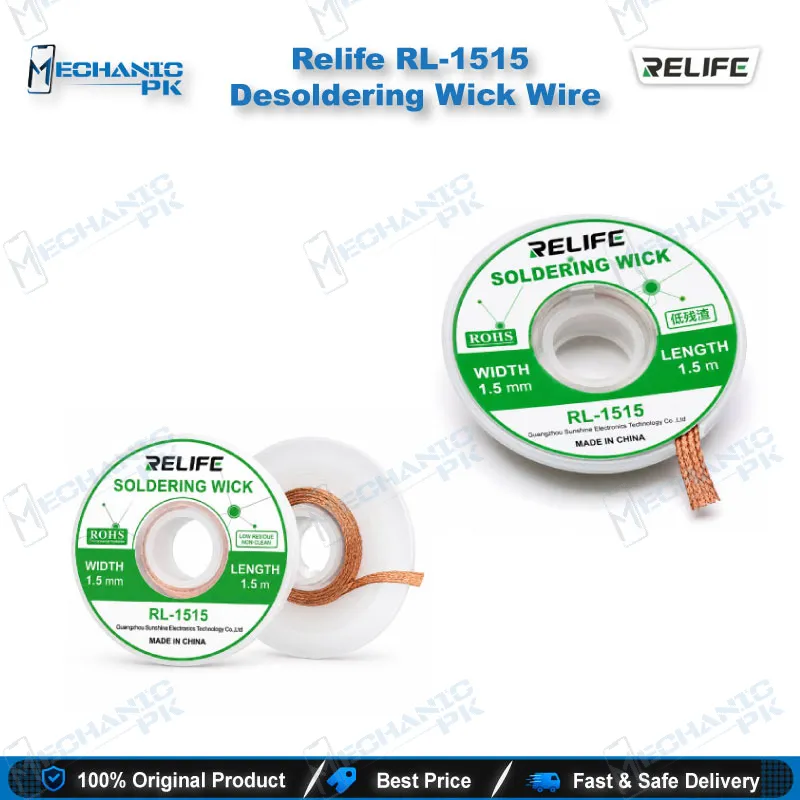
Relife RL-1515 Desoldering Wick 1.5mm x 1.5m
₨ 300
Relife RL-1515 Desoldering Wick 1.5mm for Mobile Repair
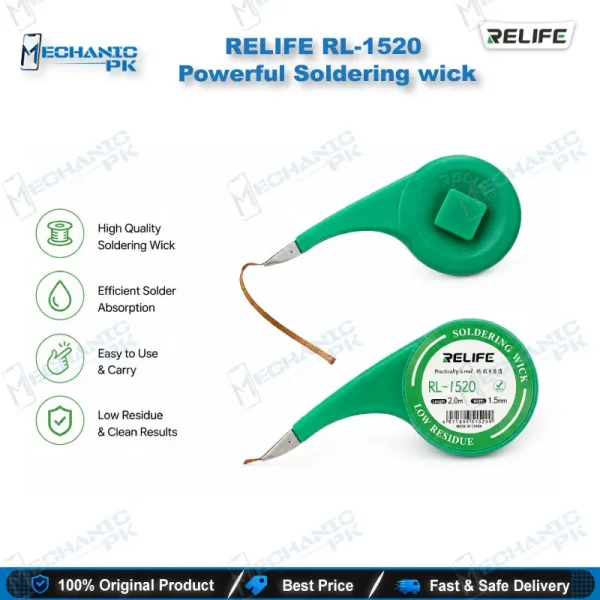
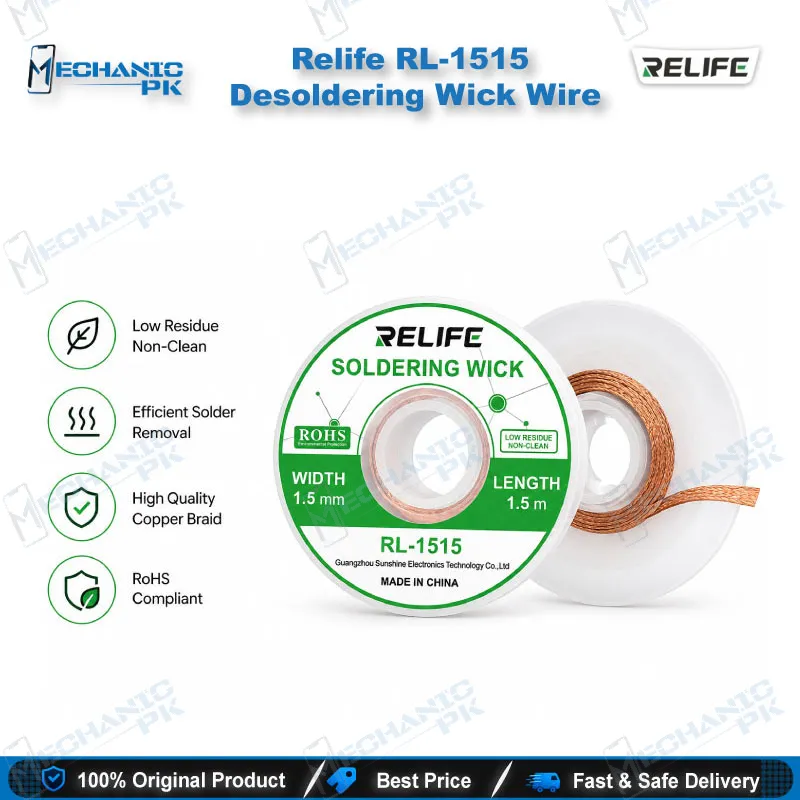
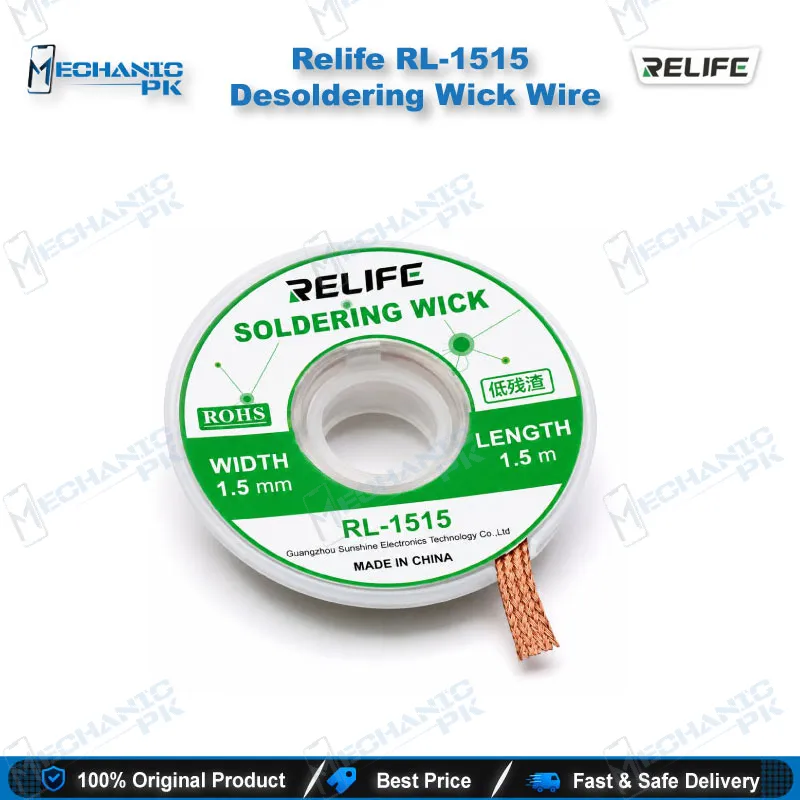
The Relife RL-1515 gives your repair bench a 1.5mm wide, 1.5m long fluxed copper desoldering wick for clean pad preparation on phone logic boards. Press it onto the pad, heat the braid with your iron, and capillary action pulls the old solder away from BGA, eMMC, UFS, and SMD pads. It suits IC change work, solder bridge cleanup, and pad leveling before reballing. The narrow braid keeps heat on the pad you treat and away from nearby components. Mechanicpk supplies this desoldering wick for mobile repair technicians, repair shops, and training institutes across Pakistan.
Out of stock
Relife RL-1515 Desoldering Wick for Mobile Repair: 1.5mm Fluxed Copper Braid
The Relife RL-1515 is a desoldering wick for mobile repair benches that need precise solder removal on crowded logic boards. You get a 1.5mm wide copper braid in a 1.5m length, fluxed so the braid pulls molten solder off pads through capillary action. That width matches the pad pitch you meet around BGA ICs, eMMC and UFS footprints, charging port pads, and small SMD parts. Mechanicpk stocks it for Pakistani technicians who clean pads after an IC change and want a consumable that works next to their hot air station and soldering iron.
Why 1.5mm Width Suits Fine-Pitch Pad Cleaning
A 1.5mm braid sits at the narrow end of the width range, and that is exactly where phone board work happens. It rests on a single row of BGA pads without bridging into the neighbouring rows, and it still carries enough copper to soak up the solder left behind after you lift an IC. When you clean eMMC, UFS, PMIC, or CPU pads, a wider braid touches too much of the board and pulls heat away from the area you want to treat. The narrow footprint keeps the heat focused under your iron tip. You also keep the braid flat against the pad surface, so you see exactly where the solder leaves the pad. For wide connector shells or large ground planes, you reach for a 2.5mm or 3.0mm wick instead, and the 1.5mm stays your pick for fine-pitch pads and ISP test points.
Fluxed Copper Braid and Capillary Action
The RL-1515 uses a copper braid carrying flux, and the flux does the first job in the process. Press the braid onto the joint, bring your iron to the top of the braid, and the flux helps the molten solder wet the copper strands. Capillary action then draws the solder up into the weave and off the pad. The result is a flat, clean pad that accepts fresh solder paste or a new reballed chip. The braid also helps clear leftover flux residue and solder from BGA thermal bonding pads, so you do not scrape the board with a blade. Cut off the used section and feed fresh braid for each pad row, because saturated copper stops absorbing solder. After you finish, wipe the pad area with your usual board cleaner and inspect it under a microscope before you place the next component.
Where It Fits in Your Repair Workflow
You use the RL-1515 at the pad preparation stage of PCB repair. After your hot air station lifts an eMMC, UFS, or PMIC chip, the pads carry uneven solder mounds that block a clean reball. Wick them level, then check the pads under a microscope before you apply flux and place a new chip or a reballing stencil. The same braid clears solder bridges after IC change karna, cleans ISP test points before you attach pinout wires, and tidies pads after jumper lagana. These steps matter on boot loop issue, dead after flash, and hang on logo boards where an eMMC swap or reflow is the repair path. Pair it with a soldering station, a PCB holder, and a reballing kit from the Mechanicpk catalog, and move up to a hot air station when your bench handles heavier rework.
| Weight | 0.1 kg |
|---|
Key Features
- 1.5mm wide braid for fine-pitch pad work
- 1.5m length for repeated pad cleaning
- Copper braid construction
- Flux-carrying braid for fast solder wetting
- Capillary action lifts solder off pads
- Helps clear flux residue from BGA thermal bonding pads
- Works with standard soldering irons
- Fits eMMC, UFS, PMIC, CPU, and SMD pad cleanup
Specifications
| Brand | Relife |
|---|---|
| Model | RL-1515 |
| Category | Soldering Tools – Desoldering Wick |
| Compatibility | Universal – works with standard soldering irons and soldering stations |
| Technology | Fluxed copper braid, capillary solder absorption |
| Material | Copper braid |
| Dimensions | Width 1.5mm, Length 1.5m |
Common Repair Uses
- Pad preparation and solder cleanup on mobile PCB repair benches.
- Cleaning pads after eMMC or UFS chip removal
- Leveling BGA pads before reballing
- Removing solder bridges after IC change
- Clearing ISP test points before pinout wiring
- Tidying pads after jumper wire repair
- Removing excess solder from charging port pads
- Preparing pads for a new CPU or PMIC chip
- Cleaning flux residue and solder from thermal bonding pads
Compatible Devices
- Smartphone logic boards from any brand
- BGA pads under eMMC and UFS chips
- CPU and PMIC pads after chip removal
- ISP test points on phone PCBs
- Charging port and FPC connector pads
- Small SMD component pads
- BGA thermal bonding pads
- Solder bridges between fine-pitch pins
FAQ
What is the product name?
What is the brand of this product?
What is the model of this product?
What is this product used for?
Which devices are compatible with this product?
Who should use this product?
What braid width and length does the RL-1515 have?
How do you clean eMMC or UFS pads with a desoldering wick without lifting the pads?
Related products