















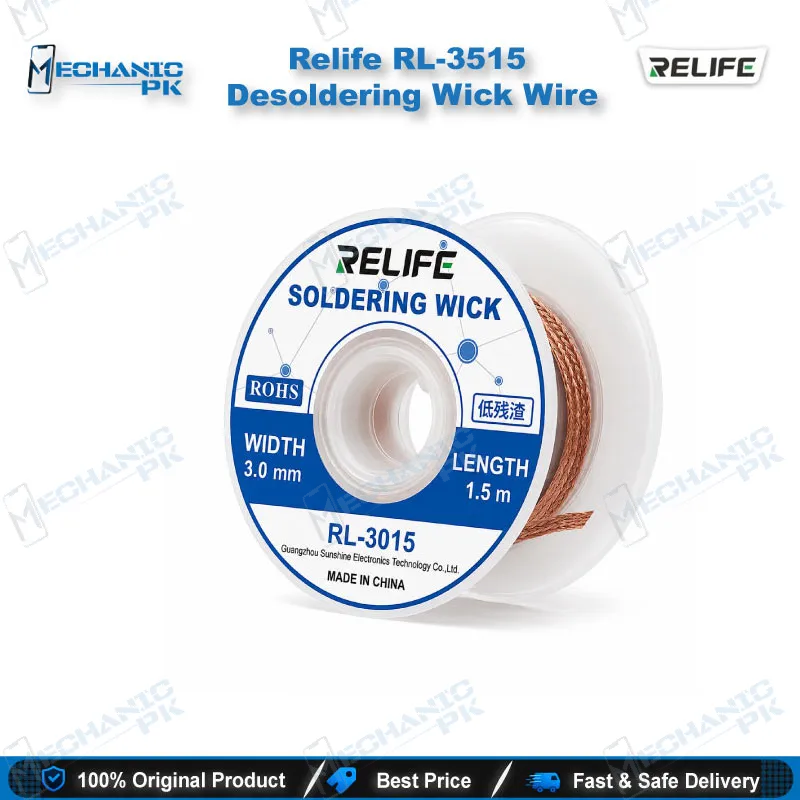
Relife RL-3015 Desoldering Wick Wire
₨ 300
H2: Relife RL-3015 Desoldering Wick for Clean Pad Rework
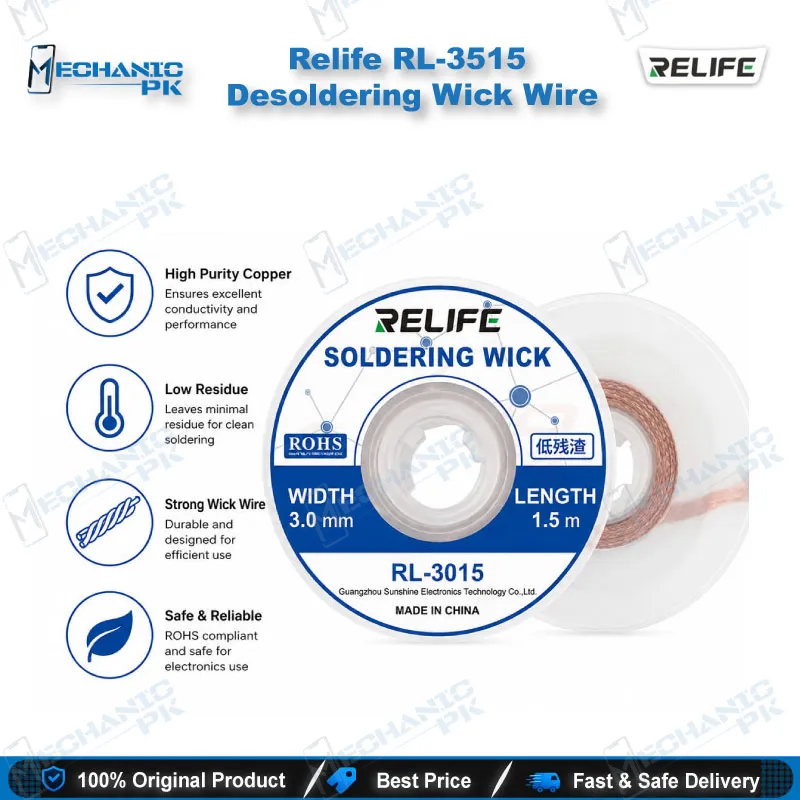
The Relife RL-3015 desoldering wick gives you a fast way to pull excess solder off pads, pins and bridges during board-level repair. Its copper braid draws molten solder away through capillary action, so you clear a joint without forcing the tip into the pad. Use it before you install a replacement IC, jumper or connector, and when a shorted component needs to come off clean. Technicians working on smartphone motherboards, laptop mainboards and general PCB rework will find it a practical addition to any soldering bench.
Out of stock
H2: Relife RL-3015 Desoldering Wick Wire for Mobile Board Repair
The Relife RL-3015 desoldering wick is a copper braid tool for removing solder from a joint, and it belongs on every repair bench that handles phone and PCB work. When you place the braid over a solder joint and press a hot iron against it, the molten solder climbs into the weave. This clears the pad so the next component sits flat and seats properly. Technicians often reach for a wick when a dead phone shows a short after a component swap, or when a rushed job leaves bridges between IC pins. Removing the old solder first keeps your workflow cleaner than piling extra flux and heat onto it.
H3: How the Braid Works on a Joint
Desoldering wick relies on capillary action, the same force that pulls liquid into a narrow tube. The copper strands form many tiny channels, and molten solder moves into them as the braid heats up. Your iron needs to transfer heat through the braid, so press the tip on top of the wick and wait until the solder flows. Keep the wick flat against the joint and lift it away only after the solder has moved into the weave. Cut off the saturated section and reposition clean braid for the next joint, because a full section stops pulling solder. This method works on through-hole pins and surface-mount pads alike when your iron tip is sized properly.
H3: Choosing the Right Width for the Pad
Braid width should match the joint you are clearing. A narrow braid suits fine SMD pads and IC pins, where a wide strip can lift copper or pull neighbouring pins. A wider braid works better on connector pins, through-hole leads and larger pads that hold more solder. Check the width printed on your reel before you start, because it decides how much solder you remove at once. Keep a spare reel of a different width on the bench so one job does not force a compromise on the next. For most smartphone motherboard work, a narrow to medium braid covers the majority of tasks.
H3: Keeping Pads Safe During Desoldering
Pads on phone boards lift easily when heat stays on too long. Apply moderate temperature and limit contact to a few seconds per joint. Add a small amount of flux before placing the wick, since flux improves flow and reduces tip drag. Lift the iron straight up once the solder moves, so the braid does not tear copper away with it. Let the joint cool on its own rather than blowing on it or forcing it. Following this routine protects both the pad and the trace underneath, which saves the bench from a much harder rework later.
H3: Where This Wick Fits in Your Repair Workflow
Clear the pads with wick before a replacement component goes on, especially after a faulty part has been lifted. After a short is traced and a component is removed, wick removes the leftover solder that would otherwise block a clean reinstall. During charging port or connector replacement, wick helps separate pins that overlap and hold excess solder. A clean finish also reduces thermal stress on neighbouring components. Pair the wick with a microscope and a hot air station when your work calls for more precision. Many shops keep a dedicated wick reel beside the flux and tweezers for these tasks.
| Weight | 0.5 kg |
|---|
Key Features
- Copper braid draws molten solder by capillary action
- Clears solder bridges between closely spaced IC pins
- Prepares pads before a replacement component goes on
- Removes excess solder from through-hole leads and connector pins
- Works with flux for smoother solder flow
- Helps leave a flat, usable pad after removal
- Suits smartphone, laptop and general PCB rework
- Practical consumable for a reliable repair bench
Specifications
| Brand | Relife |
|---|---|
| Model | RL-3015 |
| Category | Desoldering Wick |
Common Repair Uses
- Removing solder bridges between IC pins after a reflow or rushed job
- Clearing pads before installing a replacement IC
- Freeing connector pins during charging port replacement
- Removing a component that caused a short after the fault is traced
- Cleaning through-hole leads before removing a jack or socket
- Preparing a board for a jumper or a new surface-mount component
- Cleaning excess solder after a failed component removal
- Restoring flat, usable pads before reinstalling a part
Compatible Devices
- Universal, not device-specific
- Smartphone motherboards (any model, solder removal only)
- Laptop and PC mainboards
- General PCB rework boards
- Connector pins and charging port pins
- Through-hole component leads
- SMD pads and fine IC pins (with correct width)
- Solder bridges between closely spaced pins
FAQ
What is the product name?
What is the brand of this product?
What is the model of this product?
What is this product used for?
Which devices are compatible with this product?
Who should use this product?
Does this wick work with lead-free solder?
Which wick width suits fine SMD IC pins?
Related products