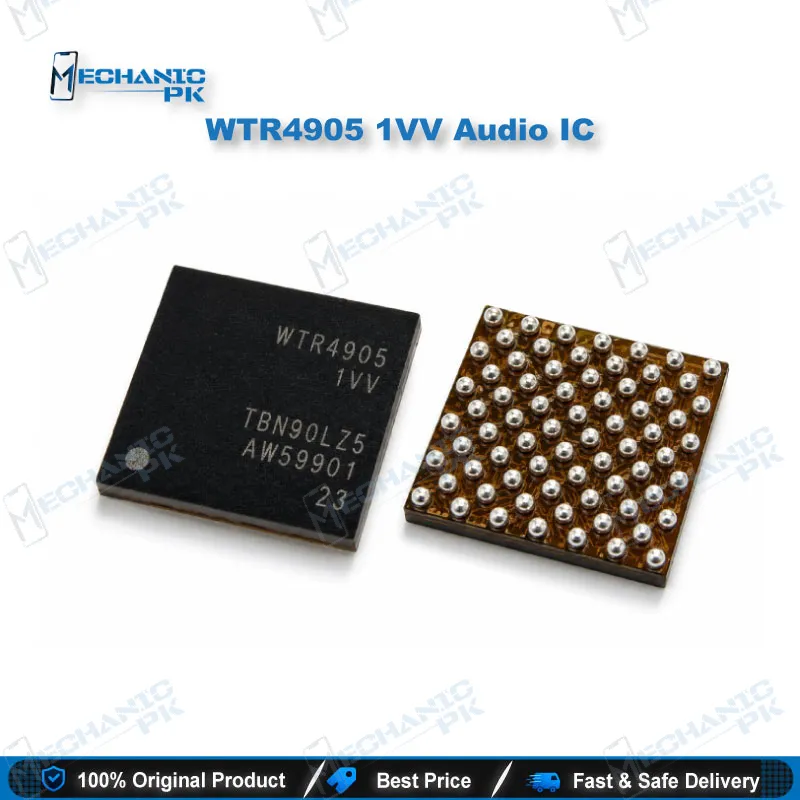
WTR4905 1VV RF Transceiver IC for Qualcomm LTE Boards
₨ 400
WTR4905 1VV Qualcomm RF Transceiver for Network Fault Repair
The WTR4905 1VV is a Qualcomm multimode RF transceiver. It links the baseband modem to the RF front end on boards built around the Snapdragon 410, 610, and 615. It converts baseband I/Q signals to RF for transmission and turns received RF back into baseband for the modem. It covers GSM/EDGE, WCDMA/HSPA+, and LTE in both FDD and TDD modes. Technicians replace it after diagnosis confirms a transceiver fault behind no service, constant network searching, or signal loss after water or drop damage. Mechanicpk supplies this IC for board-level RF repair across Pakistan, for workshops that need the exact marking variant.
WTR4905 1VV: Qualcomm Multimode LTE Transceiver for Board-Level Network Repair
The WTR4905 1VV handles every radio signal that a Snapdragon 410, 610, or 615 board sends or receives. On the transmit side, it takes analog I/Q signals from the modem and upconverts them to RF for the power amplifier. On the receive side, it brings incoming RF down to baseband for demodulation. When the WTR4905 1VV RF transceiver IC fails, the phone usually boots and runs normally but loses its network. Typical symptoms are no service, endless searching, or emergency calls only. Mechanicpk stocks this part for technicians who have already traced the fault to the transceiver and need a correct replacement.
Why Some Listings Call It an “Audio IC”
Some supplier listings sell the WTR4905 1VV as an “audio IC” or “audio frequency IC.” The label most likely comes from a loose translation of “intermediate frequency IC,” a common trade name for RF transceivers. The chip processes no audio. It handles cellular radio signals only. If a customer’s phone has a speaker or microphone fault, this part will not solve it. Check the audio codec and amplifier circuit instead.
WTR4905 1VV RF Transceiver IC: Verified Technical Capability
Qualcomm introduced the WTR4905 as its second-generation 28 nm CMOS transceiver, replacing the older WTR16xx series with lower power draw and a smaller board footprint. It supports GSM, GPRS, and EDGE; WCDMA with HSDPA, HSUPA, and HSPA+; and LTE in both FDD and TDD modes. The transmit section provides five wideband single-ended Tx outputs, all driven by a single quadrature upconverter. The primary receive chain accepts eight inputs: three low-band, three mid-band, and two high-band. The diversity chain accepts seven inputs: three low-band, two mid-band, and two high-band. The chip supports receive diversity and simultaneous GNSS. Its single Rx VCO rules out SHDR operation.
Where the Transceiver Fits in Network Fault Diagnosis
A transceiver rarely fails on its own, so diagnose the board before you order a replacement. Start with antenna contacts, coaxial cables, the RF switch, and the power amplifier. Then measure the transceiver supply rails with a multimeter. A corrupted QCN or EFS partition also causes no service, and that problem needs a software repair rather than new hardware. Rule it out with your test box before you remove any IC. Genuine transceiver failures usually trace back to water damage that corrodes the solder balls, drop impact that cracks joints under the chip, or an internal short that pulls its supply rail down.
Replacement Workflow on the Repair Bench
Mount the board securely in a PCB holder and preheat it evenly to reduce stress on surrounding components. Qualcomm boards often carry underfill around RF ICs, so soften it carefully with your hot air station and clear it away without lifting nearby pads. After removal, clean the pads with flux and desoldering wick using a temperature-controlled soldering station. If the new chip needs fresh balls, reball it with a matching stencil from a reballing kit. Align it under a microscope before reflow, because even a slight offset on a fine-pitch RF IC leaves open joints. After installation, confirm signal strength and network registration on every band the phone supports.
Match the Marking Before You Install
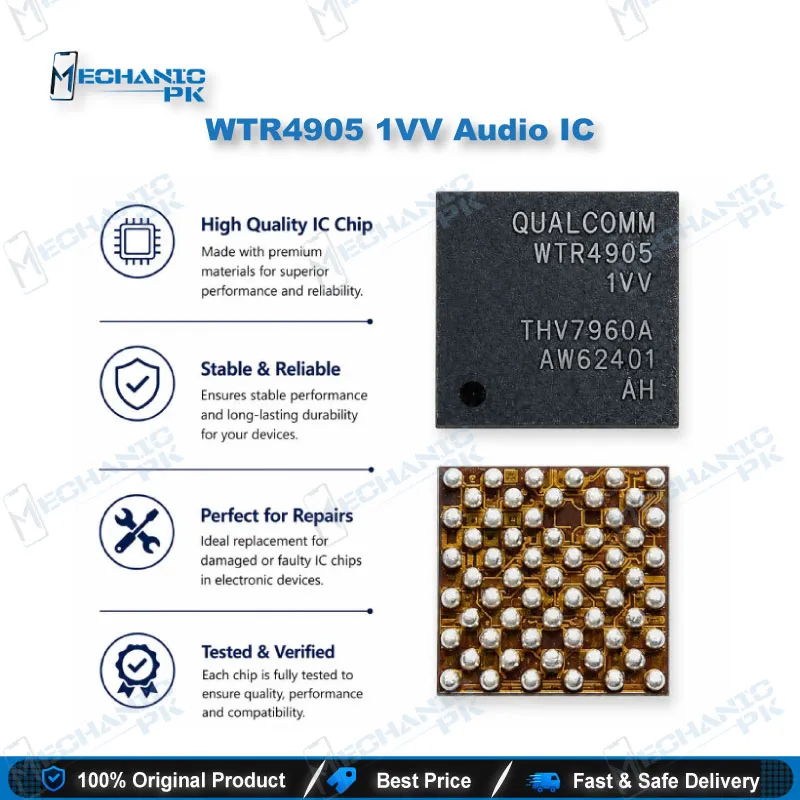
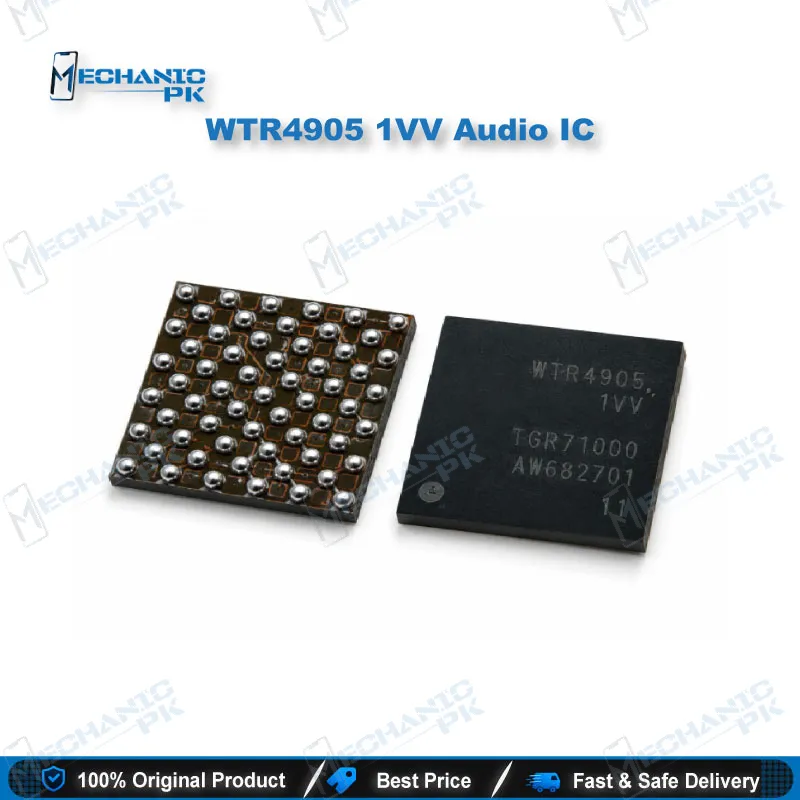
The “1VV” suffix belongs to the chip’s top marking. The WTR4905 also circulates under other markings, including 0VV. Mechanicpk makes no claim of interchangeability between marking variants. Read the marking on the original chip and order the same variant. This simple check prevents a dead-after-repair callback and saves rework time on the board.
Building a Complete RF Repair Setup
A reliable RF IC replacement depends on the tools around it. Mechanicpk carries hot air stations, soldering stations, reballing kits, PCB holders, microscopes, multimeters, and test boxes in one catalog. You can equip your bench for the full network repair workflow without sourcing tools and ICs from separate suppliers.
| Weight | 0.1 kg |
|---|
Key Features
- Genuine Qualcomm WTR4905 transceiver with the 1VV top marking, for exact-match replacement on boards that carry the same variant
- Multimode coverage of GSM, GPRS, EDGE, WCDMA, HSDPA, HSUPA, HSPA+, and LTE in FDD and TDD modes
- Five wideband single-ended Tx outputs driven from one quadrature upconverter for all transmit bands
- Eight primary receive inputs across low, mid, and high bands for full primary-path coverage
- Seven diversity receive inputs, supporting receive diversity on designs that use it
- Simultaneous GNSS support, so location and cellular functions run side by side
- Second-generation 28 nm CMOS design with lower power draw than the WTR16xx series
- Designed as the companion transceiver for Snapdragon 410, 610, and 615 platforms
Specifications
| Brand | Qualcomm |
|---|---|
| Model | WTR4905 (1VV marking) |
| Category | RF Transceiver IC / Network IC |
| Compatibility | Qualcomm Snapdragon 410, 610, and 615 platforms |
| Technology | 28 nm CMOS multimode RF transceiver; GSM/GPRS/EDGE, WCDMA/HSPA+, LTE FDD/TDD; 5 Tx outputs; 8 PRx and 7 DRx inputs; Rx diversity; simultaneous GNSS |
Common Repair Uses
- Fixing no service or constant network searching once diagnosis confirms a transceiver fault
- Restoring network after water damage has corroded the transceiver's solder balls
- Repairing signal loss caused by cracked joints under the IC after a drop
- Replacing a shorted transceiver that pulls down its supply rail
- Correcting band-specific signal loss traced to failed transceiver receive paths
- Replacing a chip damaged during a previous rework attempt
- Refurbishing Snapdragon 410, 610, and 615 boards with RF faults
- Practising BGA RF IC replacement in technical training institutes
Compatible Devices
- Verified at the chipset-platform level. The WTR4905 pairs with the following Qualcomm platforms, so it fits only those boards whose original transceiver is a WTR4905 with the same marking.
- Qualcomm Snapdragon 410 (MSM8916) platform boards
- Qualcomm Snapdragon 610 (MSM8936) platform boards
- Qualcomm Snapdragon 615 (MSM8939) platform boards
- Any board whose original transceiver carries the WTR4905 1VV marking
- Multimode LTE FDD/TDD board designs built around the WTR4905
FAQ
What is the product name?
What is the brand of this product?
What is the model of this product?
What is this product used for?
Which devices are compatible with this product?
Who should use this product?
Does the WTR4905 support both LTE FDD and LTE TDD?
Can I install a WTR4905 0VV in place of a WTR4905 1VV?
Related products