














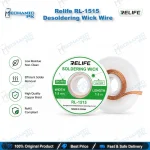
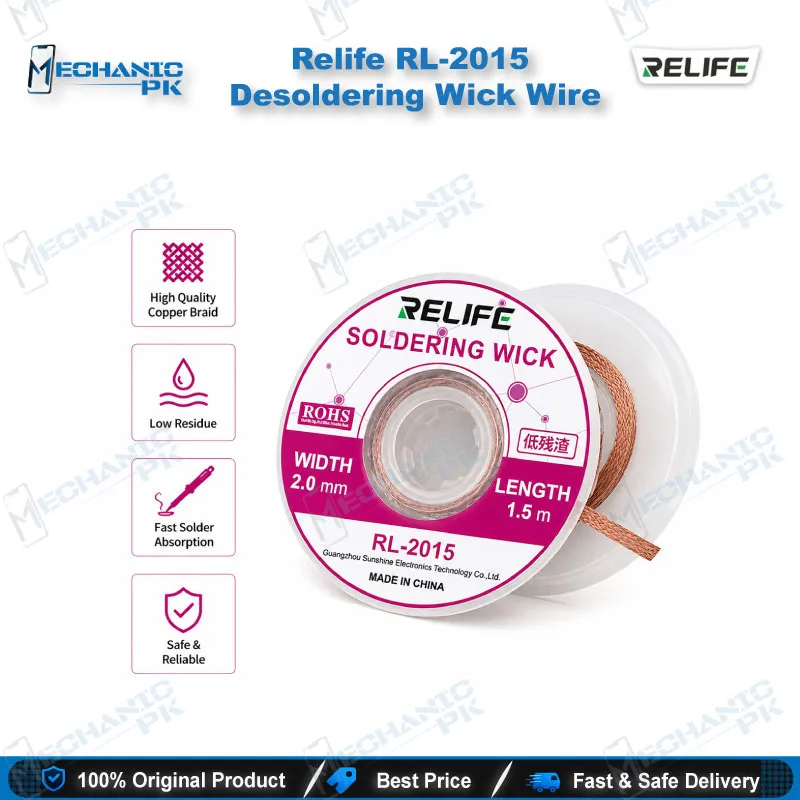
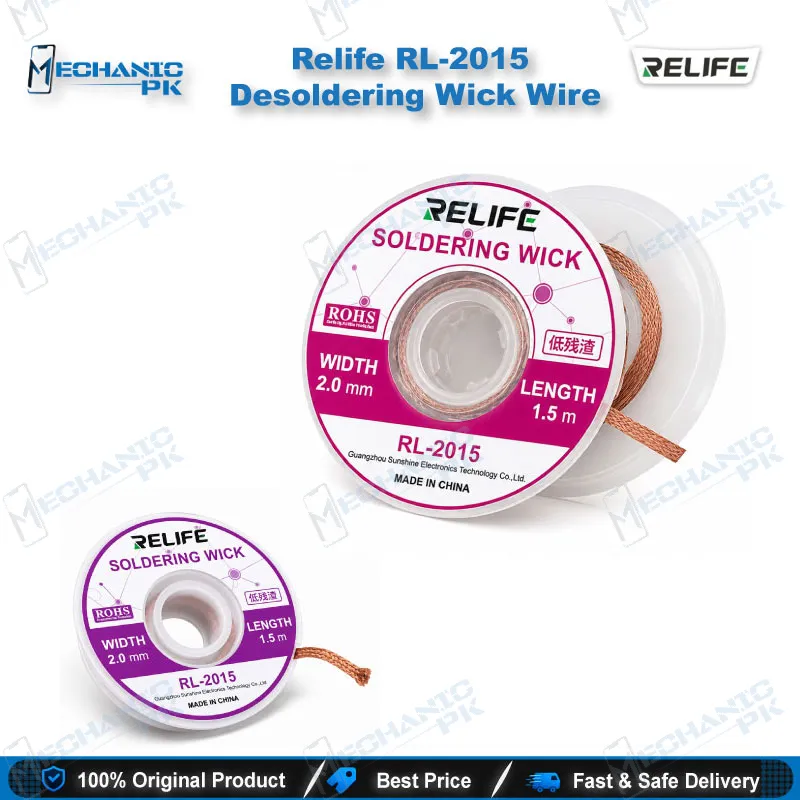
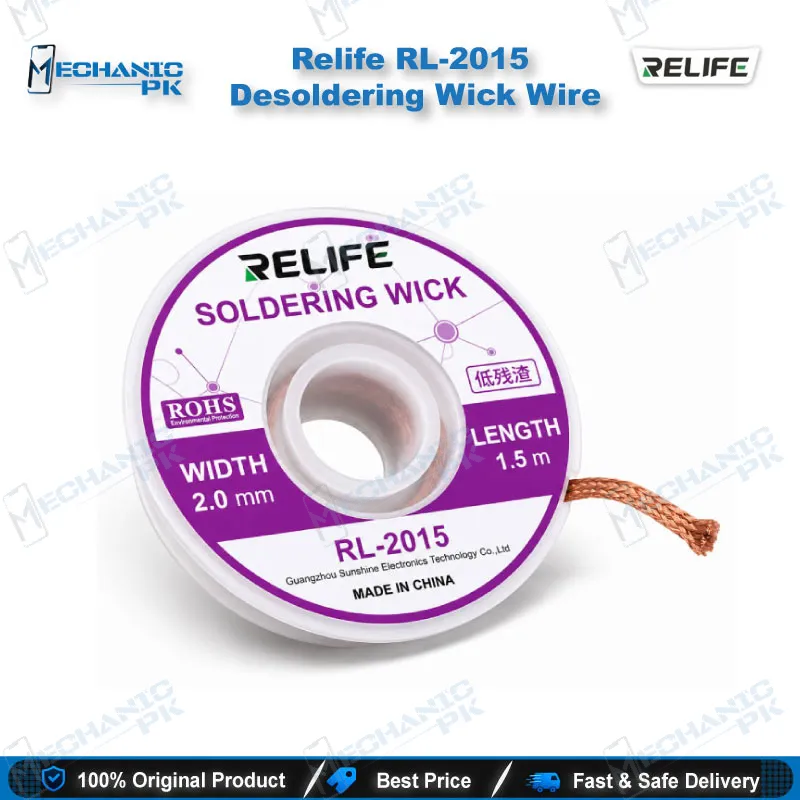
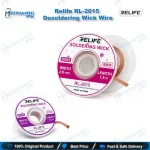
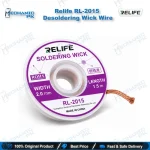
Relife RL-2015 Desoldering Wick 2.0mm x 1.5m
₨ 300
H2: Relife RL-2015 Desoldering Wick for Mobile Repair
The Relife RL-2015 is a 2.0mm wide, 1.5m long copper desoldering braid built for pad cleaning on mobile motherboards and general PCBs. You press it under a heated iron tip, and the braid absorbs molten solder through capillary action. That leaves flat, clean pads for the next IC, connector, or reballing step. The 2.0mm width suits both IC pad rows and larger ground pads, so one roll covers most daily rework on your bench. Mechanicpk supplies the RL-2015 for technicians, repair shops, and training institutes across Pakistan who need a dependable solder removal consumable.
Out of stock
H2: Relife RL-2015 Desoldering Wick: 2.0mm Copper Braid for Pad Cleanup
The Relife RL-2015 desoldering wick is a 2.0mm wide, 1.5m long copper braid that pulls molten solder off PCB pads through capillary action. You lay the braid across the joint, press a heated iron tip on top, and the weave draws the solder up and away. After every IC, connector, or jumper job, the pads hold leftover tin, and that tin decides whether the next component sits flat. This wick gives your repair bench a controlled way to level pads without a vacuum pump or a full desoldering station. It suits mobile motherboard work, general PCB repair, and any task where you need clean copper before the next joint.
H3: Why this 2mm desoldering wick suits mobile motherboard pads
Width decides where a wick works. The RL-2015 sits in the middle of the Relife RL-1515 to RL-3515 series, which runs from 1.5mm to 3.5mm. At 2.0mm, the braid fits across a row of IC pads and still carries enough copper to clear a larger ground pad in one pass. Narrower wicks reach tight rows but saturate quickly. Wider wicks absorb more solder but crowd neighbouring components. Treat the 2.0mm size as your general-purpose braid, and add a narrower or wider roll from the same series when a specific board demands it.
H3: Where the wick fits in your repair workflow
The wick belongs in the rework stage, after hot air or an iron removes a component and before you fit the replacement. On a dead phone with a failed charging IC, you lift the chip, wick the pads flat, and inspect them under a microscope before you place the new part. The same sequence applies to eMMC and UFS pad cleanup before reballing, where a solder wick for BGA pad cleaning protects the pads from rough scraping. It also applies when you replace a flex connector for a display problem or a SIM tray connector for a network issue, and when you clear solder bridges after an IC change karna job. Pair the Relife RL-2015 desoldering wick with a hot air station or soldering station, a reballing kit, and a microscope, and you cover the full pad-preparation chain from removal to inspection. When your volume outgrows what braid handles comfortably, a dedicated hot air rework station is the natural next step.
H3: Handling technique that protects your pads
Keep the iron tip on the braid, never directly on the board. Lay the braid over the solder, press the heated tip down, and slide the braid back as it fills with solder. Pull the braid away while the solder is still molten, because a braid that cools on the pad can lift the pad with it. Cut off the saturated section and move to fresh braid for the next pass. A pair of side cutters beside your bench keeps that trimming quick. Store the roll dry and clean, since oxidized copper wets poorly. If the braid stalls on a stubborn joint, add a small amount of flux. Use light pressure throughout, because a hot pad has little mechanical strength.
H3: Stocking notes for repair shops in Pakistan
The RL-2015 comes as a single 1.5m roll of 2.0mm braid under the Relife brand, a name GSM technicians already recognize from its repair tools and soldering consumables. Treat it as a bench consumable, not a one-time tool. A shop that handles hardware fault boards and dead after flash repairs daily goes through rolls steadily, so keep a spare beside your solder wire, flux, and solder paste. Order the neighbouring widths together if your bench handles both fine IC rows and larger ground pads.
| Weight | 0.1 kg |
|---|
Key Features
- 2.0mm braid width for IC pad rows and larger pads
- 1.5m roll length
- Copper braid construction
- Capillary solder absorption
- Works with any soldering iron
- Suits BGA, SMD, and connector pad cleanup
- Single-roll Relife consumable
- Part of the Relife RL-1515 to RL-3515 width series
Specifications
| Brand | Relife |
|---|---|
| Model | RL-2015 |
| Category | Soldering Consumables / Desoldering Wick |
| Compatibility | Universal, works with any soldering iron |
| Supported Devices | Universal, not device-specific |
| Technology | Braided copper capillary solder absorption |
| Material | Copper braid |
| Dimensions | 2.0mm width x 1.5m length |
Common Repair Uses
- Cleaning leftover solder from pads after IC removal
- Preparing BGA pads for reballing
- Clearing solder bridges between fine-pitch IC pins
- Flattening eMMC and UFS pads after chip-off
- Cleaning pads after charging IC replacement on a dead phone
- Prepping pads for flex connector replacement
- Removing excess solder after jumper wire correction
- Levelling CPU and PMIC pads before reflow
Compatible Devices
- Universal consumable, not device-specific. It works on any PCB with a soldering iron.
- Android smartphone motherboards
- iPhone logic boards
- Tablet motherboards
- Laptop and desktop PCBs
- BGA IC pads, including eMMC and UFS pads
- Charging port and flex connector pads
- SMD component pads
- General electronics PCBs
FAQ
What is the product name?
What is the brand of this product?
What is the model of this product?
What is this product used for?
Which devices are compatible with this product?
Who should use this product?
What is the difference between Relife RL-2015 and the RL-1515 or RL-2515 wick?
How do I clean BGA pads with the Relife RL-2015 without lifting them?
Related products