














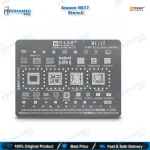
Amaoe MI17 Stencil for Dimensity & Redmi CPU Reballing
₨ 599
Amaoe MI17 Stencil for MediaTek CPU Reballing
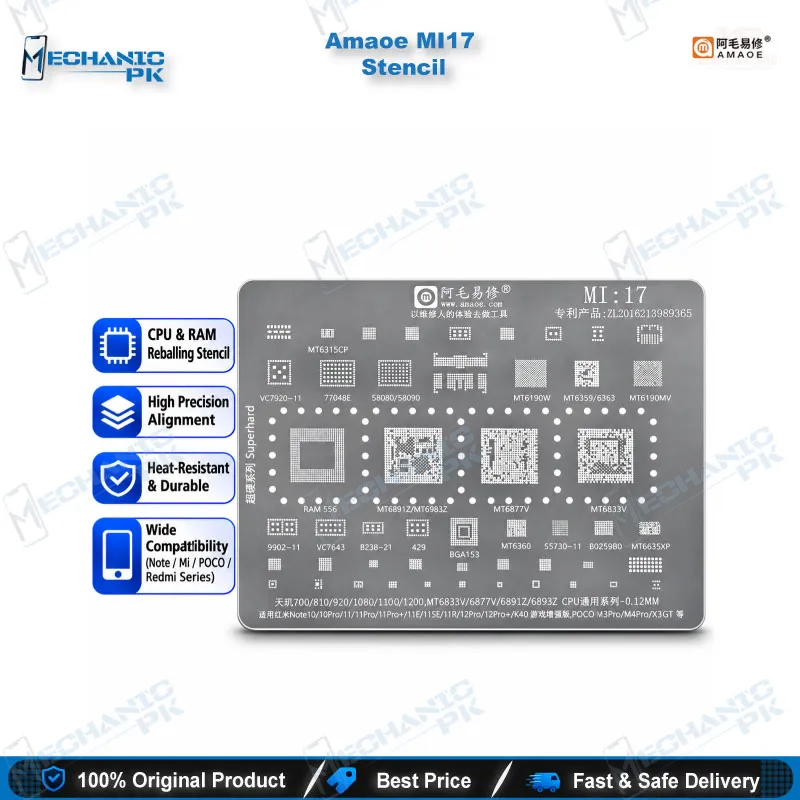
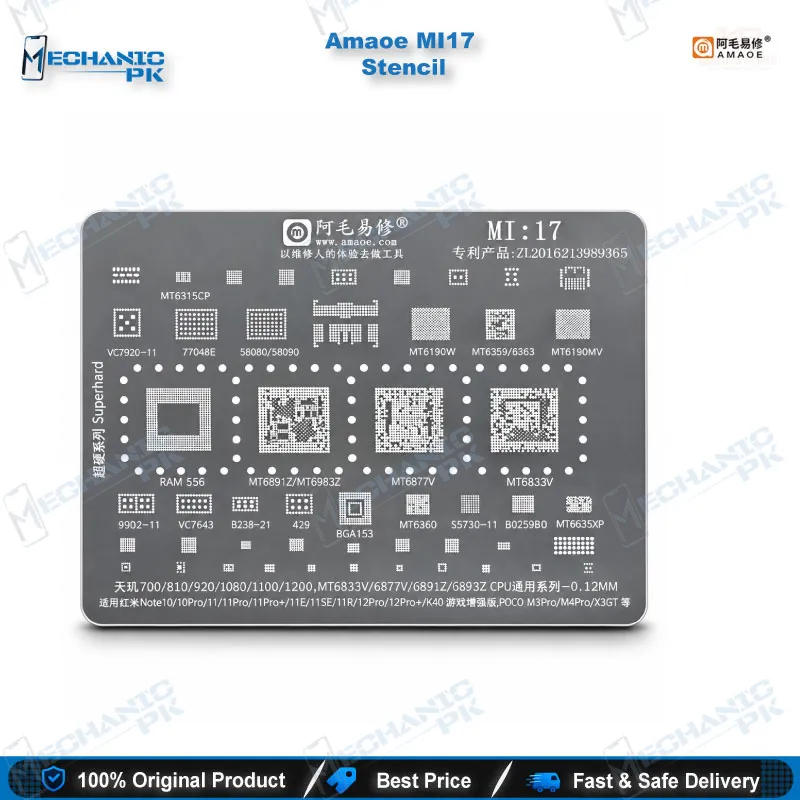
Amaoe MI17 stencil is a 0.12 mm steel mesh BGA reballing template for MediaTek Dimensity CPUs. The supplier listing covers Dimensity 700, 810, 920, 1080, 1100 and 1200, plus the MT6833V, MT6877V, MT6891Z and MT6893Z packages used in Redmi Note 10, 11 and 12 series, Redmi K40 and POCO M3 Pro, M4 Pro and X3 GT boards. You use it to rebuild solder balls on a removed CPU when a dead phone, hang on logo or boot loop fault points to cracked joints. Check your chip code against the list before you order, since this template targets MediaTek CPUs only.
In stock
Amaoe MI17 Stencil for MediaTek Dimensity CPU Reballing
The Amaoe MI17 stencil gives your bench a dedicated reballing template for MediaTek Dimensity CPUs used in the Redmi Note 10, 11 and 12 series, the Redmi K40 and several POCO models. The supplier listing names Dimensity 700, 810, 920, 1080, 1100 and 1200, along with the MT6833V, MT6877V, MT6891Z and MT6893Z package codes. When a CPU lifts, loses solder balls or comes off a dead phone with damaged pads, this template fixes the ball positions and pitch, so you rebuild the array on the chip instead of estimating it by eye. Mechanicpk supplies it to technicians who already work at BGA level and want the correct template for each chipset family. The template reuses across many jobs, so one MI17 on your bench covers a whole run of Redmi Note and POCO repairs without a new purchase per phone.
Chipset Coverage and Fit
Each Amaoe MI stencil targets one chipset group, and MI17 belongs to the MediaTek Dimensity group. That makes it the wrong choice for Qualcomm boards, so match the CPU marking on your board against the codes above before you order. The listing describes the product as 0.12 mm steel mesh, a thickness that suits the ball size most phone CPU rework uses. The listing covers CPU packages only. It does not name RAM or power management ICs for this model, so pick separate Amaoe stencils for those chips. Keep the Dimensity chip family and the board model together on your job card, because several Redmi and POCO phones share one MediaTek platform. Check the template against the chip itself before you start, hold the stencil over the pads, and confirm every hole lines up with a pad. A stencil that does not match the chip footprint costs you a lifted CPU and a wasted heat cycle.
Where MI17 Sits in a CPU Reballing Workflow
You use MI17 after you lift the CPU and clean the pads. Remove the old solder with flux and wick, clean the chip face, and check the pads under a microscope for lifted copper. Fix the chip in a holder, align the stencil holes over the pads, and apply paste or place balls through the mesh. Heat the chip with a hot air station until the balls melt and settle, let it cool, and peel the stencil away. Then reseat the CPU on the board and reflow it. This sequence handles the hang on logo, boot loop and dead after flash faults that trace back to cracked CPU joints on Dimensity boards. Run a continuity check with a multimeter or a test box reading before you close the phone, so you catch an open ball before the customer does. Charging issue, network issue and display problem complaints on these phones sometimes come from the same weak CPU joints, so a clean reball often clears several symptoms at once.
Pairing the Stencil With Your Bench Tools
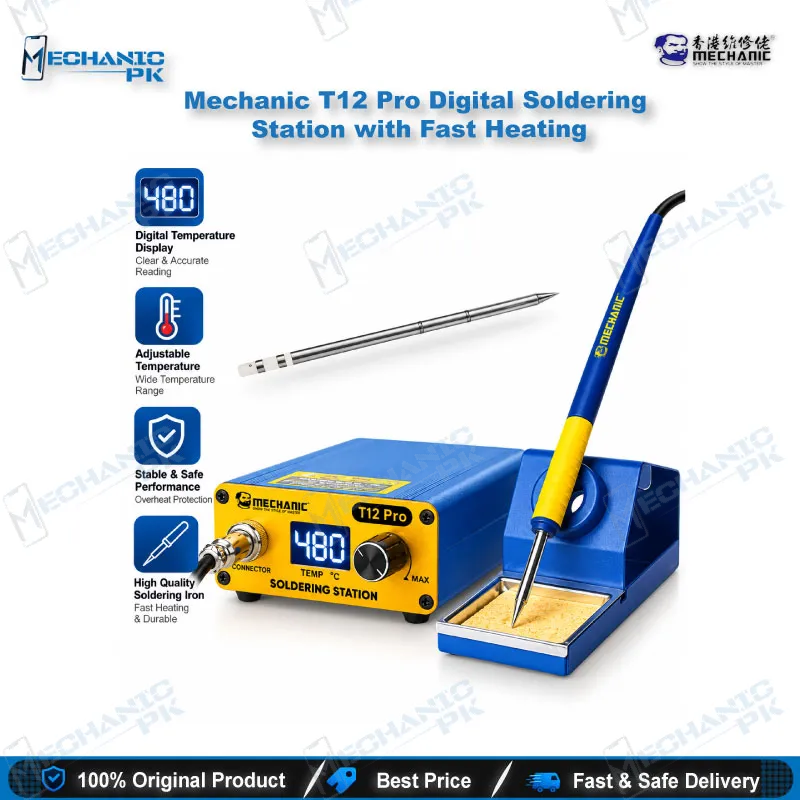
A stencil only performs as well as the gear around it. Pair MI17 with a temperature-controlled hot air station and a soldering station with a fine tip for pad cleanup. Add a PCB holder to keep the board flat during heating, and a microscope to inspect ball alignment after reflow. A reballing kit with flux, solder paste and tweezers covers the consumables. If your shop also repairs Qualcomm, Samsung or iPhone boards, you will need the matching Amaoe stencil for each platform, and an eMMC or UFS programmer for storage-level faults. Build the set once and every Redmi or POCO Dimensity job runs the same way, with predictable results across your repair bench. Store the stencil flat and wipe flux residue off the mesh with isopropyl alcohol after each use, so the holes stay clear for the next chip.
| Weight | 0.1 kg |
|---|
Key Features
- Dedicated MI17 template for MediaTek Dimensity CPU packages
- Covers Dimensity 700, 810, 920, 1080, 1100 and 1200
- Covers MT6833V, MT6877V, MT6891Z and MT6893Z package codes
- 0.12 mm steel mesh build
- Reusable across repeated reballing jobs
- Fixes ball pitch and position for consistent solder balls
- Fits Redmi Note 10, 11 and 12 series, Redmi K40 and POCO boards
- Works with standard hot air and BGA rework setups
Specifications
| Brand Entity | Amaoe |
|---|---|
| Product Entity | Amaoe MI17 BGA reballing stencil |
| Technology Entity | BGA reballing, steel mesh stencil, MediaTek Dimensity |
| Compatible Device Entities | Redmi Note 10/11/12 series, Redmi K40, POCO M3 Pro, M4 Pro, X3 GT |
| Repair Process Entity | CPU reballing and solder ball replacement |
| Industry Entity | Mobile phone repair, PCB rework |
Common Repair Uses
- CPU-level reballing on Dimensity boards
- Reballing a removed MediaTek Dimensity CPU
- Dead phone with a cracked or lifted CPU joint
- Hang on logo or boot loop caused by weak CPU solder balls
- Replacing a damaged CPU with fresh solder balls before reseating
- Repairing a board after a drop or impact fault
- Charging issue, network issue or display problem traced to CPU joints
- Dead after flash cases that end up as a hardware fault
- Rebuilding balls on a chip after pad cleaning and flux removal
Compatible Devices
- MediaTek Dimensity CPU families per the supplier listing
- Redmi Note 10 Pro
- Redmi Note 11
- Redmi Note 11 Pro
- Redmi Note 11 Pro+
- Redmi Note 12 Pro
- Redmi Note 12 Pro+
- Redmi K40
- POCO M3 Pro / M4 Pro / X3 GT
FAQ
What is the product name?
What is the brand of this product?
What is the model of this product?
What is this product used for?
Which devices are compatible with this product?
Who should use this product?
Which CPU chips does the Amaoe MI17 stencil support?
Can I use the MI17 stencil on Qualcomm boards or for RAM and PMIC chips?
Related products