














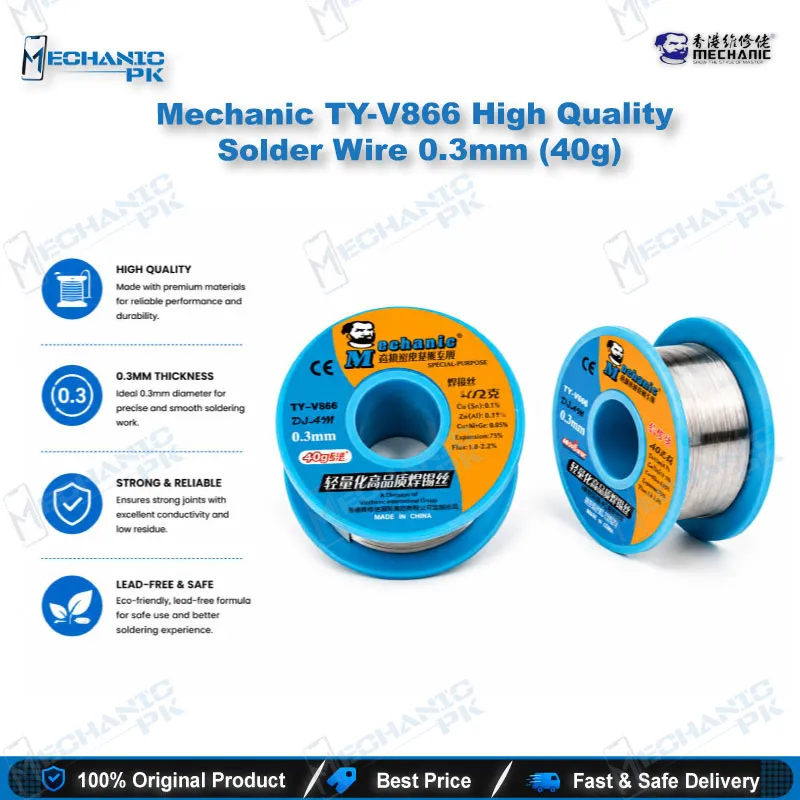
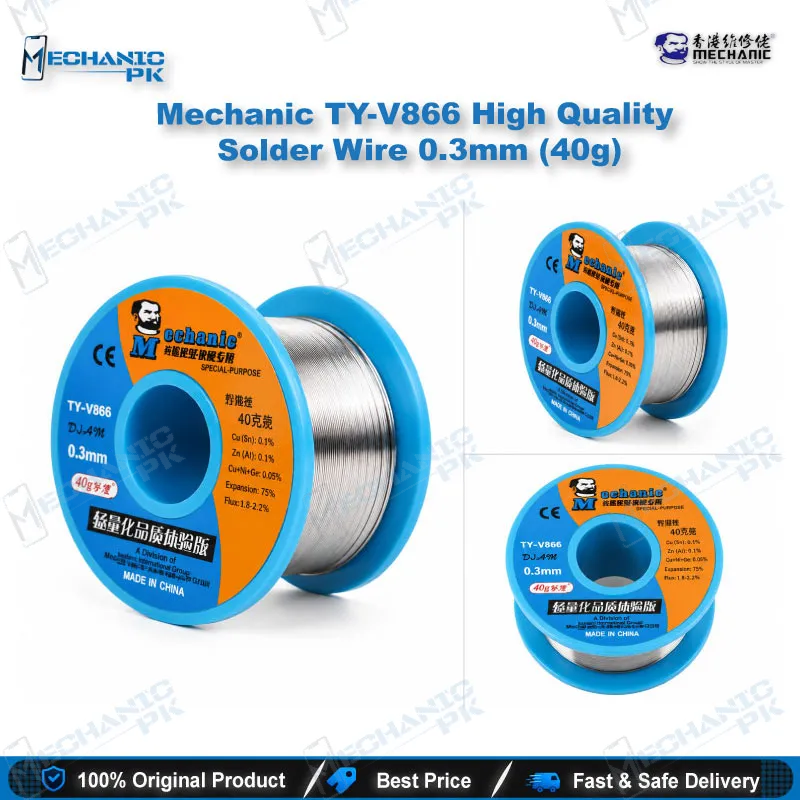
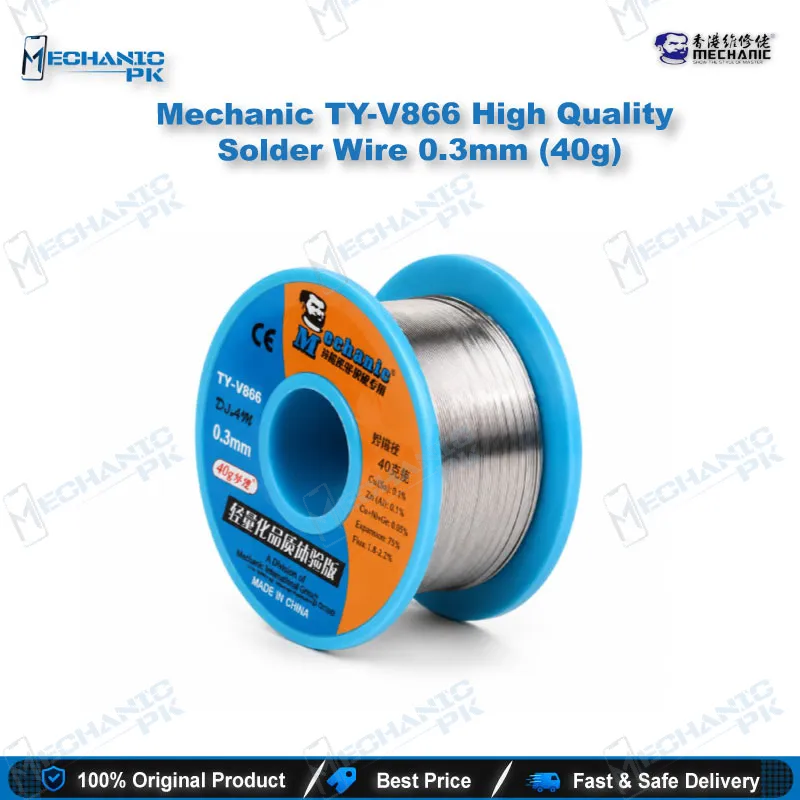
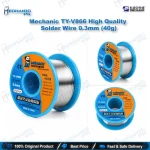
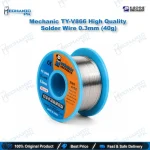
Mechanic TY-V866 0.3mm Solder Wire 40g Sn63/Pb37
₨ 480
0.3mm Rosin Core Solder Wire
The Mechanic TY-V866 0.3mm solder wire packs a Sn63/Pb37 eutectic alloy and a rosin flux core onto a 40g spool. It melts at 183°C, flows fast, and sets bright joints on SMD pads, jumper points, and flex connectors. The fine gauge gives you tight control over solder volume on dense mobile boards, so you avoid bridges while you rework charging ports, ICs, and broken traces. The low-residue flux leaves the board clean for inspection under a microscope. The wire contains lead, so you work with ventilation and a fume extractor. Order it from Mechanicpk for your Pakistan repair bench alongside soldering stations and hot air tools.
In stock
Mechanic TY-V866 0.3mm Solder Wire for Board-Level Repair
The Mechanic TY-V866 0.3mm solder wire gives board-level technicians a eutectic Sn63/Pb37 alloy in a fine gauge on a 40g spool. The alloy melts at a single point, 183°C, so it moves from solid to liquid with no pasty phase and sets the moment you lift the iron. A rosin flux core runs through the wire, so every feed of solder carries its own cleaning agent to the pad. At 0.3mm, you decide exactly how much solder lands on a pad, a jumper point, or a flex contact. Benches that handle dead phone, charging issue, and display problem boards reach for this gauge when thicker wire floods the joint.
Sn63/Pb37 Rosin Core Solder Wire: Alloy and Flux Behaviour
Sn63/Pb37 sits at the eutectic composition of tin-lead solder. That matters on dense mobile boards, because the joint freezes instantly and a small hand movement does not leave a disturbed, grainy connection. The 183°C melting point also sits well below lead-free alloys, so your iron or hot air station pushes less heat into neighbouring ICs and pads. The rosin core carries 1.0–3.0% flux, which strips oxide from copper and component terminals as the wire melts. You get bright, wetted joints without brushing flux on first, although liquid flux still helps on oxidised pads and old boards. The formula leaves low residue. Wipe the area with isopropyl alcohol after soldering to keep the board clean for inspection under a microscope.
Where 0.3mm Solder Wire for Mobile Repair Fits Your Workflow
Fine wire suits the jobs that punish excess solder. You tin pads on a charging port sub-board, rebuild a lifted track with a jumper wire, touch up SMD capacitors and resistors, and refresh the contacts on flex connectors. For IC change karna jobs, the thin gauge lets you reflow a pad with a controlled drop instead of a blob. When you prepare pads for reballing, you pair the wire with a stencil and a reballing kit, then flatten the pad before you place the chip. Pair the wire with a temperature-controlled soldering station, a hot air station, a PCB holder to steady the board, and a microscope to confirm every joint. Check continuity with a multimeter before you reassemble. Jumper lagana on a damaged trace goes faster when you pre-tin the jumper end with a small amount of this wire.
Handling, Safety and Storage
This wire contains lead. Solder in a ventilated space, run a fume extractor, and wash your hands before you eat. Keep the spool away from moisture and heat, and tuck the wire tail in so the flux core stays active. Clean and tin your tip before you start so heat transfers evenly. The leaded alloy suits workshop repair and rework; if a job demands lead-free soldering, choose a lead-free wire instead. The TY-V866 line also comes in other gauges, so you can match wire thickness to each repair task.
| Weight | 0.40 kg |
|---|
Key Features
- Eutectic Sn63/Pb37 alloy melts at a single 183°C point
- 0.3mm fine gauge for precise solder volume control
- Rosin flux core in every inch of wire
- Flux content of 1.0–3.0% for reliable wetting
- Bright, even joints on SMD and BGA pads
- Low-residue formula that wipes clean with IPA
- 40g spool for steady daily workshop use
- Low melting temperature reduces heat stress on nearby ICs
Specifications
| Brand | Mechanic |
|---|---|
| Model | TY-V866 |
| Category | Solder Wire |
| Technology | Rosin core flux |
| Material | Tin-lead alloy (Sn63/Pb37) |
| Wire Diameter | 0.3mm |
| Melting Point | 183°C |
| Flux Content | 1.0–3.0% |
| Weight | 40g |
Common Repair Uses
- Fine-gauge leaded soldering across mobile board repair and rework.
- Charging port repair and pad rebuild
- Jumper wire repair on broken or lifted traces
- SMD component replacement and touch-up
- IC change karna pad preparation
- Reballing pad preparation
- Flex connector contact refresh
- Tinning wires and test leads
- Dry joint reflow on dead phone boards
Compatible Devices
- Universal, not device-specific. The wire works on any board that accepts leaded solder, including Android and iPhone mainboards.
- Android smartphone mainboards (Samsung, Oppo, Vivo, Infinix, Tecno, Xiaomi and similar)
- iPhone mainboards
- Charging port sub-boards
- Flex connector pads and FPC contacts
- Tablet logic boards
- SMD resistor, capacitor and inductor pads
- BGA pads during reballing preparation
- Jumper and trace repair points
FAQ
What is the product name?
What is the brand of this product?
What is the model of this product?
What is this product used for?
Which devices are compatible with this product?
Who should use this product?
What is the melting point and alloy of the Mechanic TY-V866 0.3mm solder wire?
Is the Mechanic TY-V866 solder wire lead-free?
Related products