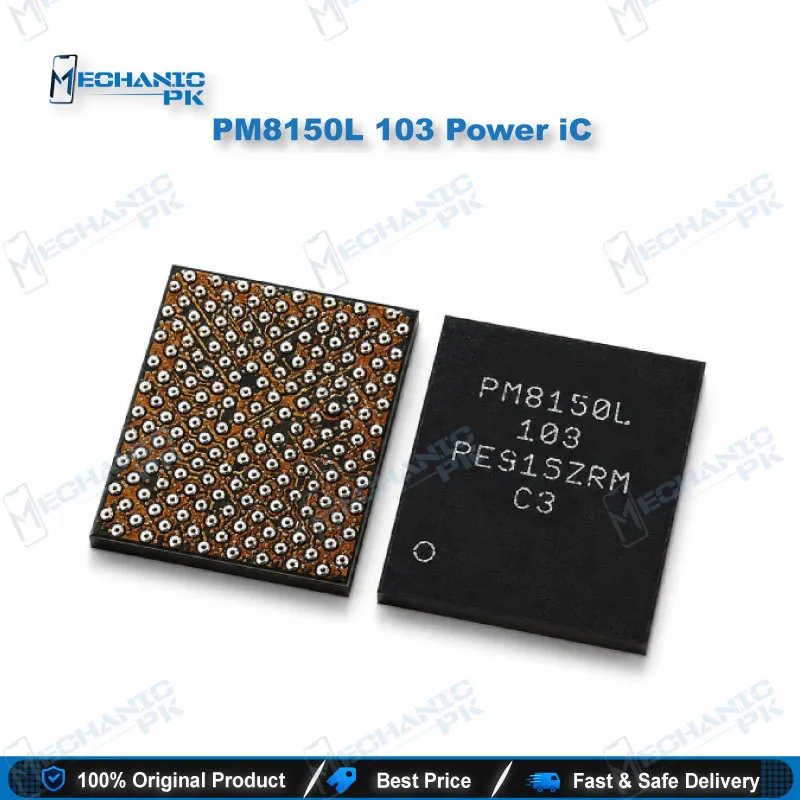
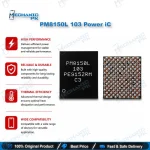
PM8150L 103 Power iC – Qualcomm SM8250 Secondary PMIC
₨ 400
PM8150L 103 Power iC for Snapdragon Board Repair
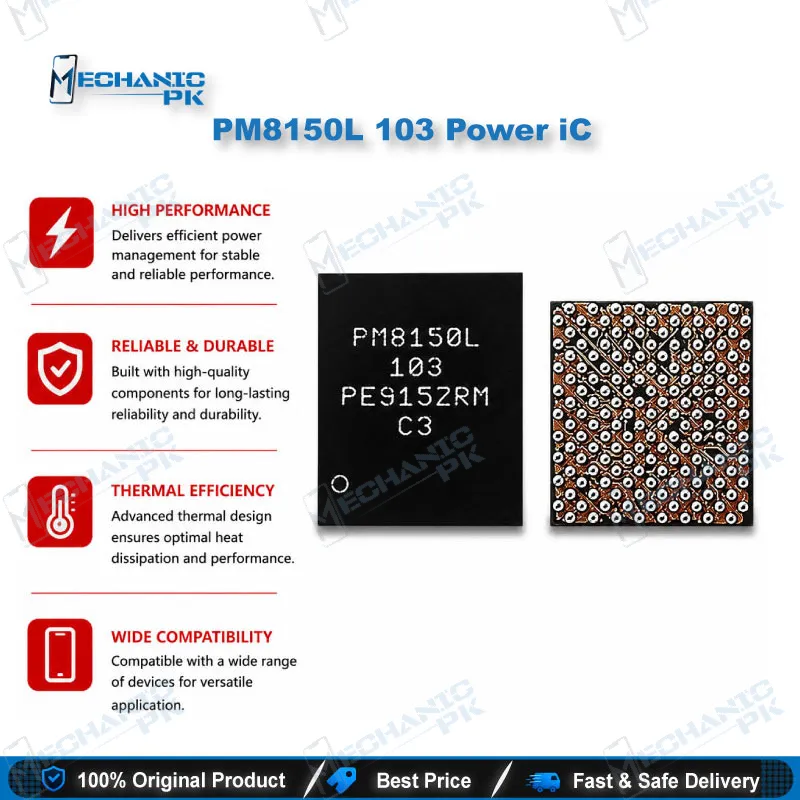
The PM8150L 103 Power iC is Qualcomm’s secondary power management IC for flagship boards built on the SM8150 and SM8250 platforms. It drives eight SMPS buck regulators, eleven LDOs, a BOB regulator, a flash LED driver, and an RGB LED block. These rails feed large parts of the board, so a failed chip often leaves a dead phone, a shorted rail, or a hang on logo. Technicians use this PM8150L 103 power IC for board-level IC replacement once rail measurements confirm the fault. Check the “103” top marking before you order, because PM8150B 102 and PM8150A chips handle different roles and cannot replace it.
PM8150L 103 Power iC: Precision Rail Control for Snapdragon Flagship Boards
The PM8150L 103 Power iC handles secondary power distribution on Qualcomm Snapdragon flagship motherboards. The main PMIC starts the core, and the PM8150B manages charging and the fuel gauge. The PM8150L supplies the dedicated regulator rails that the rest of the board needs. When this PM8150L 103 power IC fails, you usually see one of three results: no boot current, a hard short on one of its output rails, or a phone that hangs on logo because a secondary rail never comes up. Mechanicpk lists this chip by its exact marking so you can match the board position without guesswork.
Where the PM8150L 103 Power IC Sits in Qualcomm’s Power Architecture
Qualcomm divides power duties across several PMICs on these platforms. On SM8250 (Snapdragon 865) boards, Qualcomm’s own platform documentation pairs the PM8150L with the PM8250 core PMIC and the PM8150B interface PMIC. Linux kernel sources define the Qualcomm PM8150L PMIC as a slave PMIC on the SPMI bus. It carries SMPS1 through SMPS8, LDO1 through LDO11, a BOB (buck-or-boost) regulator, a flash LED driver, and an RGB LED driver. That rail count explains why a single failed chip can disable several subsystems at once and why diagnosis has to start with rail-by-rail measurement.
Fault Patterns That Lead to This Chip
A dead phone after liquid damage or a short circuit is the most common entry point. Connect the board to a DC power supply and watch the current draw first. If one of the PM8150L output rails shows a short to ground, lift the decoupling capacitors on that rail one at a time. When the short clears with the capacitors removed, the capacitor is the culprit. When the short stays, the PMIC itself has failed internally. A camera flash that never fires, or an RGB indicator that stays dark, also points toward the flash and RGB blocks inside this IC. A boot loop or hang on logo can also trace back here once you have ruled out storage and software faults.
Match the 103 Marking Before Any IC Change
Qualcomm uses several PMICs with similar names on these boards, and they are not interchangeable. Asus ROG Phone 3 owners have reported ordering a PM8150B 102 only to find the failed chip read PM8150L 103, and the shop correctly refused to fit it. Read the top marking under your microscope before you order. The PM8150B handles charging, the PM8150A serves other platform configurations, and the PM8150L handles the secondary rails described above. Ordering by exact marking saves you a wasted reball and a second heating cycle on the board.
Replacement Workflow on the Repair Bench
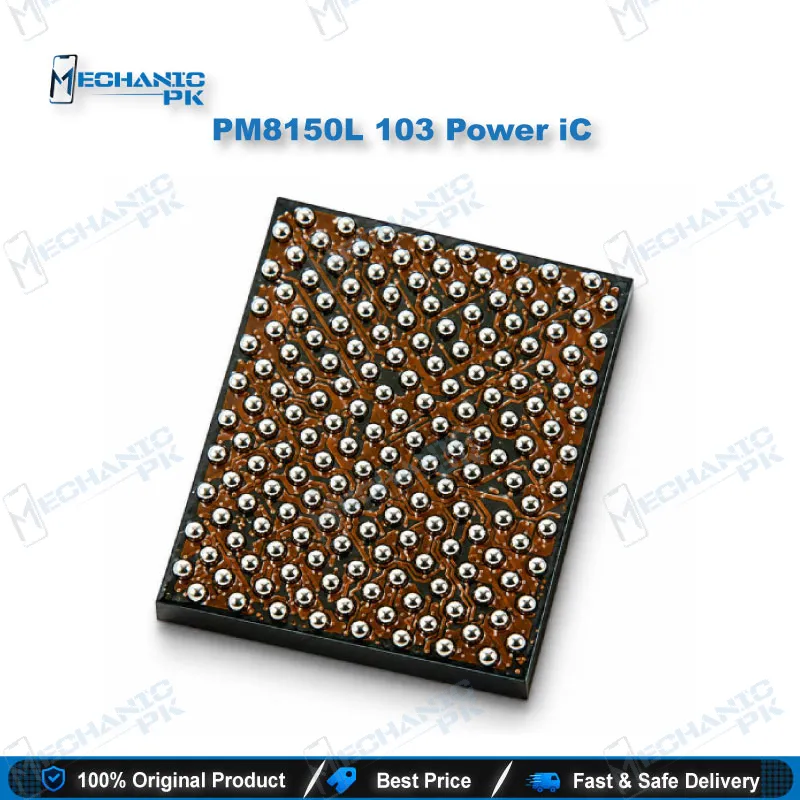
Secure the board in a PCB holder and preheat it to reduce thermal stress on the surrounding components. Apply quality flux and lift the old chip with a hot air station, keeping airflow moderate to protect nearby passives. Clean the pads with desoldering wick and a soldering station until they sit flat and bright. Reball the new PM8150L 103 using a reballing kit with the correct stencil, then align it under a microscope before reflow. After the board cools, measure every PM8150L rail with a multimeter against a known-good board before you connect a battery. If the phone powers on but still fails to boot, move to the storage side with ISP pinout tools, eMMC programmers, or UFS adapters, and use a test box for software-level checks.
Who Buys This Snapdragon 865 Power IC
Board-level technicians, mobile service centers, and repair shops that handle Snapdragon flagship devices keep this Snapdragon 865 power IC in stock because power-section faults on these boards come up regularly. Training institutes also use it to teach PMIC rail diagnosis on multi-PMIC Qualcomm platforms.
| Weight | 0.1 kg |
|---|
Key Features
- Qualcomm secondary PMIC for SM8150 and SM8250 Snapdragon platforms
- Eight SMPS buck regulator outputs (SMPS1–SMPS8) for board power distribution
- Eleven LDO outputs (LDO1–LDO11) for low-noise supply rails
- Integrated BOB (buck-or-boost) regulator
- Built-in flash LED driver for camera flash circuits
- Built-in RGB LED driver block
- Communicates with the SoC over the SPMI bus as a slave PMIC
- Exact "103" marking for direct board-position replacement
Specifications
| Brand | Qualcomm |
|---|---|
| Model | PM8150L 103 |
| Category | Mobile Phone ICs – Power Management IC (PMIC) |
| Compatibility | Qualcomm SM8150 / SM8250 platform boards with a PM8150L 103 board position |
| Supported Devices | Asus ROG Phone 3 (verified PM8150L 103 position); other boards require marking match |
| Technology | Secondary (slave) PMIC on SPMI bus – SMPS1–8, LDO1–11, BOB, flash LED driver, RGB LED driver |
Common Repair Uses
- Dead phone repair where a PM8150L rail shows a short to ground
- Power IC replacement after liquid damage or a short-circuit event
- Hang on logo and boot loop diagnosis traced to a missing secondary rail
- Camera flash LED faults linked to the PMIC flash driver block
- RGB indicator LED faults linked to the PMIC RGB driver block
- BGA reballing and reflow of PMICs during board-level repair
- Rail-by-rail voltage diagnosis on multi-PMIC Snapdragon boards
- Spare stock for service centers handling Snapdragon flagship motherboards
Compatible Devices
- Asus ROG Phone 3 (PM8150L 103 secondary power IC position)
- Snapdragon 865 / 865+ (SM8250) boards that use PM8150L as the secondary PMIC
- Snapdragon 855 (SM8150) family boards with a PM8150L position (confirm the "103" marking)
- SM8250 boards that pair PM8150L with the PM8250 core PMIC
- SM8150 boards that pair PM8150L with the PM8150 main PMIC
- Qualcomm boards that use the PM8150B charger PMIC alongside PM8150L
- Any motherboard where the original chip reads PM8150L 103
- Not a substitute for PM8150B 102 or PM8150A positions
FAQ
What is the product name?
What is the brand of this product?
What is the model of this product?
What is this product used for?
Which devices are compatible with this product?
Who should use this product?
Can I use a PM8150B 102 IC in place of PM8150L 103?
Which power rails does the PM8150L 103 control?
Related products