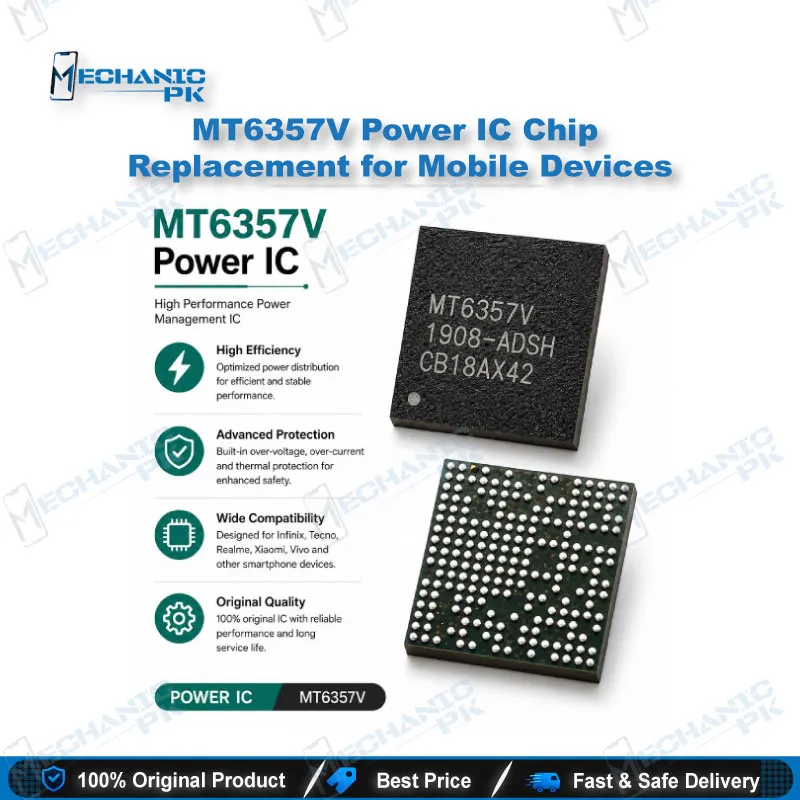
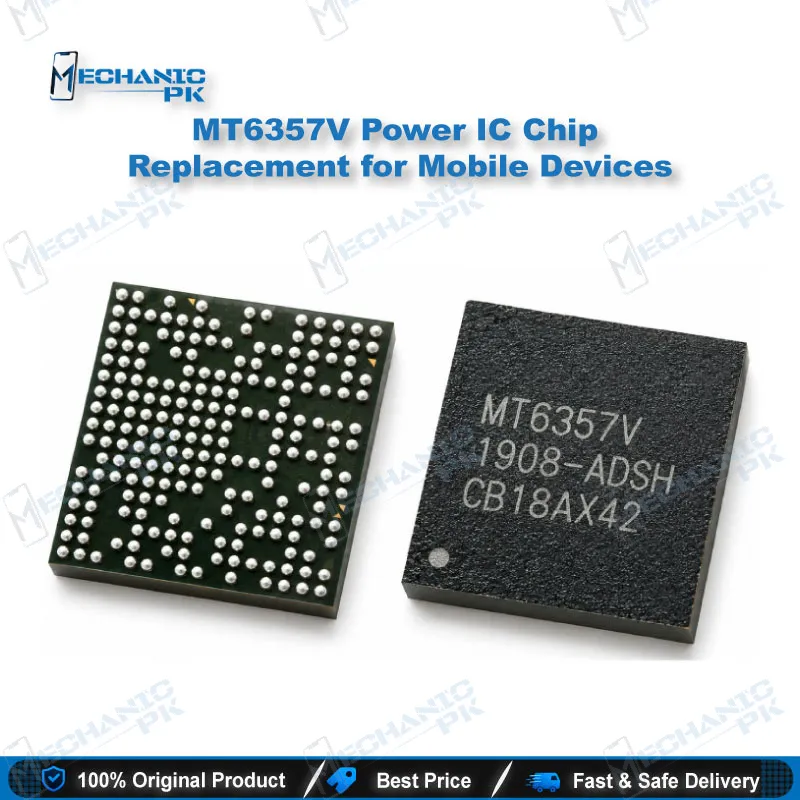
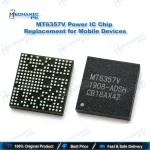
MT6357V Power IC Chip Replacement for Mobile Devices
₨ 300
MT6357V Power IC for MediaTek Smartphone Boards
The MT6357V Power IC Chip Replacement for Mobile Devices is MediaTek’s MT6357V/A power management IC. This PMIC feeds the baseband processor, memory, SIM, camera and audio rails on Helio A22, P22 and P35-class boards. MediaTek packs 5 buck converters, 29 LDOs, a BC1.2-compliant charger detection block, a fuel gauge, an RTC and an audio codec into one 209-pin VFBGA package. Technicians reach for this MT6357V power IC when diagnosis points to the PMIC on a dead phone, a board with abnormal current draw, or a handset with no charging or no audio. Match the original chip marking before you install it.
MT6357V Power IC: MediaTek PMIC Built for 4G Smartphone Platforms
The MT6357V Power IC Chip Replacement for Mobile Devices gives you the exact MediaTek part number at the centre of power distribution on many entry-level and mid-range 4G Android boards. MediaTek’s official ordering information lists the MT6357V/A as a 209-pin VFBGA power management IC rated for -30°C to +85°C operation. When a board refuses to power on, heats up around the PMIC, or shows a short on a main rail, the MT6357V power IC often decides whether that board returns to service or goes to the scrap bin.
What the MT6357V Controls on the Board
MediaTek designed the MT6357 as a complete power solution for 2G, 3G and 4G handsets. The chip accepts a battery-side input from 2.6V to 5V and derives every major supply rail through 5 buck converters and 29 LDO regulators. Those rails feed the baseband processor and GPU, memory, SIM cards, camera sensors, the memory card slot and the RF power amplifier path. The PMIC talks to the SoC over an SPI interface with two SRCLKEN control pins, so the processor and PMIC work as a matched pair through every power-up sequence.
MT6357V Power IC Technical Profile
The MediaTek MT6357V PMIC carries far more than voltage regulators. It integrates USB charger detection compliant with BC1.2, a precision fuel gauge that measures voltage, temperature and current, and a real-time clock that keeps running for several hours without a battery. It also houses a full uplink and downlink audio codec. Protection logic covers over-current, thermal overload, programmable under-voltage lockout, watchdog reset and a hardware PMIC reset function. This level of integration explains why one failed PMIC can produce symptoms as different as a charging issue, a dead microphone and random restarts.
Fault Patterns That Point to the PMIC
On the bench, a failing MT6357V usually reveals itself through current behaviour on a DC power supply. A dead phone that pulls a fixed high current the moment you connect power often has a shorted rail, and thermal camera or freeze spray checks frequently lead back to the PMIC area. Other boards draw zero current when you press the power key, which suggests a missing power-on sequence. Hang on logo, a boot loop issue after liquid exposure, charging faults and no audio can all trace back to this chip once you rule out the battery, the charging port and the firmware.
Reballing and Installation Workflow
Lift the old chip with a hot air station at a controlled profile while a PCB holder keeps the board flat and stable. Clean the pads with flux and desoldering wick under a stereo microscope, and inspect for lifted or torn pads before you continue. If your replacement chip needs fresh solder balls, reball it with a matching stencil from a BGA reballing kit before placement. After reflow, measure the main rails with a multimeter in diode mode, then power the board from a DC supply and watch the current rise through a normal boot pattern.
Choosing the Correct MT6357 Variant
MediaTek’s MT6357 family appears under several markings, including MT6357V, MT6357CRV and MT6357MRV. Repair suppliers commonly fit MT6357-family PMICs on boards built around Helio A22 (MT6761), Helio P22 (MT6762) and Helio P35/G35 (MT6765), covering models such as the Redmi 6A, Galaxy A10s (SM-A107F), Oppo A5s and Realme C2. Variants can look identical, yet power sequencing can differ, and a mismatched chip may refuse to boot the board. Read the marking on the original IC or check the board schematic, then install the same version. Treat every MT6357 power IC replacement as a matched SoC-and-PMIC job.
Where This IC Fits in Your Repair Toolkit
A PMIC swap rarely happens in isolation. Pair this IC with a reliable hot air station, a fine-tip soldering station, BGA reballing stencils and a microscope for pad inspection. If the board still hangs on the logo after the hardware repair, move to the software side with ISP pinout tools and an eMMC programmer to check storage health and reflash firmware. Mechanicpk stocks each of these categories, so you can complete the full board-level repair from one distributor.
| Weight | 0.1 kg |
|---|
Key Features
- Genuine MediaTek MT6357V marking for an exact replacement match
- 5 buck converters and 29 LDO regulators covering every major board rail
- Wide 2.6V to 5V input range for lithium-ion battery-powered handsets
- BC1.2-compliant USB charger detection for stable charging behaviour
- Precision fuel gauge measuring voltage, temperature and current
- Integrated uplink and downlink audio codec
- Over-current, thermal overload, under-voltage lockout and watchdog protection
- 209-pin VFBGA package rated for -30°C to +85°C operation
Specifications
| Brand | MediaTek |
|---|---|
| Model | MT6357V (ordering code MT6357V/A) |
| Category | Power Management IC (PMIC) |
| Compatibility | MediaTek MT6357-family boards carrying the MT6357V marking |
| Supported Devices | 2G/3G/4G smartphones and portable systems built on MT6357-based MediaTek platforms |
| Technology | 5 buck converters, 29 LDOs, SPI interface, BC1.2 charger detection, fuel gauge, RTC, audio codec, 209-pin VFBGA package, -30°C to +85°C operating range |
| Input Voltage | 2.6V to 5V |
Common Repair Uses
- Dead phone repair where the PMIC shorts a main supply rail
- Boards with zero current draw on power key press
- Charging issue caused by a failed charger detection or fuel gauge block
- Hang on logo and random restarts traced to unstable PMIC rails
- No audio or dead microphone faults linked to the integrated codec
- Liquid-damaged boards with corroded or burnt PMIC areas
- PMIC reballing after a cracked or lifted BGA joint
- Donor-board IC transfer during board-level rework
Compatible Devices
- MediaTek MT6357-family platforms; confirm the original chip reads MT6357V before replacement
- MediaTek Helio A22 (MT6761) boards using the MT6357 PMIC
- MediaTek Helio P22 (MT6762) boards using the MT6357 PMIC
- MediaTek Helio P35 / G35 (MT6765) boards using the MT6357 PMIC
- Xiaomi Redmi 6A (MT6357-family PMIC board)
- Samsung Galaxy A10s SM-A107F (MT6357-family PMIC board)
- Oppo A5s and Oppo A1k (MT6357-family PMIC boards)
- Realme C2 (MT6357-family PMIC board)
- Any board whose schematic specifies MT6357V/A as the main PMIC
FAQ
What is the product name?
What is the brand of this product?
What is the model of this product?
What is this product used for?
Which devices are compatible with this product?
Who should use this product?
Is the MT6357V interchangeable with the MT6357CRV or MT6357MRV?
What input voltage range does the MT6357V power IC support?
Related products