























One-Stop 2015 Desoldering Wick 2.0mm 5 Rolls Box
₨ 1,499
2mm Desoldering Wick for Mobile Repair
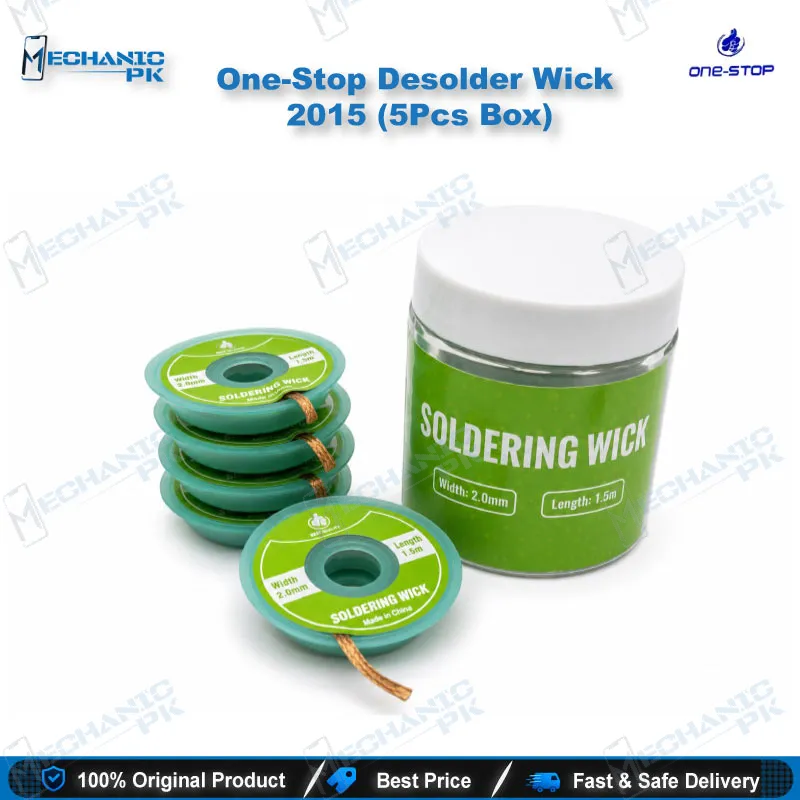
The One-Stop 2015 gives your repair bench a 2.0mm copper desoldering wick in a five-piece box. Press the braid onto a pad, touch your iron on top, and the excess solder climbs into the strands. That leaves a flat surface ready for reballing, IC reseating, or jumper work. You use it after every chip lift, on charging port pads, and across solder bridges on fine-pitch pins. Technicians in Pakistani repair shops and service centres stock it beside their soldering stations, hot air stations, and microscopes. Clean pad prep decides whether the next IC change karna job sits flat on the first try. Order it from Mechanicpk.
Out of stock
2mm Desoldering Wick for Mobile Repair: One-Stop 2015 Box
The One-Stop 2015 is a 2mm desoldering wick for mobile repair benches, built for technicians who clean pads, shield frames, and IC footprints before every reball or chip reseat. The box gives you five braid pieces, so each technician or station keeps a fresh piece in hand instead of stretching a nearly empty one through the next job. If you run a repair shop or service centre in Pakistan, a small consumable like this sets how clean your board looks before the hot air station comes back out. This listing covers what the braid does on the board, where it fits in your repair sequence, and what to pair with it.
Braid Width and Pad Control
The 2015 class of wick uses a 2.0mm flat copper braid, the width most phone-board technicians reach for first. Two millimetres spans a charging port pad row, a shield frame edge, or a PMIC footprint in one pass. It stays narrow enough to keep clear of neighbouring 0402 and 0201 passives. The braid pulls molten solder up through its strands by capillary action. You press it flat against the pad, touch the iron tip on top, and the excess alloy leaves the pad and climbs into the copper. Unlike a desoldering pump, braid strips solder off a pad completely.
Fine strands conduct heat quickly, so you spend less time on the pad and protect the track underneath. On stubborn joints, add a little liquid flux first. The copper turns silver as it loads with solder, which tells you exactly when to lift the braid and move to a fresh section.
Where It Fits in the Board-Level Workflow
Every IC change karna job leaves the same problem: uneven solder on the pads after the hot air station lifts the chip. Drag the wick across those pads at a low angle before you place a stencil, and the new BGA ball gets a flat, even landing zone. eMMC, CPU, and power IC rework all follow this step, and the technique stays the same on Qualcomm, MediaTek, and Exynos boards. The same braid also clears solder bridges between fine-pitch pins, cleans jumper lagana points on broken tracks, and tidies a charging port pad that a previous attempt left lumpy.
Keep each contact short. A few seconds on the braid is enough, and holding the iron longer only heats the PCB for no extra gain. When a section fills with solder, cut it off with nippers and continue on fresh braid. You cannot reuse a filled section.
Why a Five-Piece Box Suits a Busy Bench
A dead phone should not wait on your bench because the last wick ran out. Five pieces in one box let a shared workshop hand a piece to each station without anyone hunting for stock. Training institutes and service centres use the same approach, giving every trainee a fresh piece for each practice board.
Pair the wick with a temperature-controlled soldering station, a microscope for pad inspection, a PCB holder to lock the board, and a reballing kit for the next step. Together they cover pad prep from first lift to final reball, whether the phone arrived with a charging issue, a hang on logo fault, or a hardware fault after a failed repair. Browse the soldering station, hot air station, microscope, reballing kit, and PCB holder categories at Mechanicpk to build the full set around this wick.
| Weight | 0.1 kg |
|---|
Key Features
- 2.0mm flat copper braid for general phone-board work
- Capillary action pulls molten solder off the pad
- Five-piece box for multi-station benches
- Works with any standard soldering iron or station
- Fine strands conduct heat quickly
- Suits fine-pitch pads and larger joints
- Copper colour change shows when the braid loads with solder
- Cut off filled sections and keep working on fresh braid
Specifications
| Brand | One-Stop |
|---|---|
| Model | 2015 |
| Category | Desoldering Wick / Soldering Accessories |
| Compatibility | Universal — works with standard soldering irons and soldering stations |
| Supported Devices | Universal — not device-specific |
| Technology | Capillary-action copper braid solder absorption |
| Material | Copper braid |
| Dimensions | Width 2.0mm, Length 1.5m per roll |
| Package Quantity | 5 pieces per box |
Common Repair Uses
- Solder removal and pad levelling during board-level mobile repair.
- Cleaning pads after IC removal
- Prepping eMMC and CPU pads before reballing
- Removing solder bridges between fine-pitch pins
- Clearing shield frame solder
- Charging port pad cleanup
- Resetting pads after a failed IC change
- Cleaning jumper points on broken tracks
- Training practice for desoldering technique
Compatible Devices
- Universal — not device-specific. Works on any phone, tablet, or laptop PCB where you remove or level solder.
- Samsung boards
- Oppo boards
- Vivo boards
- Infinix boards
- Tecno boards
- Xiaomi and Redmi boards
- Huawei boards
- iPhone boards
FAQ
What is the product name?
What is the brand of this product?
What is the model of this product?
What is this product used for?
Which devices are compatible with this product?
Who should use this product?
How long can I hold the iron on the desoldering wick?
Can I use this wick to clean BGA pads before reballing an eMMC or CPU?
Related products