














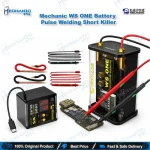
Mechanic WS ONE Short Killer & Battery Spot Welder
₨ 8,200
WS ONE 2-in-1 Short Killer
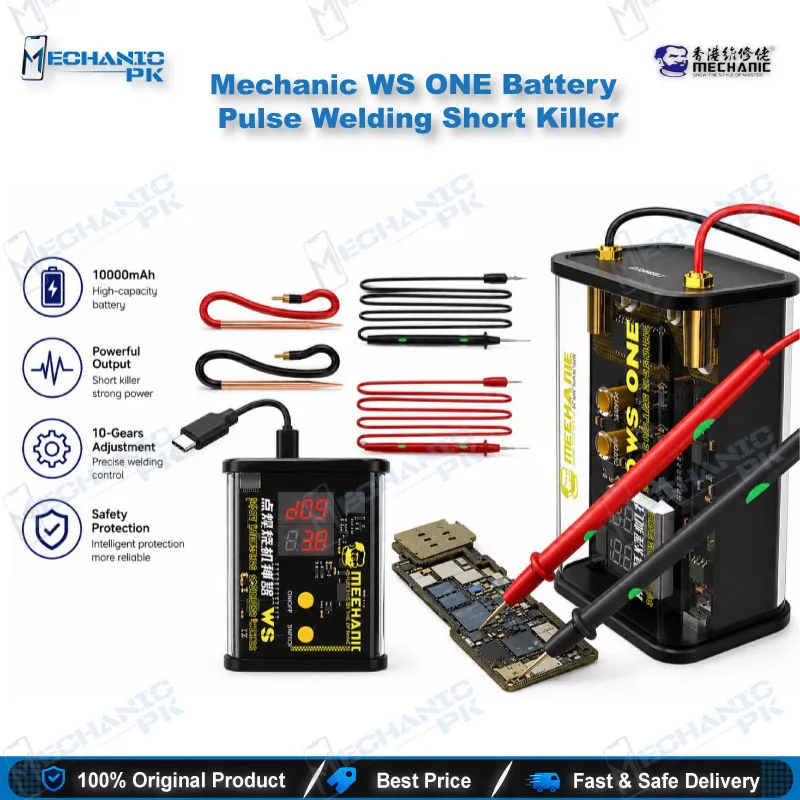
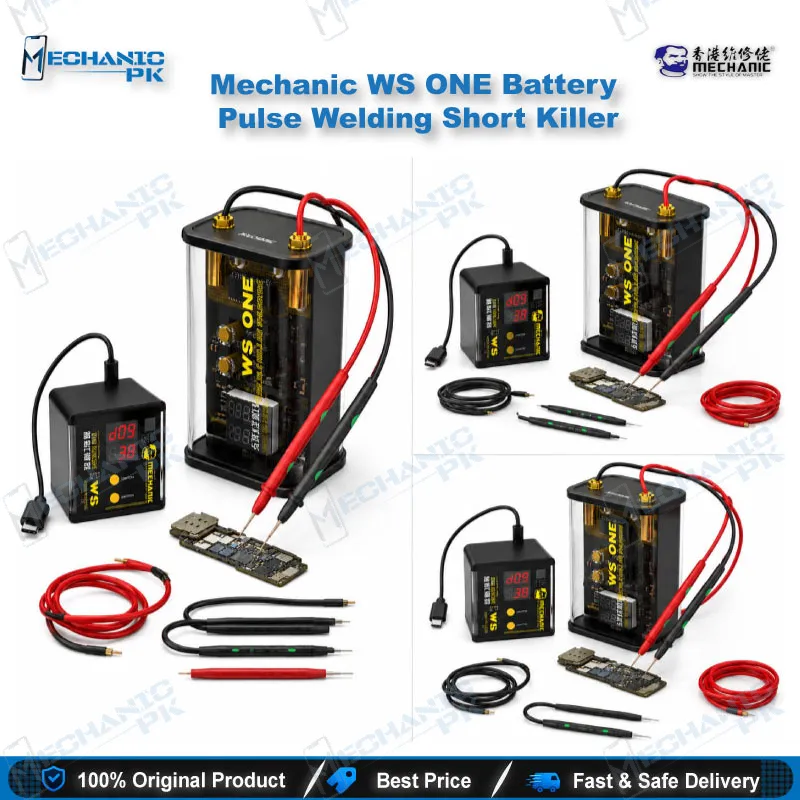
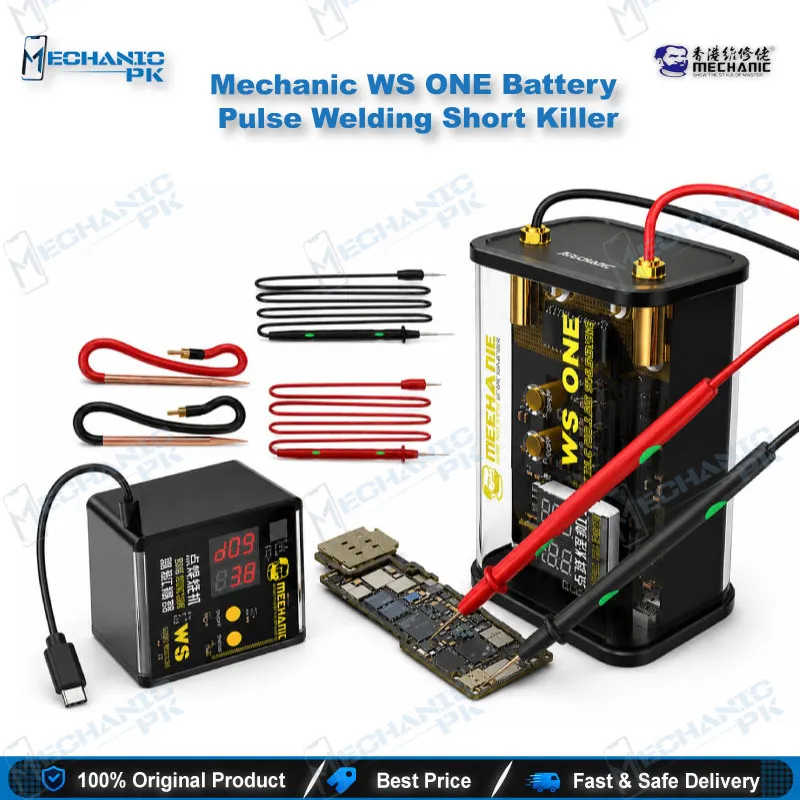
The Mechanic WS ONE short killer puts two bench tools in one handheld body. You get a 6-gear short circuit burner for locating shorted components on phone and laptop motherboards. You also get a 10-gear pulse spot welder for nickel strips on lithium batteries. A 10000mAh rechargeable battery powers both modes, and Type-C charging keeps the unit ready between jobs. Mechanic builds it for technicians who want a mobile motherboard short circuit detector and a battery spot welding machine without carrying two separate devices. Switch modes with one button, pick a gear, and start the repair.
In stock
Mechanic WS ONE Short Killer for Board-Level Fault Hunting
The Mechanic WS ONE short killer combines two jobs that normally need separate equipment: locating short circuit faults on motherboards and spot welding nickel strips onto lithium batteries. Mechanic Hongkong designed it as a portable 2-in-1 unit with a 10-gear spot welding output and a 6-gear short killer output, both powered by an internal 10000mAh battery. If you run a repair bench in Pakistan and handle dead phone cases every day, this tool puts fault location and battery tab work in one compact body.
Dual-Mode Output Control
The WS ONE uses a two-button interface. A long press on the ON/OFF button powers the unit on or off. A short press switches between the spot welding function and the short killer function. The SWITCH button steps through the power gears of whichever mode you selected. You get 10 gears for welding and 6 gears for short circuit burning, so you match output to the job instead of using one fixed setting for everything.
That gear spread matters at the bench. Thin nickel strips need lower pulse energy than thicker battery tabs, and a stubborn short on a power rail needs a different current than a light leak on a signal line. Start low, step up gear by gear, and stop when the job responds.
Short Killer Workflow on Dead Boards
The short killer mode applies a controlled current to the board through the two meter pen probes. The shorted component or trace heats up and burns, which reveals the fault location. Mechanic rates the tool for locking onto a fault in about one second on various mobile phone and computer motherboards.
Here is how it fits a typical hardware fault workflow. Your multimeter shows a short on a VBAT or VCC_MAIN rail. You identify the rail on the schematic, set a low gear, touch the probes across the shorted line, and watch the board under your microscope. The component that smokes or discolors is your culprit. You remove it with your hot air station, clean the pads, and confirm the rail no longer reads shorted. This replaces slow trial-and-error part pulling on boards that arrive dead after a water or charging fault.
Battery Nickel Spot Welding
The pulse spot welding mode targets mobile phone battery nickel strips, lithium battery nickel sheets, battery plate replacement, and precision welding of small electronic components. Two welding electrodes with cables handle the weld, and the 10 gears let you adjust pulse strength to the strip thickness. You rebuild a swollen or damaged battery tab, weld a fresh nickel strip, and return the pack to a clean, solid connection without a bulky capacitor welder on your bench.
Power, Charging and Bench Handling
The 10000mAh lithium rechargeable battery runs the unit without a mains cord, so you can work at any corner of your repair bench or carry it to a service call. Charging uses a 5V USB Type-C connector, which means the same cable you use for phones tops it up. The body is lightweight and portable, and the transparent housing gives the tool a clear technician-grade look.
Pair the WS ONE with a good multimeter, a soldering station, a PCB holder, and a microscope, and you cover the full cycle from fault detection to component replacement on one bench.
What Ships in the Box
Each kit includes one WS ONE host, two spot welding cables with electrodes, and two meter pen cables with probes. You can start welding or burning shorts as soon as you charge the unit.
| Weight | 0.61 kg |
|---|
Key Features
- 2-in-1 design combining spot welder and short killer
- 10-gear adjustable pulse spot welding output
- 6-gear adjustable short killer output
- 10000mAh high-capacity rechargeable battery
- USB Type-C charging
- Fault location in as little as one second
- One-button switching between welding and burning modes
- Lightweight, portable transparent body
Specifications
| Brand | Mechanic |
|---|---|
| Model | WS ONE |
| Category | Spot Welding Machine / Short Circuit Detector |
| Compatibility | Mobile phone motherboards, laptop and computer motherboards, lithium battery nickel strips |
| Technology | Pulse spot welding, controlled-current short circuit burning |
| Input Voltage | 5V DC via USB Type-C charging |
| Battery Capacity | 10000mAh rechargeable lithium battery |
| Spot Welding Gears | 10 |
| Short Killer Gears | 6 |
Common Repair Uses
- Short circuit fault location and battery nickel strip welding on the repair bench
- Locating shorted components on dead phone motherboards
- Burning out faulty capacitors on shorted power rails
- Finding short faults on laptop motherboards
- Spot welding nickel strips onto mobile phone batteries
- Rebuilding lithium battery nickel tabs
- Replacing battery plates
- Precision welding of small electronic components
- Fast fault triage on boards with charging issue or hardware fault
Compatible Devices
- Universal — works through probes and electrodes, not tied to a specific brand or chipset family
- Mobile phone motherboards (short circuit detection)
- Laptop motherboards
- Computer motherboards
- Mobile phone battery nickel strips
- Lithium battery nickel sheets
- Battery plate replacement jobs
- Small electronic components requiring precision spot welding
- Brand-agnostic repair use across Android and other smartphone boards
FAQ
What is the product name?
What is the brand of this product?
What is the model of this product?
What is this product used for?
Which devices are compatible with this product?
Who should use this product?
How many power gears does the Mechanic WS ONE have?
How do I switch between spot welding and short killer mode on the WS ONE?
Related products